Barn Odor Monitoring for a Sustainable Livestock Industry
As consumption of livestock products has grown, the number of animals raised in Korea has climbed steadily. This scaling-up of the livestock industry brings the positive of a stable supply of livestock products — and, at the same time, the negative of the various odors the industry generates.
The government enacted the Odor Prevention Act in 2005 and has enforced it since, but questions persist about its effectiveness. Odor complaints keep coming, yet 78.1% of the public environmental infrastructure facilities that are supposed to manage odor were found to be violating the Act’s emission limits. The facilities exceeding those limits most often were livestock manure facilities.
So, with odor complaints on the rise, how can barn odor be prevented or reduced? And beyond that, what might a sustainable path forward for the livestock industry look like? Let’s take a look.
Growing Pig Farm Odor Disputes
Pork is one of Korea’s best-loved foods. And with so much pork consumed, disputes involving pig farms are surging. The smell and odor from pig farms are far stronger and more severe than from chicken or cattle farms. The reality is that most pig barns lack modern facilities and are old and rundown. Nearby residents, suffering from the odor, file complaints demanding the barns be removed, while pig farmers push back, saying they should not be treated like criminals.
According to the ‘Improving the Livestock Environment for Sustainable Livestock Farming’ report published by the Korea Rural Economic Institute in 2017, odor complaints rose rapidly among livestock environmental issues after the Odor Prevention Act was enacted in 2005, and barn odor emerged as a social issue. Complaints surged as apartment complexes spread and people pursued quality of life, and the need for stronger odor management has grown to the point that odor is arguably the most serious livestock environmental issue of recent years.
That said, eliminating pig barns is no cure-all. Food self-sufficiency must be protected, so upgrading to modern facilities and converting to clean, odor-free operations is urgent. Industry experts say facility improvements backed by active government support are needed. They agree that sealing barns and applying the latest odor-reduction technologies to cut pig barn odor is the way to reduce disputes.
What Is Barn Odor (Livestock Odor)?
Livestock odor — commonly called barn odor — can be defined as ‘gaseous substances generated in barns and in manure composting and liquid-fertilizer facilities that irritate the human nose, causing discomfort and disgust.’ The causes of barn odor lie latent across every aspect of farm management: feeding management, care of the barn inside and out, and manure management.
How Barn Odor Forms
1. Excretion of feed carbohydrates and proteins left incompletely digested in the animal’s gut
2. Anaerobic fermentation in the barn pit as slurry sits in long-term storage
What Causes Barn Odor
1. Overfeeding of protein, and the resulting manure and undigested protein
2. Microbial flora imbalances driven by changes in the microbes’ environment (temperature, pH, energy sources, etc.)
3. Poor cleaning inside and outside the barn
4. Abnormal operation of composting and liquid-fertilizer facilities
Pig farm odor varies from farm to farm with barn structure, temperature, feeding management, and manure treatment facilities — and notably, it takes the form of a complex odor blending multiple odorants rather than any single compound.
Tackling Pig Barn Odor with ICT
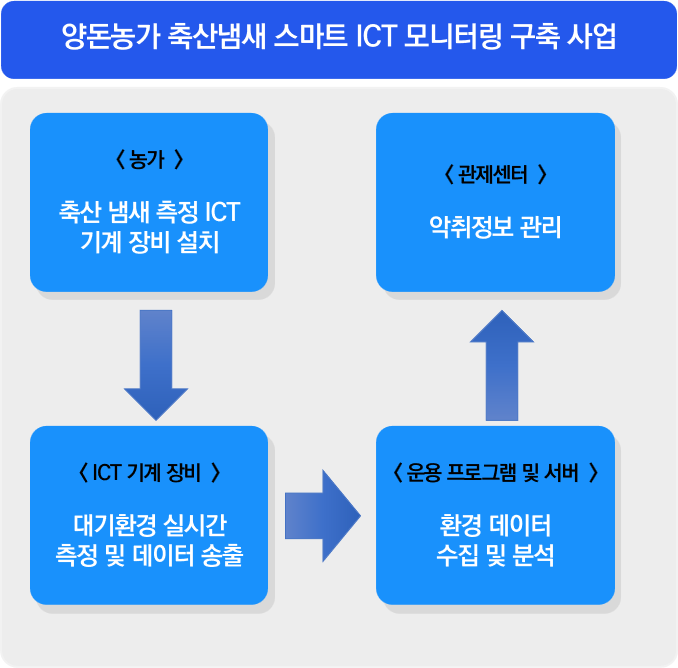
With IoT devices and a cloud platform, a smart ICT monitoring system for barn odor can be built. Odor meters and display boards installed at pig farms collect and present real-time information, while software built to run it all manages barn odor in an integrated way. The data acquired along the way can also be analyzed and used to shape policy measures for improving barn odor.
Toward a Sustainable Livestock Industry

Sustainable livestock farming / Source: Farmstory
As greenhouse gas reduction targets for 2050 carbon neutrality (Net-Zero) take concrete shape, the livestock sector is being asked to move away from its input-heavy structure toward environmentally friendly livestock farming. The government, in turn, is strengthening support for the industry’s sustainable development to meet the ‘2050 carbon neutrality’ goal, centered on agendas such as recycling livestock manure into resources and data-driven smart livestock farming.
Only after the natural circular agriculture policy took effect in 2006 did the view spread that livestock manure is a ‘resource’ rather than a ‘pollutant,’ and its use came to be assumed as a prerequisite for ‘circular agriculture’ and ‘eco-friendly agriculture.’ Since 2012, in step with the complete ban on ocean dumping of manure, resource recovery — composting, liquid fertilizer, and energy conversion — has become the mainstream method of proper manure treatment.
According to Korea’s carbon neutrality declaration announced in October 2020, the 2030 greenhouse gas reduction target for agriculture and livestock requires a cut of about 22.6% from 2018 levels, with the livestock industry accounting for 56.1% of the total reduction. In the detailed agricultural reductions under the proposed upward revision of the national target, the goal is to cut carbon emissions by about 2.5 million tons by reducing nitrogen fertilizer use and utilizing organic farming materials such as biochar, already used as a soil amendment, to realize low-carbon agriculture.
In announcing its ‘Livestock Environment Improvement Plan,’ the government packed in a range of policy tools to cut the sector’s greenhouse gas emissions 30% by 2030. At its core: low-carbon feeding management that minimizes unnecessary inputs during rearing, proper manure treatment including expanded purification, biochar, and energy conversion, barn odor improvement, and building the foundations for a better livestock environment.
In the end, ‘carbon neutrality’ and ‘smart livestock farming’ are the key agendas. Realizing a carbon-neutral society demands a sweeping transformation of our livestock industry into an environmentally friendly, smart industry. It is time for livestock farming, too, to remake itself as smart livestock farming — creating clean, pristine rearing environments and improving odor.
Systematizing the domestic livestock industry, codifying best rearing practices, and modernizing facilities to bring excellent pork to the table would contribute greatly to public health. Beyond that, the smart farm technology advanced along the way is expected to play a major role in earning foreign currency through exports.
The Thingplus Barn Odor Monitoring Service
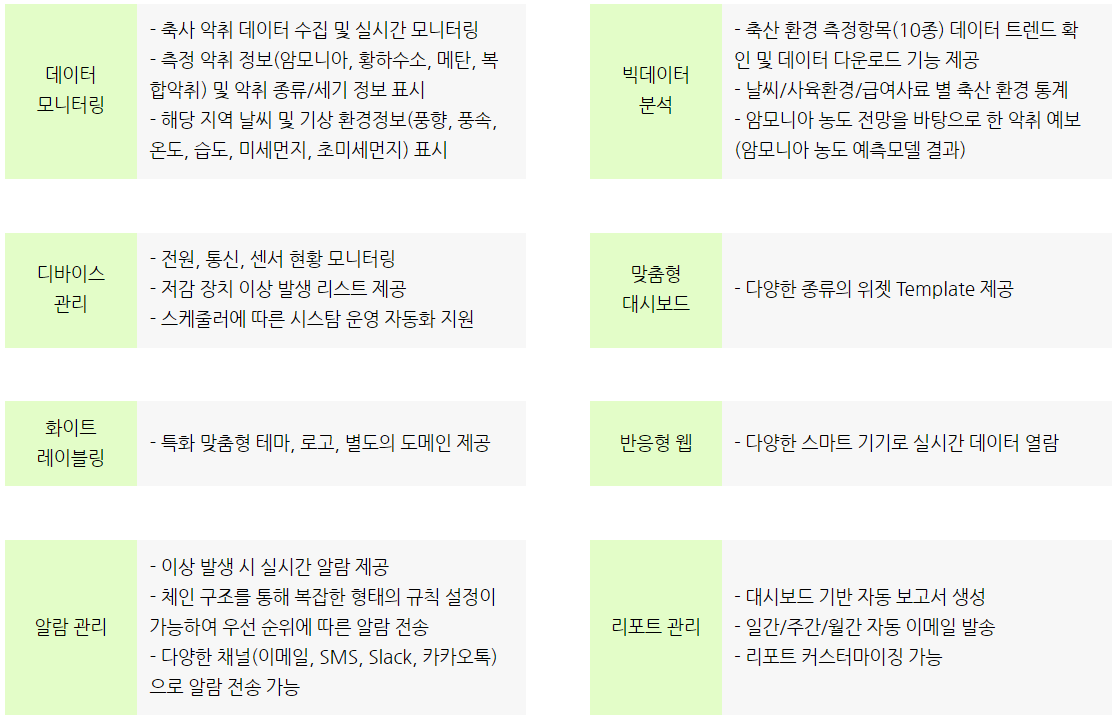
The Thingplus barn odor monitoring service is an integrated livestock odor control system providing real-time odor monitoring and automatic control for odor reduction. Web-based, real-time integrated monitoring puts the barn’s odor situation in view at a glance, and facilities can be controlled automatically according to odor intensity. A mobile app lets you check conditions anytime, anywhere, and alarms delivered across multiple channels enable a rapid response when odor occurs. Livestock environment statistics by weather, rearing environment, and feed provide insight into what causes odor, supporting systematic management down the road. Going further, odor forecasts based on projected ammonia concentrations can be put to use in driving practical odor-reduction activities.
Key Strengths
– Built on the Thingplus AIoT platform, it applies the latest cloud services and ICT technology.
– Data analytics and AI deliver ammonia concentration forecasts.
– Linked with misting sprayers, it executes odor reduction the moment odor occurs.
– Sensor performance is optimized for accurate odor measurement.
– Air purification filter technology extends the replacement cycle of sensor equipment.
The advance of the smart farm is the realization of sustainable livestock farming and the bedrock of food self-sufficiency. It is time to adopt new technology and work toward building a sustainable livestock industry.
Thingplus supports the entire process of adopting a smart farm service — from consulting and service/system design to communications/device recommendations and service delivery. Try Thingplus, covering every domain of smart cultivation!