Reducing energy costs and running operations efficiently are key challenges for manufacturers. In factories with heavy power consumption in particular, energy management translates directly into cost savings. As a result, many companies are considering adopting a FEMS (Factory Energy Management System). In this article, we introduce how Customer A achieved successful energy savings with EnergyQ.
What Is EnergyQ?
Thingplus® EnergyQ is a service that helps factories reduce energy costs, improve efficiency, and practice sustainable management through electrical energy consumption monitoring and power quality management.
Key Features
– Real-time monitoring: Check the power usage of various facilities across the factory in real time
– Data analysis and anomaly alerts: Detect sources of wasted power early and support peak management
– PQM (Power Quality Management) capability: Maximize equipment efficiency through power quality analysis
– Automatic power quality reports (EN50160): Regularly inspect the quality of electrical equipment and correct issues
EN50160 is a European standard (EN, European Norm) that defines the quality of supplied power.
The standard specifies quality requirements for voltage, frequency, harmonics, momentary interruptions, and more from power suppliers, so that users’ electrical equipment can operate reliably.
EnergyQ’s automatic EN50160 power quality reporting evaluates whether the power used in the factory complies with this standard and enables a rapid response when problems occur.
Through these capabilities, EnergyQ contributes to cost reduction, regulatory compliance, and ESG management at the factory while supporting the optimization of energy use.
Why Customer A Adopted EnergyQ
Customer A is a manufacturer operating four factory buildings and numerous outdoor facilities, with some equipment running 24 hours a day. Its average monthly electricity bill reached roughly KRW 80 million, and during power peaks costs climbed past KRW 100 million. We ask for your understanding that, for security reasons, photos of this site cannot be shown.

A virtual factory image is used for security reasons.
For security reasons, we are showing a photo of a different factory.
Adoption Goals
– Establish measures to cut costs during power peaks
– Improve efficiency through systematic monitoring of electricity consumption
– Build an optimal operating strategy through per-equipment power usage analysis
The EnergyQ Deployment Process
1. Installing Power Meters
We analyzed the metering points and deployed power quality meters (PQM), power meters (PM), and the supporting network.
– Meters installed on switchgear and distribution panels, outdoor air handlers, scrubbers, dust collectors, compressors, and more across the factory
– Wireless communication environment built so the power usage of key equipment can be collected and analyzed in real time
2. Real-Time Energy Monitoring
A real-time monitoring system was applied so the factory’s energy usage could be seen at a glance.
– Energy usage visible at a glance for the entire factory, individual equipment, and equipment groups
– Early identification of and response to energy waste through anomaly detection
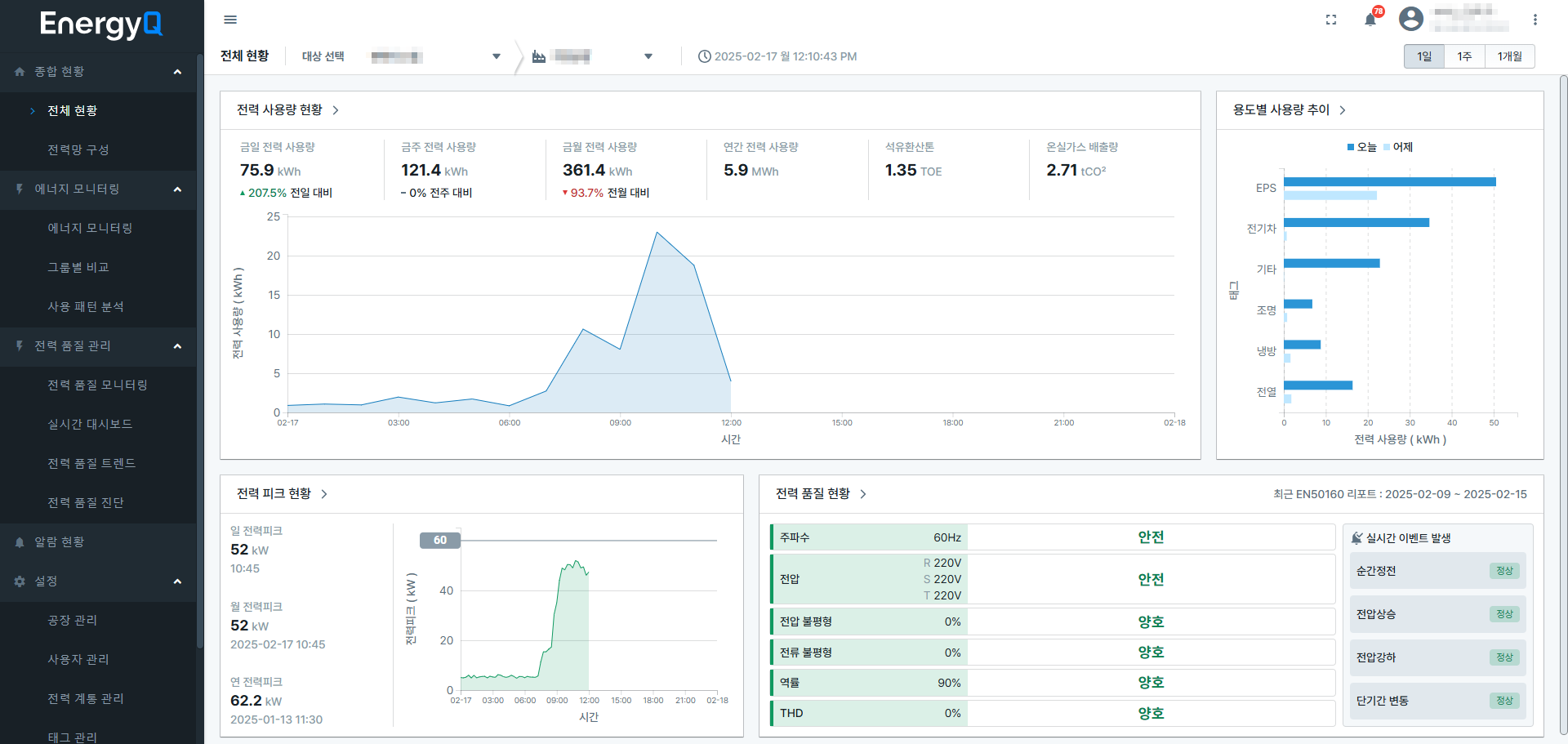
The EnergyQ dashboard
3. Peak Demand Response and Optimization
Appropriate responses to power peaks were put in place to maximize energy efficiency.
– Alerts issued when power peaks occur so energy-saving measures can be carried out
– Per-equipment power consumption patterns analyzed to raise operational efficiency
Results
After adopting EnergyQ, Customer A achieved the following outcomes.
Lower Upfront Investment
– Initial deployment costs minimized through a subscription-based SaaS (Software as a Service) model
Stronger Peak Demand Response
– Power usage during peak hours forecast in advance, with operating practices introduced to reduce unnecessary consumption
Cost Savings Through Power Usage Analysis
– Waste eliminated through continuous monitoring of power usage by group
– Monthly electricity costs reduced by improving inefficient equipment operation
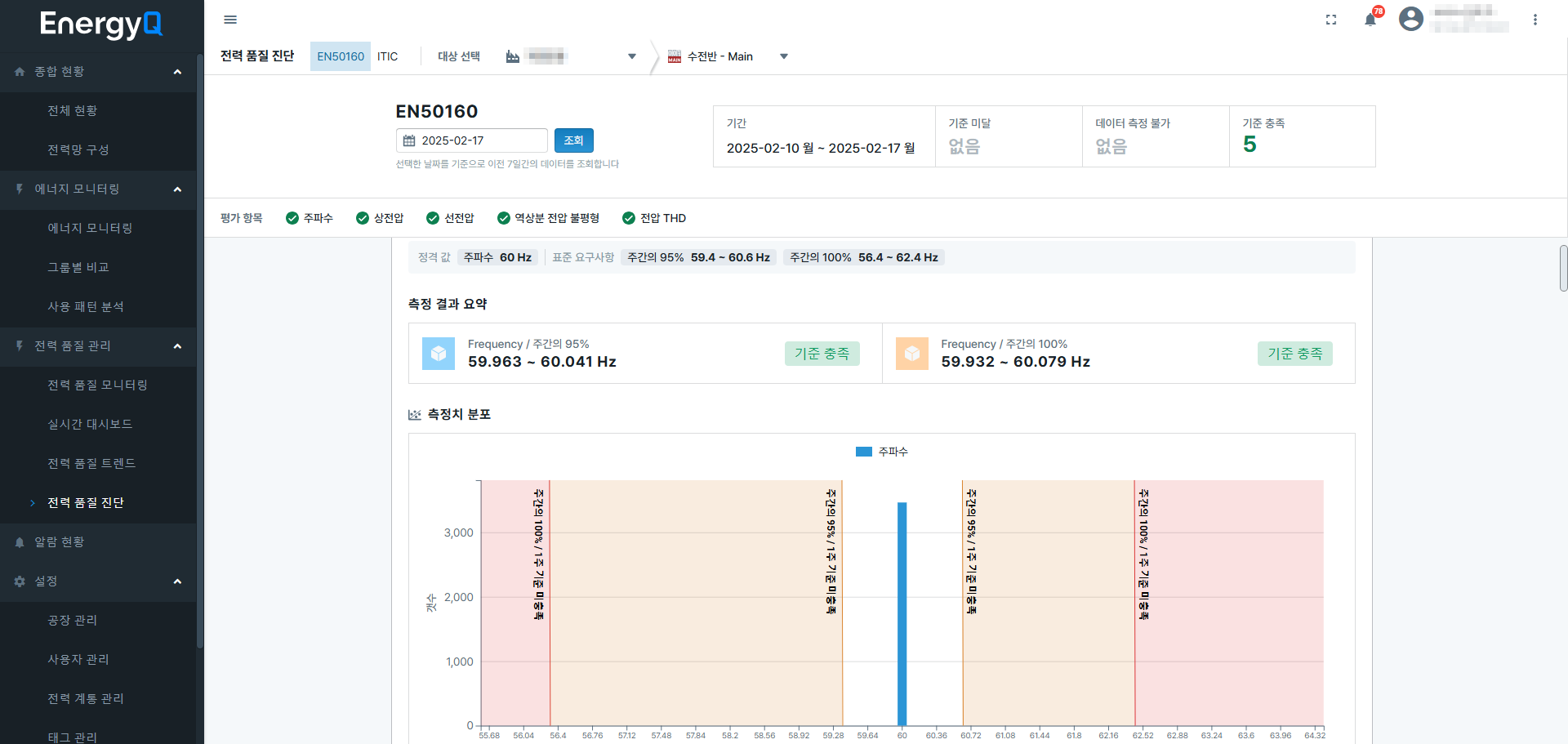
EnergyQ’s EN50160 report
Closing Thoughts
Factory energy management plays an important role not only in cutting costs but also in protecting the environment, sustaining responsible management, and improving productivity. By adopting EnergyQ, Customer A achieved its three goals: lower power costs, stronger peak management, and higher energy efficiency.
We look forward to seeing more manufacturers use EnergyQ to realize efficient energy management and build their own smart factories.
✅ Related content worth reading
Energy efficiency UP, power quality KEEP — the EnergyQ service