The Future of AIoT in Manufacturing: The AI Motor Diagnostics Service
For companies pursuing digital transformation today, artificial intelligence (AI) and machine learning (ML) are essential capabilities. Finding fresh insights that read the market, automating work, optimizing supply chains, and maximizing marketing performance all hinge on how well these two technologies are used.
Industrial sites in particular are adopting AI and ML to solve a host of problems. According to one survey, AI/ML adoption among Korean companies grew substantially over the two to three years of the pandemic, and the spread of AI/ML is expected to continue for the time being. About 80% of companies that adopted AI/ML said they achieved the results they had hoped for.
So how much, and in what ways, are Korean companies adopting AI/ML — and for which tasks? Which AI/ML technologies do they prefer, and what benefits are they reaping? The answers to these questions will be the key that opens new opportunities for businesses.
How Much Are Korean Companies Using AI?
According to a 2022 survey by Korea IDG, four in ten responding companies (42.6%) had adopted or were in the process of adopting AI/ML. 26.9% said they were already using it in actual work, while 15.7% were running adoption pilots. In a 2021 survey by O’Reilly, the well-known US publisher, of 5,154 people across 111 countries, 26% said they had adopted AI and were using it well, and 36% were evaluating it through pilots and the like — putting concrete adoption at 52%. In other words, AI/ML adoption among Korean companies tracks closely with the global trend. Compared with earlier domestic surveys, the share of companies adopting AI/ML had grown more than tenfold in just two years.
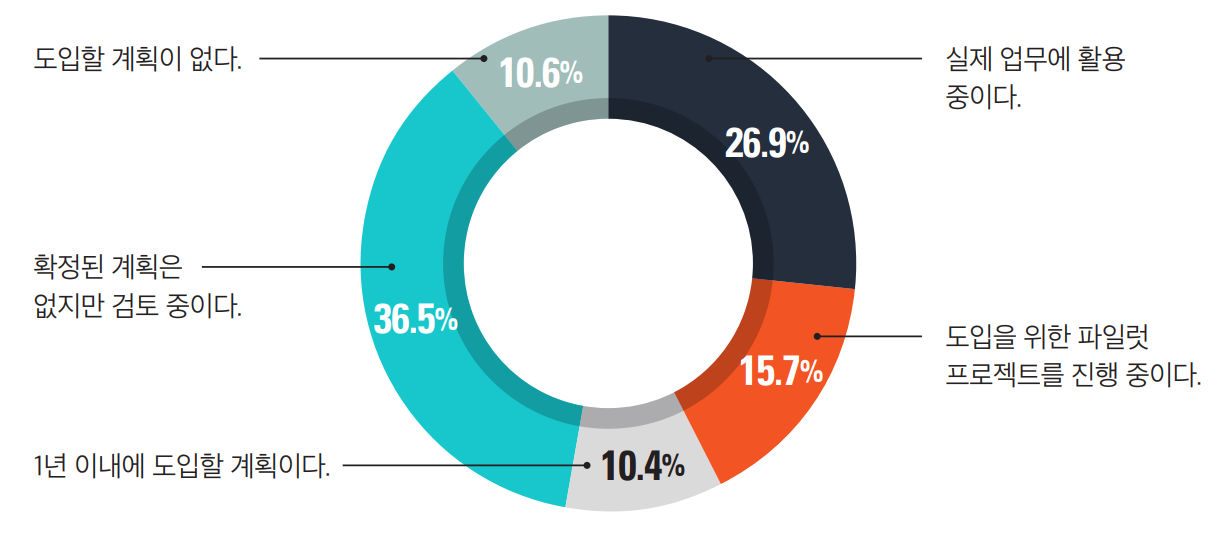
AI adoption among Korean companies / Source: Korea IDG, 2022 Survey on AI Adoption and Use by Korean Companies
The Preferred AI/ML Technology: Predictive Analytics
So which AI/ML technologies are companies interested in? In Korea IDG’s 2022 survey, the technologies companies had adopted or planned to adopt were led by machine learning/deep learning platforms for predictive analytics (54.9%) and virtual agents such as chatbots (39.4%), followed at similar rates by image/visual recognition (33.5%), text analytics and natural language processing (32.1%), and robotic process automation (31.7%).
‘Machine learning/deep learning platforms for predictive analytics’ cover algorithms, APIs, data, model design, development, training, and more. They are used in a wide range of enterprise applications, especially for prediction and classification. The overwhelming lead of this answer shows that many companies are now trying to improve the work they care about using the diverse data that exists inside and outside the enterprise. Rather than specialized technologies strong at a particular task, they appear intent on securing AI/ML capabilities that can be applied across a broad range.
Where Does AI Stand in Manufacturing?
Solving problems with AI at industrial sites generally follows the steps of problem definition → data collection → preprocessing → modeling → validation → analysis → application. So for manufacturers weighing AI, the first question must be problem definition — the purpose of using AI and the results expected. Will AI improve internal processes such as productivity or product quality control? Will it be embedded in products to sharpen competitiveness or offer options? Or will it transform the business model? Clues for resolving these questions come from looking at which AI technologies are being used where in manufacturing today — in other words, what AI can actually do. Only by knowing how far AI has actually been applied on manufacturing floors can a company minimize the exploration and opportunity costs that reckless ventures incur.
What Happens When You Add Predictive Analytics to Manufacturing?
Even before the coronavirus swept the globe, manufacturers knew they had to raise manufacturing speed, efficiency, and the resilience of their processes. But as they realized that thriving — not merely surviving — in the new normal would require a new way of competing, the pandemic became the moment when the need for digital transformation grew and its pace accelerated. Any organization that wants to understand and improve its short- and long-term operations must pursue digital transformation. Following this trend, many manufacturers are actively adopting new business processes, services, and models.
By carrying out analytics — a core element of digital transformation — and putting data to proper use, companies can hold their ground in fast-moving markets while hitting business goals and raising competitiveness. That is why adoption and use of analytics solutions has been climbing quickly across manufacturing — and the field drawing the most attention is predictive analytics.
Predictive analytics is the process of using past data to infer scenarios that may occur in the future. A predictive analytics solution examines new data to determine the likelihood of a given situation. That new data usually comes from Internet of Things (IoT) technology. The analysis collects large volumes of data, identifies distinctive patterns, and gauges the probability of events such as asset failure. This is why AI and ML technologies are so important as well.
Benefits of Adopting a Predictive Analytics Solution
– Better service quality and profitability
– Greater field technician efficiency
– Improved productivity on and off the floor
Manufacturers use predictive analytics in many ways. Its greatest benefit is preventing machine failures. Collecting real-time streams of machine condition data from current sensors, vibration sensors, sound sensors, and more makes it possible to predict the likelihood of failure. The collected data is analyzed to spot what has changed from the normal operating state, and cross-referencing it against historical data and/or industry benchmarks reveals what those changes mean.
Most manufacturers hope digital innovation will prevent unplanned downtime. Unscheduled downtime costs companies billions of dollars on average. Preventing it maximizes ROA (return on assets). Any company serious about digital innovation should therefore weigh the resource costs of advanced analytics against the potential for serious risk when critical assets fail.
Today, ever more manufacturing facilities are applying predictive maintenance and product quality use cases. And as the volume of collected data grows, the accuracy of predictive maintenance data gathered in real time keeps rising. Using this data to increase uptime and cut unplanned downtime raises ROA. Tracking process performance also delivers early alerts when machines drift out of tolerance, preventing scrap and rework. What’s more, expanding connectivity to raise the share of remote diagnostic analysis can supplement the expertise of field technicians.
The Thingplus AI Motor Diagnostics Service
The Thingplus AI motor diagnostics service diagnoses the condition of motors — the core equipment of industrial sites — and predicts failures. Current sensors are installed on motors, and within the manufacturing process the electrical signal data used by motor equipment is analyzed to identify anomalies, enabling proactive equipment diagnostics. Equipment operating data is monitored in real time, with alarms issued when anomalies occur so issues can be addressed immediately. Going further, AI can predict anomalies in advance. Machine learning on equipment operating patterns monitors for abnormal states in real time and catches early defects, preventing sudden equipment failures and minimizing downtime. The AI motor diagnostics service raises the stability of the production environment while cutting maintenance costs. It grows even more effective over time: as the factory keeps operating, AI training data and analysis cases accumulate, sharpening prediction accuracy. Adopting the AI motor diagnostics service solves chronic problems on the industrial floor and brings digital transformation within reach.
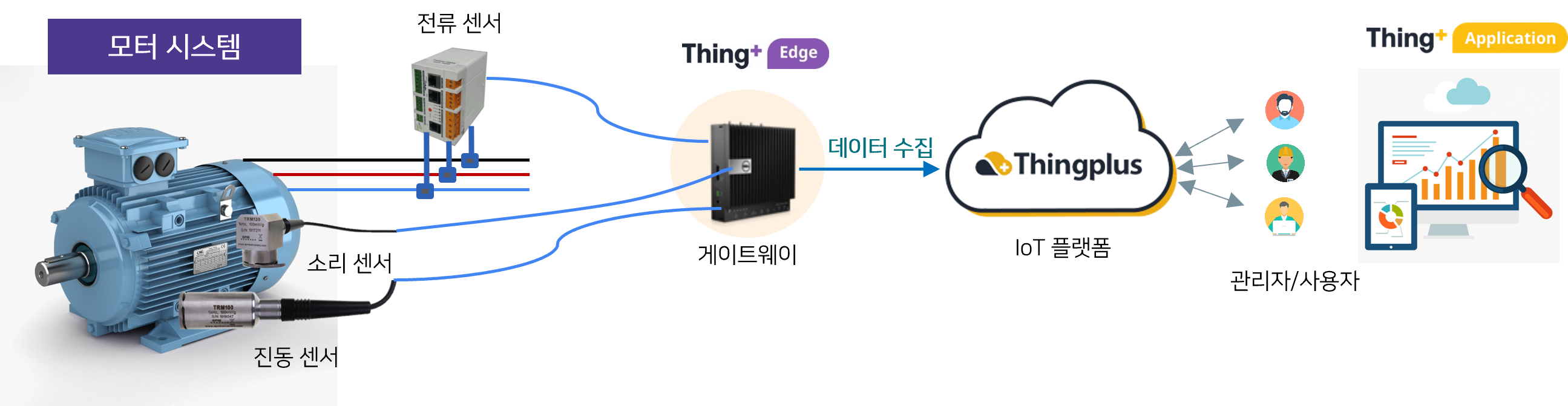
- Key Features
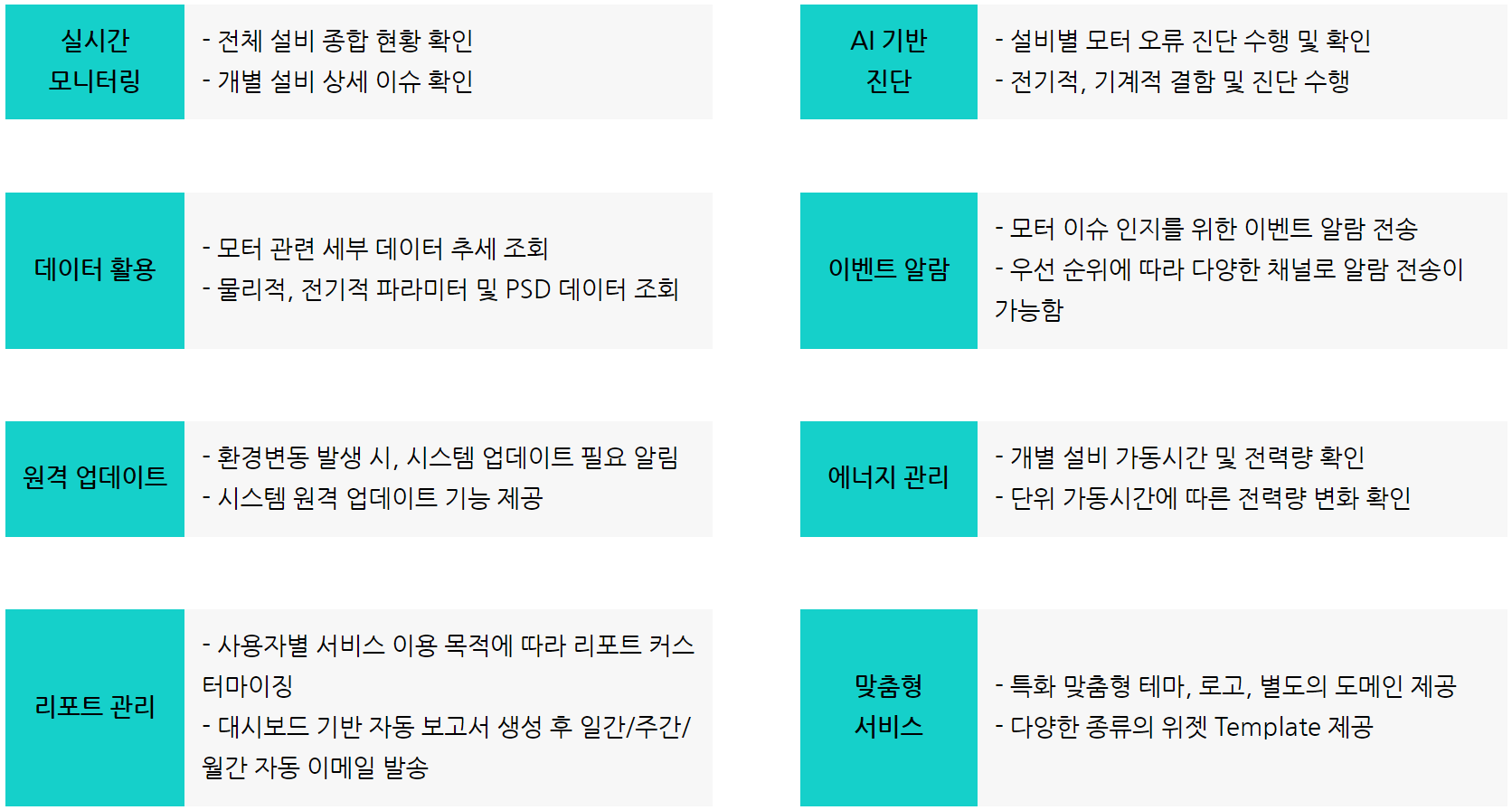
For efficient management of industrial sites and higher equipment productivity, AI motor diagnostics — analyzing equipment data to identify and act on anomalies in advance — is essential. Try the Thingplus AI motor diagnostics service!
Want to Adopt a Service Like AI Motor Diagnostics?
Thingplus, for services tailored to every business!
Thingplus has advised a wide range of customers on AIoT services for years. Thingplus supports the entire process of adopting an IoT service — from consulting and service/system design to communications/device recommendations and service delivery. Build the service you envision on Thingplus 2.0, the AIoT platform!
✅ References
IDG Market Pulse, 2022 Survey on AI Adoption and Use in Korea
Monthly SW-Centered Society, May issue: AI Adoption Trends and Considerations in Manufacturing
ARC analysis, Product Innovation and Service Optimization Through Predictive Analytics; ‘DT’ and ‘ESG’: 3 Ways to Catch Both Rabbits