Prevent Accidents Before They Happen! The Building Safety Diagnostics System
Twenty-seven years have passed since the Sampoong Department Store collapse. The disaster was caused by across-the-board failures spanning design, construction, and maintenance. Structural engineering experts in particular point time and again to the root causes: a lack of awareness of structural safety among building owners, contractors, and government agencies, and lax institutional safeguards.
Laws and regulations have been enacted and revised repeatedly since Sampoong, yet blind spots remain. Experts argue that because legal reform has focused on ‘expanding industry turf’ rather than ‘safety and expertise,’ it may actually raise the risk of construction accidents.
Here we consider what it takes to prevent building accidents and manage building assets efficiently.
Building Accidents Keep Happening
Collapses have claimed lives and property without pause: the Haengju Bridge collapse (July 1992), the Cheongju Uam shopping center collapse (January 1993), the Seongsu Bridge collapse (October 1994), the Sampoong Department Store collapse (June 1995), the Gyeongju Mauna Resort collapse (February 2014), and the Yongsan building collapse (June 2018), among others. Infrastructure that was poorly designed and built, compounded by inadequate maintenance, leads to major disasters. What’s more, with climate change bringing more frequent localized downpours and natural disasters such as earthquakes, the risk of aging facilities collapsing in Korea is growing.
Facility safety management was subsequently written into law. To prevent disasters through safety inspections and proper maintenance, the ‘Special Act on the Safety Control of Public Structures’ (the Facility Safety Act) was enacted through a legislative bill on January 5, 1995. Sensor-based measurement systems are mandatory for certain facilities: Tower Palace in Dogok-dong, Doosan We’ve the Zenith in Haeundae, and the second Lotte Tower maintain their buildings with anemometers, vibration accelerometers, and other instruments.
Technology Trends
In Korea, core safety diagnostics and maintenance technologies with international competitiveness are needed to match the scale of the construction market. Korea’s construction output is fourth in the world, yet it lacks core technologies such as maintenance performance evaluation for concrete structures, and the technology for assessing the serviceability and durability of concrete structures depends on the technology and equipment of advanced foreign companies.
Domestically, system standards and technology for applying BIM (Building Information Modeling: 3D models) at the maintenance stage remain underdeveloped, so BIM is not yet widely used in the field. Compared with the maintenance market’s quantitative growth, efforts toward qualitative growth fall short. The market and its players keep growing, but efforts at qualitative growth — applying scientific maintenance techniques and training engineers and experts — are lacking. Korea’s intelligent facility safety and maintenance technology also stands at 76.2% of the top technology-holding country, a 4.3-year technology gap that leaves its capabilities behind.
Advanced countries, equipped across the board with growth infrastructure — foundational technology, capital, facilities, and talent — are cultivating sensors as a national core technology. The United States, funded by the NSF (National Science Foundation), invests $2 million a year in accelerometer development, with concentrated sensor R&D investment through government agencies such as DARPA, NIH, and NASA. Standards foundations of many kinds — specification development, technical support, inspection technology, and talent development — have been built with government backing or independently through the I/UCRP Program and NDE Center (US), the professional nondestructive testing institute (Germany), RCNDE (UK), and the NDE Group (France). The US, Europe, and other advanced nations are expanding national-level support, pursuing R&D plans grounded in nondestructive evaluation and establishing investment and specialized research institutes. And with industrialization in China and India and economic growth across Southeast Asia, the nondestructive testing market in Asia is expected to grow steeply.
Why Building Safety Diagnostics Is Needed
Building accidents are frequent, but prevention falls short
With buildings making up an ever-larger share of infrastructure, the importance of building safety diagnostics and maintenance keeps rising. The key to preventing accidents is fixing the problem of limited expert involvement and developing and applying a maintenance framework that incorporates real-time monitoring.
The existing safety diagnostics regime has hit the limits of labor-centric operation
Facility inspection and diagnostics today consume enormous time and effort — field surveys, keying findings into PCs back at the office, organizing data, and writing reports. The skill level demanded by building safety and maintenance work is high, yet engineers’ expertise falls short, and frequent turnover driven by poor working conditions is eroding the skills of professional engineers. Plenty of diagnostic equipment has been developed and deployed to support them, but experts who can use it are scarce and it goes underutilized. Overcoming the labor-based limits of the existing regime therefore requires strengthening expert capabilities and developing core technologies for real-time, data-driven building safety diagnostics and evaluation.
Buildings are aging rapidly
Korea built a great many buildings in a short span from the 1970s onward, driven by rapid economic growth and housing expansion policies, but with maintenance never systematized, many have deteriorated severely. Unless facilities already rated D or E are repaired urgently, the number of disaster-risk facilities will surge every year. Ministry of Land statistics (2014) put buildings over 30 years old at 35.8% of all buildings nationwide — 24.5% in the capital region and 40.2% elsewhere. By use, buildings over 30 years old comprised 38.8% of residential, 38.5% of commercial, 15.6% of industrial, and 10.1% of educational and social buildings — showing that aging is severe and concentrated mainly in residential and commercial buildings.
Expected Benefits of Building Safety Diagnostics
Technical benefits
– Core technologies can be secured, such as models that predict building collapse in advance through deep learning analysis of structural data under external shocks like earthquakes
– Fusing sensor devices with ICT raises the reliability of building safety diagnostics, overcoming the limits of visual inspection
Economic benefits
– IoT technology can effectively address social issues around the environment, safety, and welfare
– Compensating for the shortage of diagnostics experts and cutting the time diagnostics take can greatly reduce diagnostics and maintenance costs
Social benefits
– Real-time safety diagnostics and early detection of collapse warning signs help reduce casualties from structural collapse
– Always-on sensor detection warns of building anomalies, so reinforcement work or other measures taken in advance raise building safety
– If adopted for key national buildings, it could serve as the basis for an always-on safety maintenance system for major facilities
– Diagnostics no longer demand deep specialization, easing the shortage of safety diagnostics personnel
The Thingplus Building Safety Diagnostics System
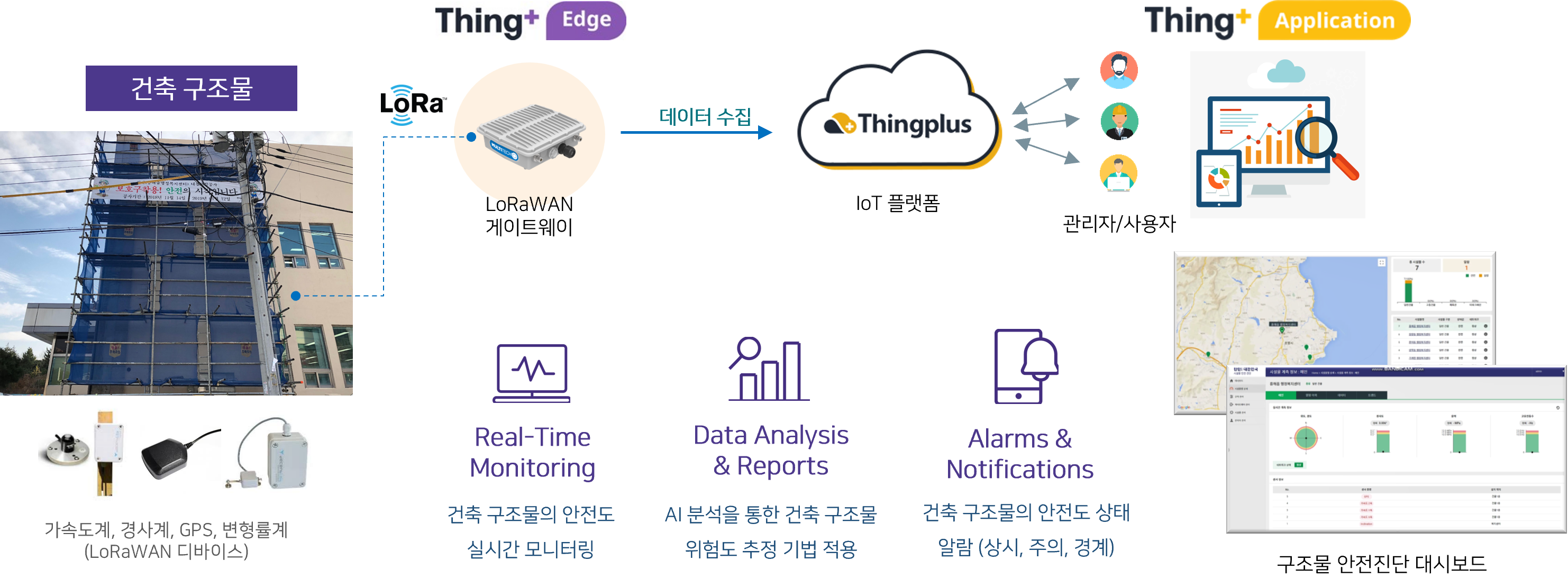
Thingplus has developed a convergence service built on an IoT cloud platform for preventing building accidents and managing building assets efficiently. The building safety diagnostics system is a real-time monitoring cloud (SaaS) service that collects data through LoRaWAN-based IoT measurement devices and analyzes it to predict anomalies and issue warnings.
Service Scenario
The building manager logs into the safety diagnostics system as usual and checks the status of the sensor devices (IoT devices) installed in the building and its safety picture on graphical screens. The system collects sensor data, presents the analyzed results in detail views, and diagnoses the building’s safety through a range of analysis items (AI algorithms). Spotting an area of questionable safety, the manager consults a safety diagnostics expert and carries out preventive repair and reinforcement work — saving costs that could otherwise have snowballed.
Future Applications
1. As a safety diagnostics and crisis response system for preventing building accidents caused by natural disasters such as earthquakes and by building aging.
2. As a safety diagnostics system during construction of large buildings, preventing accidents to nearby structures from sinkholes and the like.
3. As a system for managing building safety ratings in asset management services and for evaluating insurance products.
 Key Features
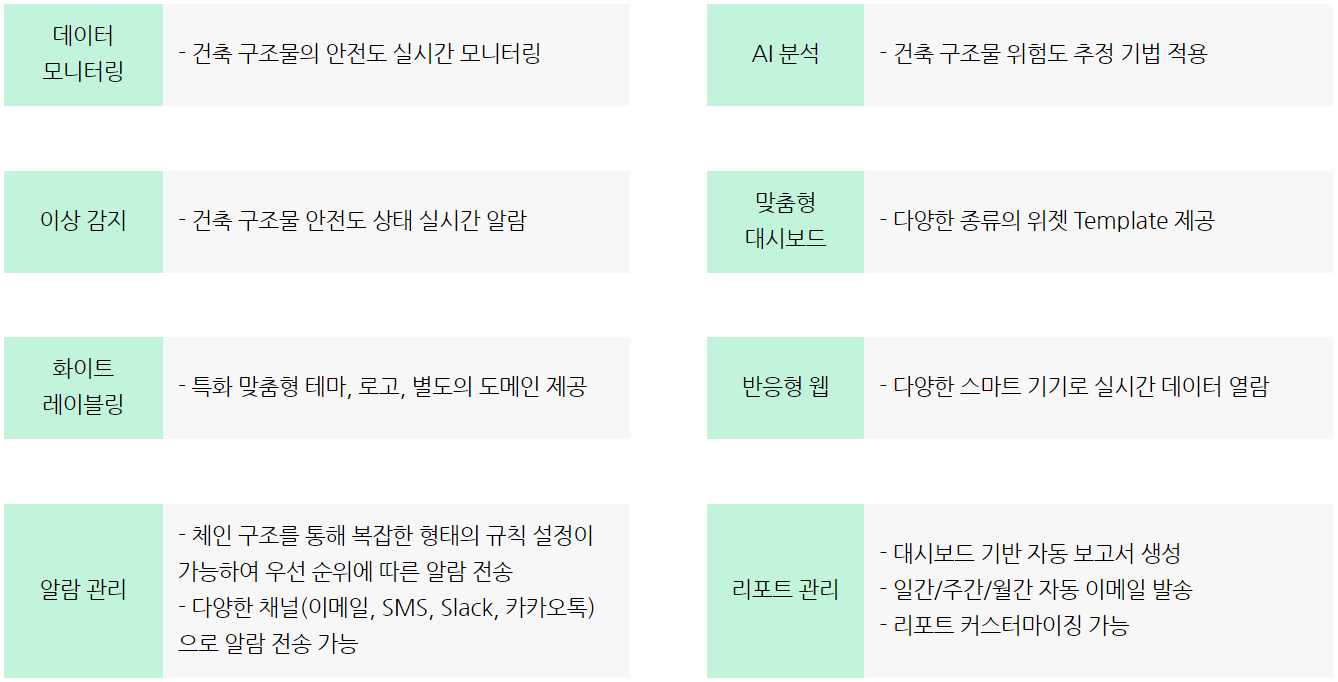
Real-time safety diagnostics of building structures and early detection of collapse warning signs help reduce casualties from structural collapse and effectively address social issues around the environment, safety, and welfare. To fix the problems of labor-centric facility maintenance, it is time to use IT to raise maintenance efficiency, and to build a preventive safety diagnostics and maintenance regime powered by advanced ICT- and IoT-based convergence technology to cut maintenance costs.
This enables timely repair and reinforcement and preventive maintenance, extends building lifespans, and ultimately yields enormous economic savings. It also identifies the moment when a building can be repaired and reinforced at the lowest cost and highest efficiency, driving optimal maintenance. Optimizing building life-cycle costs and countering building aging demands qualitative growth in technologies that apply scientific maintenance techniques (AIoT and big data, whole-life-cycle assessment, and more).
Thingplus supports the entire process of adopting a building safety diagnostics service — from consulting and service/system design to communications/device recommendations and service delivery. Try Thingplus for preventing building accidents and managing building assets efficiently!