This is Part 4 of our series, ‘Cooling Cost Reduction Strategies You Can Start Right Now.’
Part 1: 🌡️ The More You Run the AC, the Higher the Bill? How to Save with HVAC AI
Part 2: 💨 Smart Cooling for Franchise Stores: The Savings Potential of IR Control
Part 3: 🧍♂️ Factory Cooling That AI Switches On and Off by Itself: The Evolution of Occupancy Detection
When weighing summer energy-saving solutions, one topic that always comes up is the AC control method.
From small storefronts to large factories, many people wonder which approach is more efficient and more practical. In this article, we compare the characteristics, strengths, and weaknesses of remote (IR) based control and wired control.
1. IR Remote-Based Control
Characteristics
– Controls units remotely using the IR (infrared) receiver built into existing air conditioners
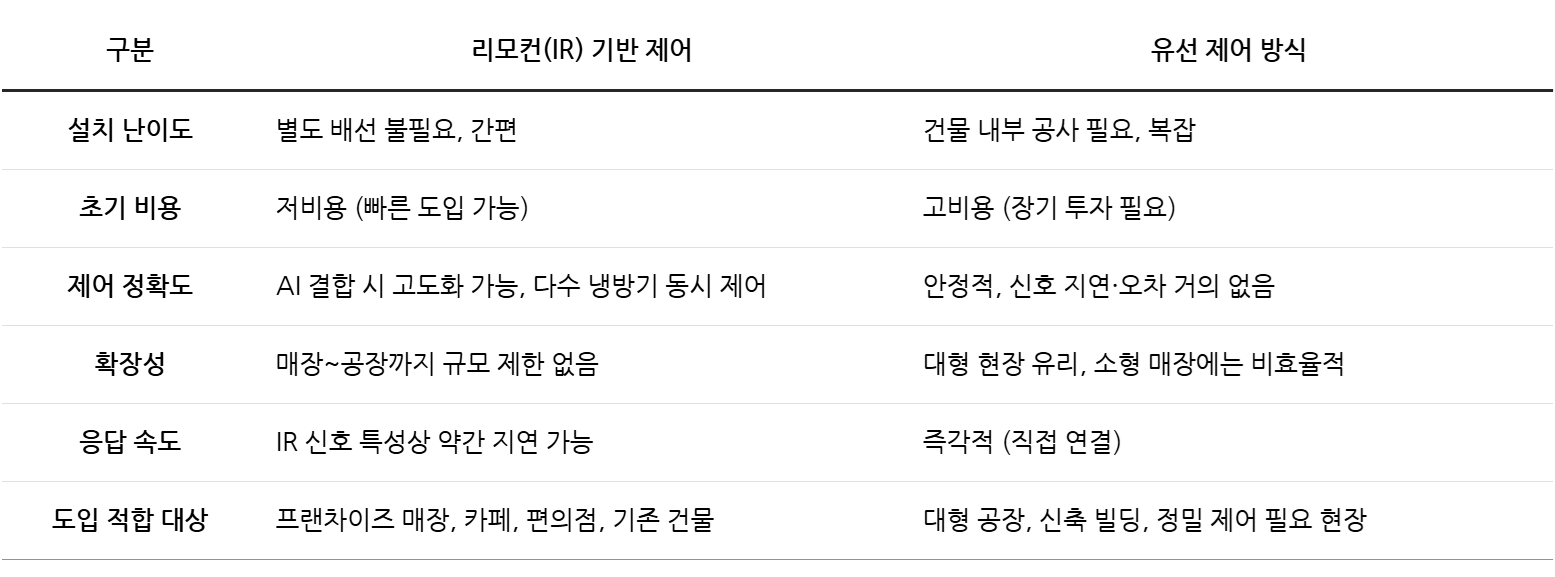
– No separate wiring work required; installation is simple and inexpensive
– Combined with an AI platform, multiple AC units can be controlled at once → no limits on store, office, or factory scale
Advantages
– Lowest upfront investment
– Fast installation, deployable even while the business stays open
– The AI algorithm manages signals centrally, enabling optimal operation regardless of the number of AC units
Disadvantages
– Due to the nature of IR signals, intermittent recognition errors are possible depending on receiver placement and environment
– As a physical signal transmission, response can be slightly slower than a direct wired connection
Best suited for
👉 Small spaces such as cafes, convenience stores, and small offices
👉 Sites that want to minimize upfront costs or need only simple control
2. Wired Control
Characteristics
– Physically wires the AC units to the control device
– Direct signal transmission → stable and fast response
Advantages
– High signal transmission stability
– Fast response with virtually no control errors
– Advantageous for large sites that require precision control
Disadvantages
– Installation work is costly and time-consuming
– May require structural changes or interior construction
– High barrier to entry for small stores and existing buildings
Best suited for
👉 Mid-to-large spaces such as factories, large stores, and franchise locations managed by headquarters
👉 Sites pursuing long-term operational stability and energy efficiency
Savings Comparison

Remote (IR) + AI Control
– Quick to deploy at low cost
– Optimizes multiple AC units simultaneously across stores, offices, and factories of any size
– With signal reliability addressed, savings on par with wired control can be expected
Wired Control
– Highest technical reliability
– However, adoption barriers (construction and cost) limit its practical range of application
📊 Remote (IR) vs. Wired Control Comparison
Which Choice Is Right for You?
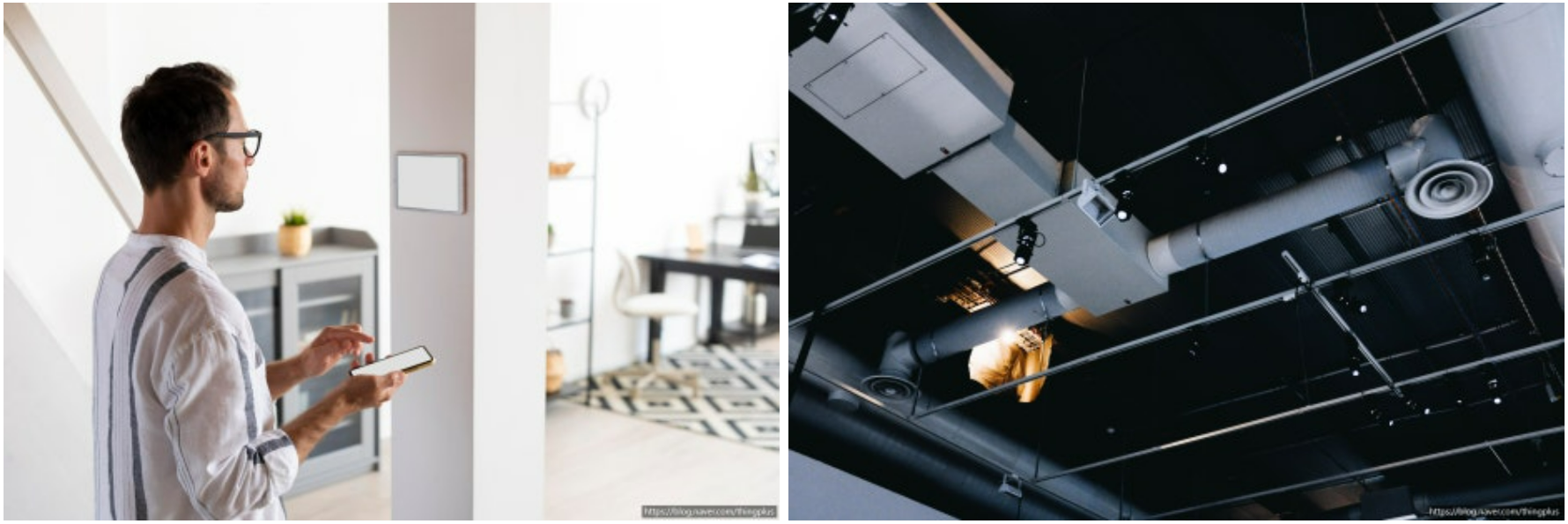
– Small stores: With fast deployment and low cost as priorities, remote (IR) + AI control is the best fit
– Large factories and new buildings: If long-term operational stability matters most, wired control is the sensible choice
✅ In conclusion, the Thingplus AI-based HVAC control system places no limit on the number of AC units even with remote (IR) based control, and the AI optimizes every indoor unit. Its greatest differentiator is the flexibility to serve “everything from small stores to large sites operating dozens of AC units or more.”
✅ Recommended Reading