1. Manufacturing Competitiveness Built on Data Visibility
In manufacturing, quality problems, missed deliveries, and production losses mostly begin with disconnected and delayed information. You have to ask someone for each process’s production status, you learn a machine has stopped long after the fact, and component defects are often discovered only after final assembly. Operating this way, a manufacturer is effectively driving with its eyes closed. However good the ERP’s plans and however busily the automated equipment runs, if you cannot see what is happening on the floor — when and why — operators are stuck in endless ‘firefighting’ instead of ‘forecasting.’
This is exactly the gap the MES (Manufacturing Execution System) closes.
An MES is not a mere process management system — it is a tool that makes the flow of production ‘visible’ in real time and an engine that makes judgment faster. With an MES, the shop floor can answer questions like these in real time.
– Which machines are running right now, and which have stopped?
– What instructions has each operator received, and what output are they producing?
– Where did the input materials go, and at which stage did the defect occur?
– Among today’s output, which processes deviated from quality standards?
This data is not mere ‘monitoring’ — it dramatically shortens decision speed, accuracy, and risk response time. For example, an alarm fires the moment defect signals are detected, supply disruptions reveal delivery risks in advance, and when a production bottleneck occurs, its location and cause can be analyzed in real time.
Data visibility is the foundation not just of a ‘visible factory’ but of a factory you can judge, a factory you can predict — and ultimately a sustainable factory. And at its center sits the MES.
2. How an MES Secures Visibility
MES collects, cleanses, and visualizes all data generated on the manufacturing floor in real time, making the flow of production visible. To do this, MES focuses its data management on four core elements:
① Production performance (Work Order Execution)
Tracks work order progress, completion status by process, input materials, and operator records in real time.
For example, you can instantly see how many units a given operator produced on Line A and how many of them were defective.
② Equipment status (Equipment Monitoring)
Integrates with PLC or SCADA systems to automatically collect equipment run status, stoppage reasons, and warning events. When early signs of equipment trouble are detected, the MES raises an immediate alarm to support preventive maintenance or replacement decisions.
③ Quality inspection results (Quality Management)
Stores quality data such as measurements against inspection criteria, pass/fail judgments by process, and defect types. This enables real-time analysis of defect rates and deviation trends by process, and early detection of quality problems concentrated in particular machines or operators.
④ Material flow and history (Traceability)
Records the entire flow from material input to finished-product shipment, so that when a problem occurs, the causal process or supplier can be traced. Using barcodes, RFID, and IoT sensors, the MES manages history data down to the material level.
This data is not merely stored — it is visualized in real time on MES dashboards or through mobile/tablet operator interfaces (UI).
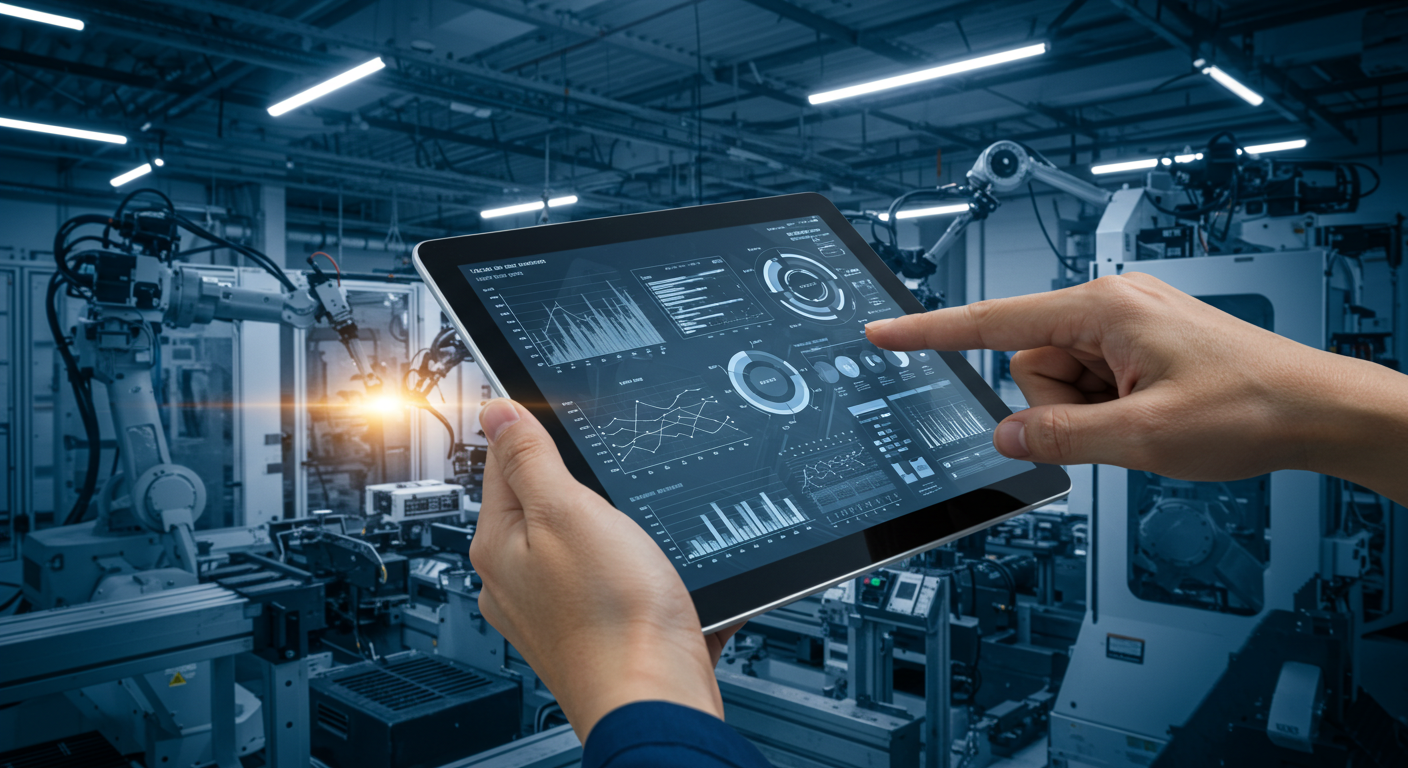
AI-generated image of an MES on a tablet
Moreover, an MES is not confined to a single process or machine — it provides a comprehensive view of the entire factory flow. Executives can see at a glance “overall production progress,” “shippable quantity,” and “the biggest bottleneck process.”
In other words, an MES is not a simple record-keeping system but an information platform that turns data into a ‘judgeable form.’ And only with this visibility can connectivity and automation deliver their full effect.
3. Manufacturing Connected All the Way to Suppliers: Why Connected Manufacturing Matters
MES was originally a system for managing production execution inside the factory. But manufacturing no longer happens within a single plant. Components arrive from outside suppliers, products are assembled by contract manufacturers, and after-sales service is performed by regional service centers.
Yet many manufacturers still cannot see in real time what is happening outside their walls, and try to resolve supplier issues through time-lagged channels — email, reports, phone calls. This disconnection is a leading cause of recalls, quality claims, delivery delays, and defects of unknown origin.
The approach that solves this problem at its root is Connected Manufacturing. Connected Manufacturing goes beyond wiring systems together with APIs — it is an architecture that integrally connects data across the entire manufacturing process, including not only the factory but suppliers, contract manufacturers, and after-sales service organizations.
The key is to build, around the MES, a framework in which every manufacturing party shares and mutually leverages its data in real time. Quality data on components delivered by suppliers, test results from contract manufacturers, repair histories from service organizations — information generated outside the factory must connect organically with the MES
for a manufacturer to predict finished-product quality in advance and trace and respond swiftly when issues arise.
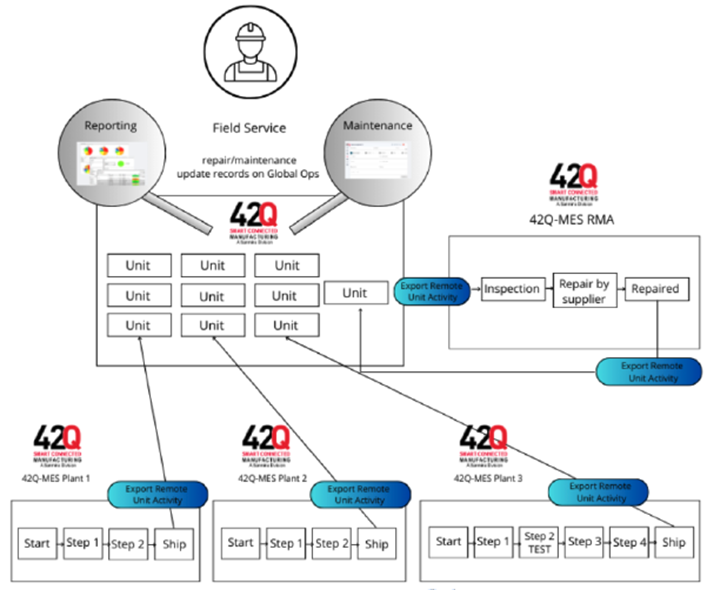
A 42Q example integrating after-sales support across multiple manufacturers
For example, when recurring defects appear in externally supplied material, the MES should instantly identify that material’s supplier, delivery history, the processes it entered, and the affected product families. Likewise, when products built by a contract manufacturer ship, the MES should provide real-time access to per-process test results, component assembly records, and inspection pass status — enabling fast responses to customers and quality audits.
Connected Manufacturing, then, is not simple system integration but a concept that unifies the entire manufacturing process into a single ‘information ecosystem.’ Because traditional one-way data transmission cannot deliver real-time performance and integrated visibility, a cloud-based MES integration architecture — or interoperable MES instances — is required.
With this structure in place, the work status, quality data, and shipment history of every manufacturing partner can be monitored in real time on a single dashboard. As a result, a company can trace and control the entire product life cycle within one framework.
Connected Manufacturing is not merely a technical evolution — it is a new manufacturing strategy for securing accountability and control across the whole supply chain. And at its center now sits the MES: no longer a single-factory system, but the connector of the entire production ecosystem.
4. A Connected Manufacturing Ecosystem Expanding Around the MES: The Architecture Seen Through 42Q
Connected Manufacturing is realized only when the factory, contract manufacturers, component suppliers, and service organizations are linked into one framework. The flagship example that brings this ideal to life is 42Q.
42Q is a cloud-based global MES that connects multiple factories, partners, suppliers, and service organizations in real time on a single platform. Its central philosophy is summed up in one sentence.
“A single pane of glass view of global operations.”
– Seeing worldwide manufacturing operations through one window.
In other words, it lets you operate manufacturing activities scattered across different organizations, systems, and regions in one integrated MES environment.
How the MES Interfaces with Other Systems
42Q does not isolate the MES as a standalone solution — it interoperates with ERP, SCADA, IoT sensors, cloud services, and AI platforms.
|
Integration target |
Role |
|
ERP |
Planning and performance reporting |
|
SCADA/PLC |
Equipment data collection and control integration |
|
IoT sensors |
Collecting environmental/equipment/product data such as temperature, humidity, vibration, and quality |
|
AI/cloud analytics |
Advanced analytics such as quality prediction, yield optimization, and failure prognostics |
Through this architecture, you can build a foundation that goes beyond work orders and performance tracking to aggregate, analyze, and act on all shop-floor data in real time.
Connected Manufacturing in Practice with 42Q
42Q is not theory — it is a platform already embedded in the operating structures of global manufacturers. Here are three representative cases.
① Integrating multiple contract manufacturers (CMs)
– Problem: Understanding the status of multiple contract factories (CMs) took days
– Solution: 42Q instances deployed at each contract factory, unified in the cloud
– Results:
. Real-time production, quality, and delivery status visible on one screen
. Performance comparison and quality trend analysis across contract factories
② Connecting history data with component suppliers
– Problem: When delivered components caused problems, manufacturing history could not be traced
– Solution: Suppliers transmit component test data and serial number information to 42Q at shipment
– Results:
. Manufacturing history and quality issues traceable at the component level in the MES
. Defect causes identified and addressed quickly at the supply stage
③ Integrated after-sales service (RMA) history management
– Problem: Global service centers could not see the original production history of repaired products
– Solution: The full history — production, shipment, repair, redelivery — unified in the MES
– Results:
. Faster responses to customer complaints
. Closed-loop data secured for quality and design improvement
As these cases show, 42Q is optimized for building not a single MES but a ‘connectable MES ecosystem.’ Small and mid-sized manufacturers can implement Connected Manufacturing progressively with 42Q — starting with internal factories and extending the connection to suppliers and outsourcing partners as needed.
5. Closing Thoughts
We have seen that the MES is evolving from a simple process management system into core infrastructure that secures data visibility and connects the manufacturing ecosystem.
Information disconnection is the greatest enemy gnawing at manufacturing competitiveness. The MES resolves it: recognizing stoppages in real time, quantifying performance by operator, and revealing bottlenecks between processes at a glance. All of this starts with visibility — and only when that visibility extends beyond the factory to suppliers, contract manufacturers, and service organizations does manufacturing truly become controllable.
Cloud-based MES platforms like 42Q are the most realistic and flexible way to realize this ‘scalable connected manufacturing.’ Small and mid-sized companies can take a fully staged approach — visibility → data connection → partner integration → enterprise-wide unification — turning a digital transformation that begins with small changes into a major innovation.