Why IoT Adoption Matters
In today’s fast-moving business environment, companies must constantly innovate and uncover new growth engines to secure their survival and prosperity. At the center of this change, alongside artificial intelligence (AI), big data, and cloud computing, sits the Internet of Things (IoT).
IoT is the technology that connects the objects around us to the internet so they can share information and interact. From home appliances such as refrigerators and air conditioners to factory equipment, farm sensors, and even the wearable devices we put on, countless things are networked together, generating and sharing real-time data, and sometimes even making intelligent decisions on their own.
As an IoT specialist, Daliworks has discussed IoT adoption with a wide range of customers. What we noticed every time is that while customers have deep knowledge and rich experience in their own operations, they find it genuinely difficult to figure out how to apply a new technology like IoT to their business. Questions such as “What goals should we set?” and “What should we start with first?” are the very real challenges that many companies considering IoT face in common.
Through this experience, we came to feel a pressing need for a clear, systematic guide to IoT adoption. We were convinced that with practical guidance to help companies understand and apply IoT, a technology that can feel complex and abstract, to their actual business situations, many more of them could achieve a successful smart transformation.
IoT adoption offers companies unprecedented opportunities. With vast amounts of data collected in real time, companies can maximize operational efficiency, cut costs, and deliver more personalized experiences to customers. On the manufacturing floor, for example, IoT sensors can detect early signs of equipment trouble, enabling predictive maintenance and higher productivity. In logistics, real-time location tracking and inventory management make efficient supply chain management possible. Companies can also analyze customer usage data to develop tailored products and services and create entirely new business models.
The concrete benefits of IoT adoption include the following.
– Higher productivity: Automated data collection and analysis optimize work processes, eliminate unnecessary waste, and maximize productivity.
– Cost savings: Greater efficiency across areas such as energy management, equipment maintenance, and inventory management reduces operating costs.
– Better customer experience: Understanding customer behavior and needs in real time enables personalized products and services and boosts customer satisfaction.
– New business models: Companies can create innovative services and value that were previously hard to imagine, opening new markets and securing a competitive edge.
– Risk management: Detecting and predicting potential hazards in advance helps prevent accidents and makes the business more stable.
Of course, IoT adoption is a complex process that goes beyond simply applying technology; it calls for changes across a company’s strategy, processes, and organizational culture. A hasty rollout can instead create confusion and fail to deliver the expected results.
This guide aims to help companies considering IoT achieve a smart transformation without failure. From setting clear goals to choosing technologies, building the system, and operating and maintaining it, we will walk through the entire IoT adoption journey step by step to support a successful digital transformation. Whether you are a manager considering IoT for the first time or an expert looking for a concrete execution strategy, this guide is meant to be a useful companion for everyone preparing for a smart future.
Step 1: Set Clear Goals and Define the Business Model
The first step toward successful IoT adoption is setting clear goals and defining a business model to support them. Just as a ship that sets sail without a clear destination easily loses its way, an IoT initiative that starts without concrete goals is likely to run into unexpected obstacles or fail to deliver a return on the investment.

Setting business goals
1. Define the Problems You Want IoT to Solve:
The first thing to think about is the question, “What specific problem does our company want to solve with IoT?” Considering IoT vaguely because it is the latest technology, or because competitors are doing it, is a shortcut to failure.
You need to closely analyze the inefficiencies in your current operations, the areas that need improvement, and the places where new growth opportunities might be captured. For example, the problems might look like these.
– Manufacturing: High defect rates, frequent equipment failures, difficulty forecasting output, or excessive energy consumption
– Logistics/distribution: Difficult inventory management, delivery delays, rising product damage rates, difficulty maintaining the cold chain
– Customer service: Slow response times, a lack of personalized service, rising customer churn
– Marketing/sales: Difficulty with targeted marketing due to insufficient customer data, difficulty finding prospective customers
As you define these specific problems, it is important to listen to the people on the front lines and to secure objective evidence through data analysis.
2. Set Specific Goals:
Based on the problems you have defined, set concrete, measurable goals. Not simply “improve productivity,” but clear, quantified targets such as “improve production efficiency by 15% within the next six months” or “cut energy costs by 10%.” These goals point the IoT project in the right direction and become the yardstick for judging its success.
3. Design a Business Model That Creates New Value:
IoT does more than improve existing business processes; it creates new value and enables innovative business models. Beyond simply attaching sensors to products, think about how the collected data could power new services or strengthen your relationships with customers.
For example, you might analyze product usage data to offer tailored maintenance services, use real-time location data to develop new logistics services, or provide personalized healthcare services based on customers’ health data.
4. Identify Critical Success Factors (CSFs):
Identify the core elements you absolutely must secure or execute well to achieve your goals and realize the business model you have designed. These are known as Critical Success Factors (CSFs).
For a smart factory project, for example, the CSFs might be building a real-time data collection and analysis system, developing an equipment failure prediction algorithm, and raising shop-floor workers’ proficiency with the IoT system. It is important to define CSFs clearly at each stage and to build strategies for achieving them.
In Step 1, then, you need clear answers to the Why and the What of IoT adoption. By accurately diagnosing the problems, setting concrete goals, and designing a business model that can create new value, you lay a solid foundation for successful IoT adoption. In the next step, we look at the IoT technologies and solutions that will help you reach those goals.
Step 2: Understand IoT Technologies and Solutions
Once your goals and business model are clearly defined, the next step is to broaden your understanding of the IoT technology components and the many solutions available to realize them. IoT is not a single, unified technology but a composite system in which several core technologies are organically combined.
1. The Key Building Blocks of an IoT System:
An IoT system generally consists of the following core elements.
– Sensors & Actuators: Sensors detect and collect data from the physical world. They can measure many kinds of data, including temperature, humidity, motion, pressure, and light. Actuators do the opposite: they receive digital signals and carry out physical actions. For example, when a temperature sensor detects a reading above a set threshold, an actuator can switch on a cooling device.
– Network: The communications network that transmits collected data and connects devices. A variety of wireless technologies are used, including Wi-Fi, Bluetooth, Zigbee, LoRaWAN, NB-IoT, and 5G, and the right one must be chosen based on factors such as data volume, transmission range, and power consumption. Wired networks (Ethernet) also play an important role in industrial settings.
– Platform: The software environment that efficiently manages, stores, processes, analyzes, and visualizes the vast data collected from sensors. It provides features for data security, device management, application development, and more. AWS IoT Core, Azure IoT Hub, and Google Cloud IoT Platform are well-known examples.
– Data Analytics: The process of analyzing collected data to extract meaningful information and patterns. Techniques range from basic statistical analysis to advanced methods such as machine learning and deep learning. The results feed into decision-making, prediction, and automation, creating business value.
– Application: The interface that delivers analyzed data to users and passes user commands back to devices. Applications can take many forms, including web, mobile apps, and dashboards.
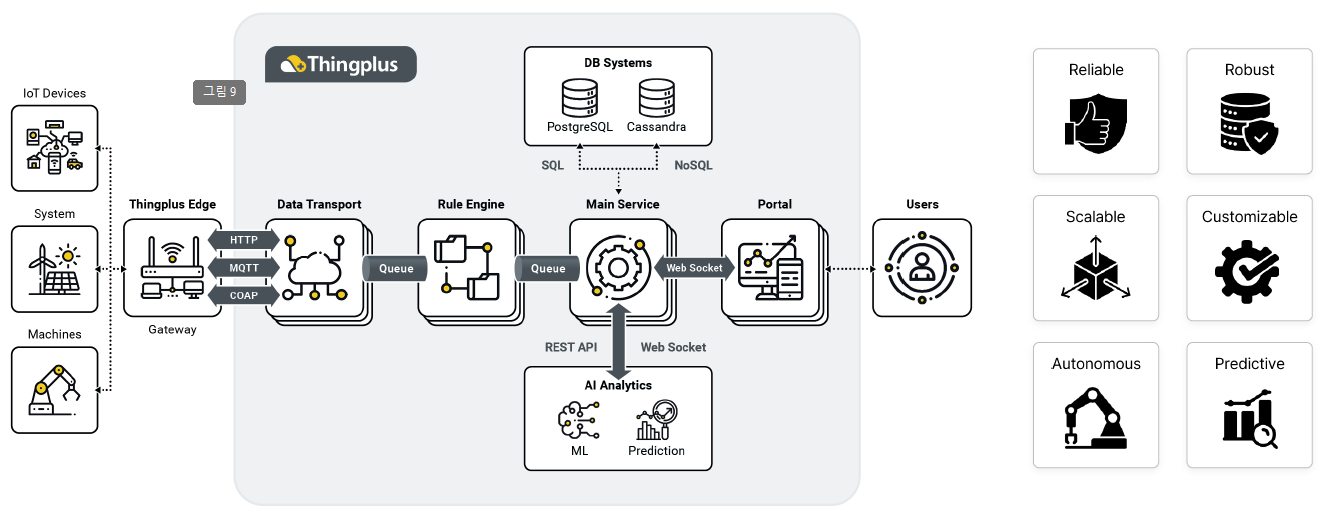
Architecture of Thingplus, the Daliworks IoT platform
2. IoT Solution Examples Across Industries:
IoT technology is being used as an innovative solution across a wide range of industries. Let’s look at a few examples.
– Smart factory: Sensors attached to production equipment monitor and analyze data in real time to predict equipment failures and raise production efficiency. IoT is also applied to automated robot control and quality management.
– Smart city: A wide range of IoT solutions improve the efficiency of city operations and the convenience of citizens, spanning traffic management, energy management, environmental monitoring, and public safety. Smart streetlights and smart parking systems are typical examples.
– Smart healthcare: Wearables and medical sensors monitor patients’ vital data in real time, enabling disease prediction and personalized health management services. IoT is also used to build telemedicine systems.
– Smart agriculture: Soil sensors and weather stations optimize crop growing conditions and predict pests and diseases to improve yields. Smart irrigation systems and drone-based farm work are in active use.
– Smart home: Appliances, lighting, and security systems are networked to increase convenience and manage energy efficiency. Voice-activated speakers and smart door locks are familiar examples.
3. How to Find the Right Technologies and Solutions for Your Business Model:
Based on the goals and business model defined earlier, you now need to explore the IoT technology components and solutions that fit your company best. Consider the following questions.
– What kinds of data should we collect to help achieve our goals? (Sensor types)
– How far and how often does the collected data need to be transmitted? (Network technology)
– How can we efficiently manage and analyze the large volumes of data we collect? (Platform and data analytics)
– How will we visualize the results and deliver them to users? (Application)
– How should we approach integration with existing systems?
– How will we ensure data security and protect personal information?
It is important to gather and compare information by consulting a range of IoT technology and solution vendors, attending relevant conferences and trade shows, and analyzing industry trend reports.
4. Why a PoC (Proof of Concept) Matters, and How to Run One:
Before a full rollout, we strongly recommend going through a PoC (Proof of Concept) stage. A PoC is the process of verifying the feasibility and potential benefits of a specific IoT technology or solution within a limited scope.
A PoC lets you confirm things such as:
– Whether the chosen technology delivers the target performance in the real business environment
– Whether there are unexpected technical difficulties in collecting, transmitting, or analyzing data
– How well users (employees) accept the system
– Whether the investment is likely to pay off
A typical PoC proceeds as follows.
– Define PoC goals: Set the specific objectives and scope you want to verify.
– Select the PoC target: Build a limited test environment similar to the actual deployment environment.
– Select the necessary technologies and solutions: Choose technologies and solutions that fit the goals, and collaborate with relevant partners.
– Run the PoC: Execute the PoC according to plan and collect data.
– Analyze and evaluate the results: Analyze the collected data to evaluate the technology’s performance, impact, and issues.
– Report the PoC results: Compile the results into a comprehensive summary and decide whether and how to proceed with adoption.
A PoC minimizes the risks that can arise during actual deployment and provides an important evidence base for the decisions behind successful IoT adoption. In the next chapter, we look at how to turn these findings into a concrete phased adoption strategy and roadmap.
Step 3: Build a Phased Adoption Strategy and Roadmap
With a basic understanding of the IoT technologies and solutions that fit your business model from Step 2, it is time to develop a concrete adoption strategy and an execution roadmap for how you will actually build and operate the IoT system. This step is the important process of creating a systematic, long-term plan for reaching your goals.
1. Build a Phased Adoption Plan Around Short-, Mid-, and Long-Term Goals:
To achieve the specific goals set in Step 1, you need a phased execution plan across short-, mid-, and long-term horizons. Rather than trying to build everything at once, starting small and expanding gradually reduces risk and raises the odds of success.
– Short-term plan (Initial Phase): Based on the PoC results, begin building the IoT system within a limited scope, starting with the most urgent problems or the areas with the greatest expected impact. Creating early wins is important for securing internal support and experience. For example, you might run relatively small projects such as improving the efficiency of one production line or monitoring energy use in one area.
– Mid-term plan (Expansion Phase): Building on the success of the short-term projects, gradually widen the scope of the IoT system. Expansion to other production lines, other sites, or other business areas can be considered. At this stage, focus on securing the stability and scalability of the system.
– Long-term plan (Optimization & Innovation Phase): Complete the company-wide IoT system, then focus on analyzing the collected data in depth to create new business value and develop innovative services. Converging IoT with other technologies such as AI and big data can produce an even more advanced smart environment.
2. Plan to Secure the Necessary Budget, People, and Resources:
For each phase of the plan, you must secure the necessary budget, people, and other resources. Building and operating an IoT system requires not only spending on hardware (sensors, gateways, and so on), software (platform, applications), and network construction, but also skilled specialists for system design, development, installation, and maintenance.
– Budget planning: Set a phase-by-phase budget that accounts for the initial investment, operating costs, and maintenance costs. Analyzing the expected ROI (Return on Investment) to validate the business case is also important. Consider taking advantage of government support programs or funding opportunities.
– Staffing plan: Decide whether to rely on internal staff or bring in outside experts. Secure the specialists you need, such as IoT engineers, data analysts, network engineers, and system developers, and build a training and upskilling plan for existing staff.
– Resource plan: Secure the physical space, network infrastructure, and power supply needed for the IoT system, and prepare for integration with existing systems.
3. Consider Integration with Existing Systems:
Most companies already run a variety of IT systems. A new IoT system must therefore be designed to integrate smoothly with what is already in place. Review approaches such as ensuring data compatibility, using APIs (Application Programming Interfaces), and building an integrated platform, and prevent data silos so the data can be put to full use.
4. Establish Data Security and Privacy Measures:
Because IoT systems collect and process enormous amounts of data, data security and privacy are critically important. Alongside technical measures such as data encryption, access control, security protocols, and de-identification of personal data, you must establish administrative and physical safeguards that comply with relevant laws and regulations. Extra care is required when handling data related to personal information.
In Step 3, then, you carry out the practical preparations for execution: building a phased plan for reaching your goals, securing the necessary resources, and addressing integration with existing systems and data security. In the next step, we look in detail at how to build and operate the actual IoT system according to this strategy and roadmap.
Step 4: Build and Operate a Successful IoT System
With the strategy and roadmap in place, it is now time to actually build the IoT system and run it reliably. At this stage, it is important to select partners you can trust, build robust infrastructure, and put an efficient data management system in place.
1. Select Trusted Partners and Define How You Will Work Together:
Because building an IoT system demands a wide range of technologies and expertise, collaboration with trusted partners can be a key to success. Work with specialized companies across multiple fields, including hardware manufacturers, software developers, telecom operators, and system integrators (SIs), to leverage each other’s strengths and create synergy.
– Partner selection criteria: Choose partners carefully based on a comprehensive review of their technical capability, experience, expertise, project delivery record, maintenance and support capacity, and company culture and communication.
– Ways of working: Define clear divisions of roles, establish close communication channels, and share project progress through regular meetings and reports so problems can be addressed jointly when they arise. It is also important to clearly define mutual responsibilities and authority in the contract and to agree on how performance will be measured.
2. Build a Stable Network Environment:
A robust, stable network environment is essential for reliably transmitting the data collected from IoT devices and keeping the system running smoothly. Choose the optimal network technology (Wi-Fi, Bluetooth, cellular, LPWAN, and so on) based on data volume, transmission speed, and security requirements, and carry out network equipment installation and configuration meticulously. Also consider building a backup system in case of network failures.
3. Build Systems for Data Collection, Storage, and Analysis:
Building systems to collect, store, and analyze the vast data generated by numerous IoT devices efficiently is a core element.
– Data collection: Collect data reliably from a wide range of sensors, applying preprocessing (filtering, error correction, and so on) where needed.
– Data storage: Build a database or cloud storage system to store the collected data safely and efficiently. Choose the right storage approach based on data volume, access frequency, and retention period.
– Data analysis: Build the analytics tools and platform needed to extract meaningful information from stored data and apply it to business decisions. Techniques can range from real-time analytics and statistical analysis to machine learning.
4. User Training and Change Management Strategy:
Sufficient user (employee) training and a change management strategy are essential for the successful adoption and use of a new IoT system. Reduce resistance to the new technology and system, and encourage active participation and use.
– User training: Develop training programs covering how to use the system, how to work with the data, and what to do when problems occur, and provide training tailored to each user group.
– Change management: Help people understand the changes the new system brings to organizational culture and work processes, and build consensus around the change. Active leadership support and participation matter; share success stories and give positive feedback to encourage the transition.
In Step 4, then, focus on working with trusted partners to build stable infrastructure, establishing an efficient data management system, and encouraging active participation from users. In the next step, we look at how to continuously manage, analyze, and improve the IoT system you have built.
Step 5: Continuous Management, Analysis, and Improvement
Completing the build of an IoT system does not mean the journey is over. The final stage of successful IoT adoption is continuously managing, analyzing, and improving the system to maximize its impact and evolve it in step with a changing business environment.
1. Monitor and Maintain IoT System Operations:
Ongoing monitoring and maintenance are essential to keep the IoT system running reliably. Periodically check the performance of each element of the system, including sensors, network equipment, the platform, and applications, and respond quickly to errors or failures to minimize downtime.
– Operations monitoring: Build a system that monitors operating status, data collection, network connectivity, and security in real time and sends alerts when anomalies occur.
– Maintenance: Optimize performance and eliminate security vulnerabilities through regular hardware and software inspections and updates. Introducing predictive maintenance to head off potential failures before they happen is another effective approach.
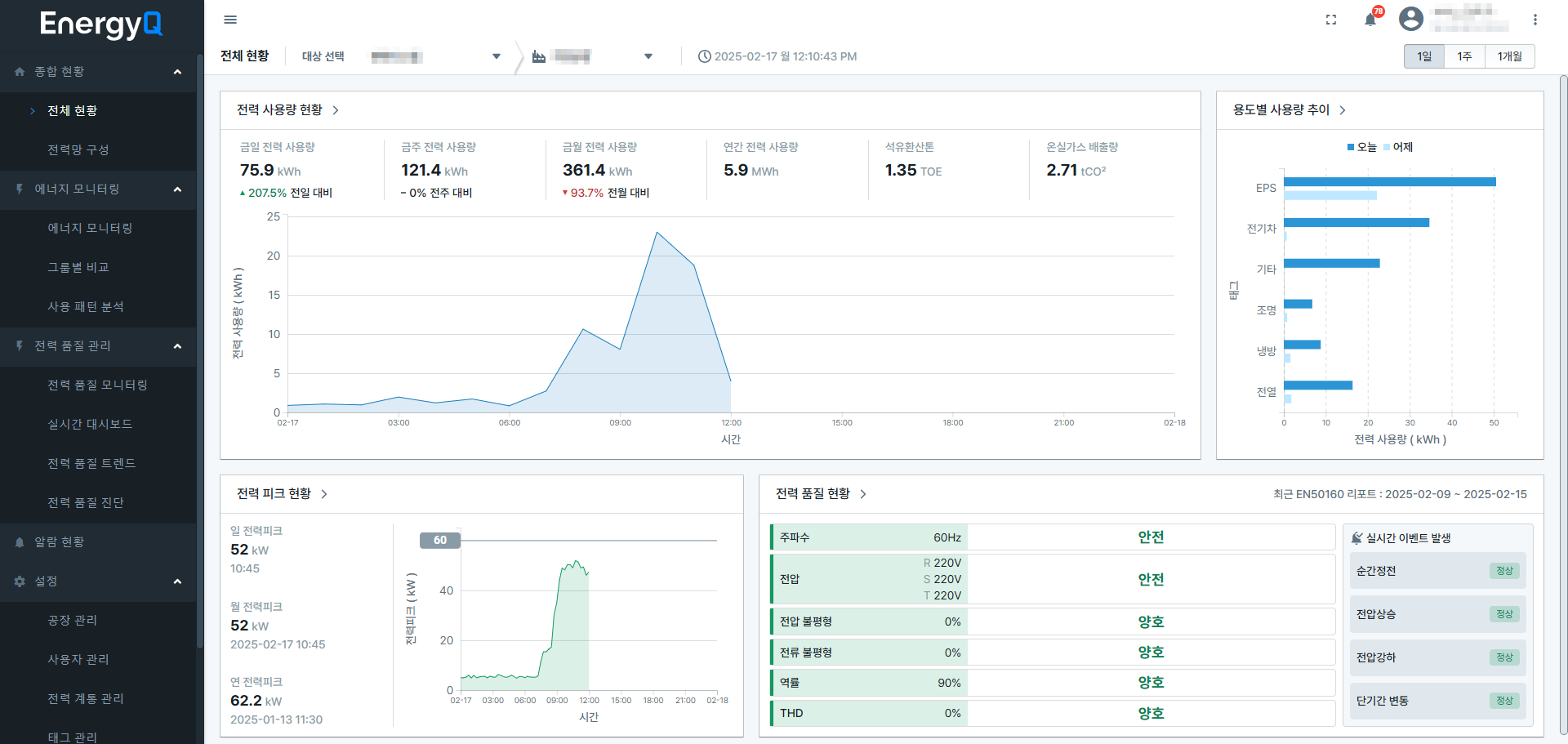
Dashboard of EnergyQ, the Daliworks FEMS solution
2. Draw Insights from the Data You Collect:
The vast data continuously collected through the IoT system must be analyzed in depth to produce insights that are useful to the business. Go beyond simply monitoring the data: uncover the patterns, trends, and correlations hidden within it, apply them to decision-making, and create new value.
– Use analytics tools: Use statistical analysis tools and machine learning platforms to analyze and visualize the data and make it easier to understand.
– Tie analysis to the business: Connect analysis results to each department and business area so they drive real problem-solving and improvement. For example, analyzing production data can raise process efficiency, while analyzing customer data can inform tailored marketing strategies.
3. Measure Performance and Evaluate Goal Achievement:
Regularly measure and evaluate whether the specific goals set before adopting the IoT system are being achieved. Analyze performance against the KPIs (Key Performance Indicators) you established, such as productivity gains, cost savings, and higher customer satisfaction, and gauge how far the goals have been met.
– Define performance metrics: Establish clear metrics that allow objective evaluation of goal achievement.
– Regular performance reporting: Report measurement results periodically, analyze what worked and what did not, and set the direction for future improvement.
4. A Strategy for Continuous Improvement and Expansion:
IoT technology keeps advancing, and the business environment keeps changing. The IoT system you have built therefore needs continuous effort to improve and expand.
– Watch technology trends: Keep a steady eye on new IoT technologies and solutions, and look for ways to apply them to your own system.
– Incorporate user feedback: Listen to the people using the system, and actively address their pain points and improvement requests to make the system easier to use.
– Review system expansion: As the business grows and changes, consider widening the scope of the IoT system or adding new capabilities. Convergence with other technologies (AI, big data, and more) can further strengthen the system’s capabilities.
In Step 5, then, by steadily managing the system, analyzing the data to create real business value, measuring results, and continuously improving and expanding, you can bring IoT adoption to a successful and fruitful conclusion.
Closing Thoughts
We have now taken a detailed look at the entire IoT adoption journey. From goal setting in Step 1 to continuous management and improvement in Step 5, we hope you now have a clear picture of the key stages of a successful smart transformation.
IoT adoption is more than introducing a new technology; it is a journey that transforms how a company operates and thinks. The journey can be complex and difficult at times, but with clear goals and a systematic, step-by-step approach, it will surely bring innovative growth and a sustainable competitive edge.
Looking back, the most important part of the IoT journey is finding a clear answer to the question, “Why are we adopting IoT?” Rather than getting absorbed in the technology itself, understanding IoT as a tool for solving business problems and creating new value is the first step toward success.
We would also like to emphasize the importance of a phased approach. Rather than trying to change everything at once, building up small wins and expanding the system gradually is an effective way to reduce risk and earn internal support. Verifying technical fit through a PoC (proof of concept) and reducing trial and error during the actual rollout are important parts of the process as well.
Of course, the road to IoT adoption can hold unexpected difficulties and setbacks: technical problems, budget constraints, staffing shortages, integration issues with existing systems, data security concerns, user resistance, and more. Overcoming them takes a clear sense of purpose, systematic planning, collaboration with trusted partners, and a commitment to continuous learning and improvement.
A successful smart transformation is not a short-term project but a long-term journey of constant change and innovation. IoT technology will keep evolving, and new services and business models will keep emerging. Companies must respond flexibly to these changes and keep advancing their IoT systems through ongoing learning and investment.
We hope this guide offers practical help and encouragement to companies that are hesitating over IoT or finding it difficult. We are cheering for your journey toward a smart future, and we look forward to seeing you grow into an even more innovative and competitive company through IoT technology.