Why IoT-Driven Digital Transformation, and Why Now?
Digital transformation is no longer some grand strategy for the distant future. From manufacturing floors to retail stores, public facilities, and energy management, it has become a practical means of solving visible, everyday problems. IoT (the Internet of Things) in particular collects data from the field in real time and makes prediction, control, and response possible on top of it.
Yet many companies still run into questions like these.
– “Is there no way to know the condition of our factory equipment before it breaks down?”
– “Could we predict a customer’s problem before they call the service center?”
– “How can we cut down on site visits caused by minor field issues?”
– “Can we head off risks like infectious disease, fire, or drainage problems in advance?”
The key to solving these problems is IoT (the Internet of Things), and Thingplus is a leading platform that puts IoT technology to work effectively in the field. Let’s look at real deployment cases to see how Thingplus IoT technology is solving on-site problems across a wide range of industries.
The Problem Is in the Field: Challenges Shared Across Industries
Few companies dispute that digital transformation is necessary. But the moment they try to adopt IoT, they run into questions like “Why do we need it?” and “Which problem should we solve first?”
The answer lies in the field. The problems unfolding in visible spaces where actual operations happen — production lines, stores, public facilities — are the starting point of digital transformation.
Looking across the many IoT deployments built on Thingplus, one thing becomes clear: even in different industries, the same problems keep recurring.
1. Inefficient Processes and Equipment Operations
When equipment fails, the process stops and people are dispatched to find the cause. Repeated visits and repairs, plus unexpected downtime, translate directly into lost productivity.
2. The Limits of People-Centered Management
Customer service, maintenance, safety management — many tasks are still structured so that a person has to do them directly. This slows response times and is a major drag on customer satisfaction.
3. No Visibility into Customer and Usage Data
There is little quantitative data on when customers visit most, when facilities see the heaviest use, or which locations are underperforming. As a result, operational decisions end up relying on gut feeling.
4. Difficulty Responding to Safety and Environmental Risks
For fires, infectious diseases, and flooding, responding only after the event is too late. Yet most workplaces today are still structured so that problems are only recognized after they occur.
The problem, in other words, is not a lack of technology — it is the lack of a system that can recognize invisible problems and respond to them in real time.
This is where IoT can be the answer.
Thingplus takes these industry problems and makes them visible with data, automates them, and turns them into predictable systems. In the next section, we look at concrete cases to see exactly how this change happens.
Innovation in the Field: Thingplus IoT Case Studies
Manufacturing: Smarter Equipment, Robots, and Energy
The manufacturing floor is where IoT can deliver its most dramatic results. Because processes, equipment, energy, and safety are all interconnected, sensor-based data collection and real-time control alone can visibly improve productivity and quality.
Working with a range of manufacturers, Thingplus has delivered digital innovations like the following.
1) Remote Monitoring and Management of Collaborative Robots
The problem:
Customers using collaborative robots are spread across the country. Every time a robot had an issue, engineers had to travel on-site at the customer’s request. In environments where remote access was difficult, response was slow, and even simple problems wasted labor costs and time.
The solution:
– Real-time monitoring of robot status
– Event alerts the moment a problem occurs
– Video streaming and remote access/control
– Automated, customer-tailored reports
The results:
– Far fewer on-site CS visits
– Immediate root-cause identification when problems occur, enabling fast response
– Better robot operating environments and growing operator expertise
– Higher customer satisfaction and maintenance efficiency at the same time
“Collaborative robots can now be looked after remotely. Remote monitoring and management services have taken robot operations to the next level.”
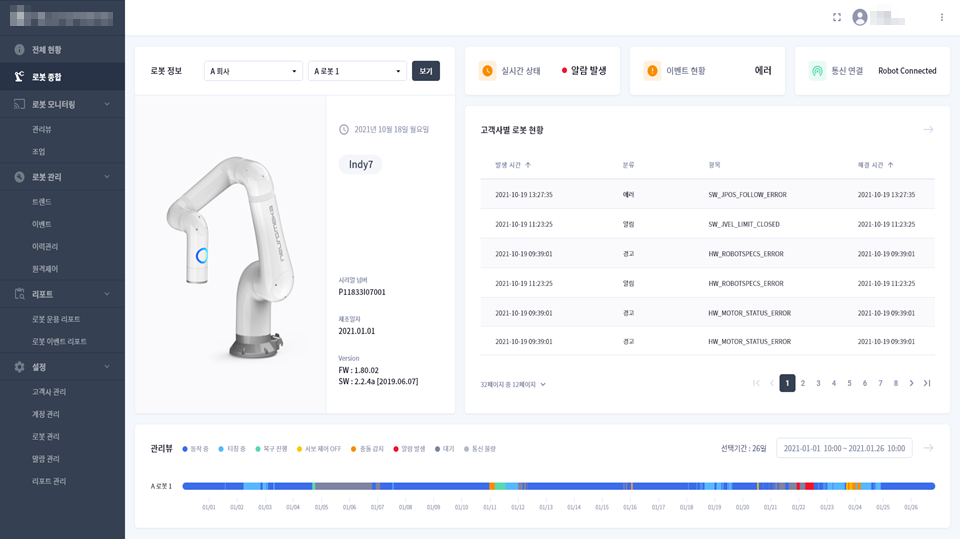
Collaborative robot management dashboard
2) AI-Based Predictive Maintenance for Motors
The problem:
Motors, the heart of production equipment, were hard to assess before failure — and when they did fail, the entire production line stopped, again and again.
The solution:
– Collection of electrical signal, vibration, and noise data
– AI analysis to detect early signs of trouble
– SMS/Email alerts and real-time monitoring
– Automated power consumption analysis and reporting
The results:
– Action before failure, reducing downtime
– Longer equipment life and optimized part replacement timing
– Better energy efficiency and stable quality
“Diagnosing equipment health with AI and keeping production lines running: this is where smart predictive maintenance begins.”
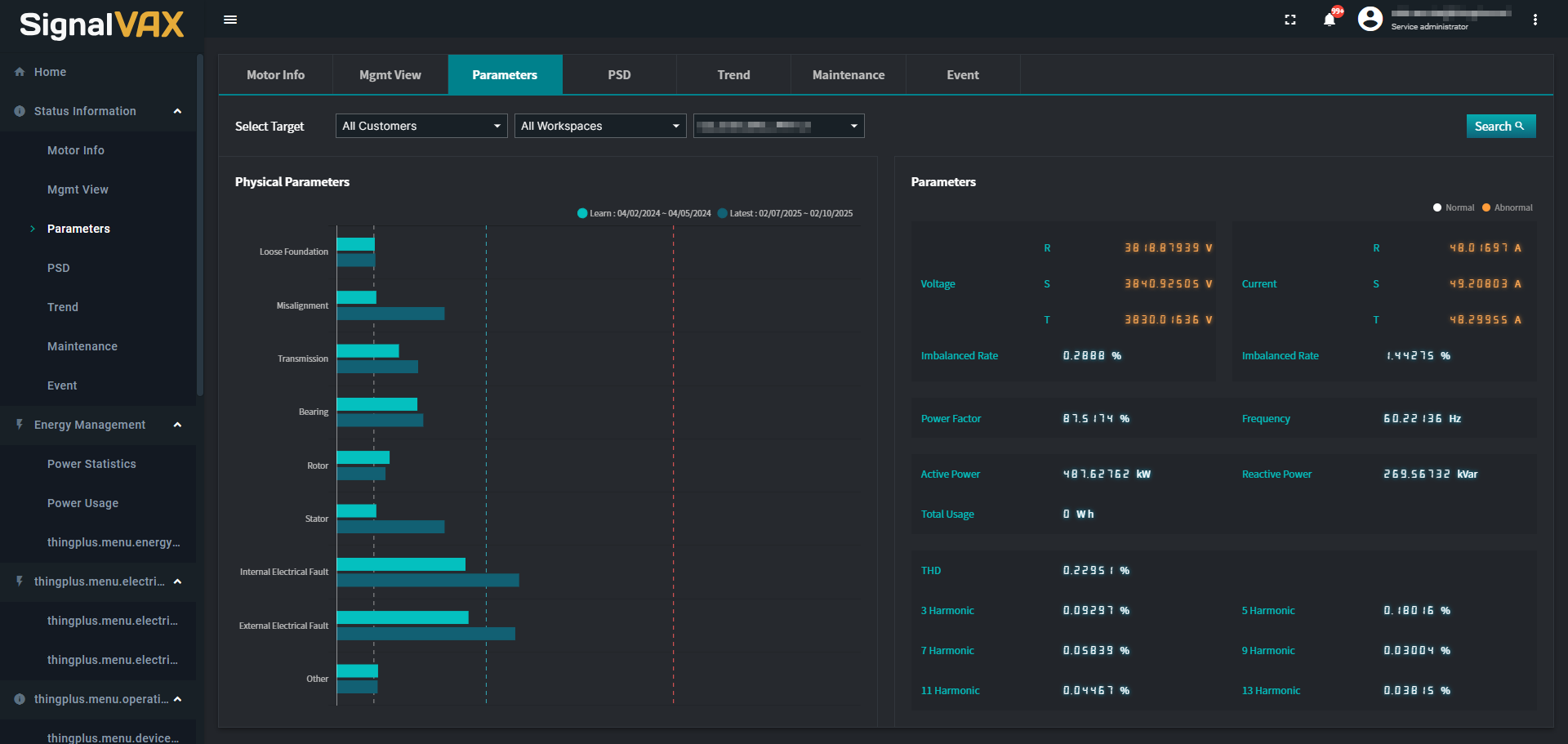
AI motor diagnostics dashboard
3) Real-Time Management of Solar Power Generation
The problem:
Weather conditions and long distances made it difficult to manage solar power installations in real time, and generation forecasts were unreliable.
The solution:
– A cloud-based real-time monitoring system
– AI-powered forecasts of generation by time of day
– Remote control and fault alert features
– Integrated management including ESS and battery status
The results:
– Maximized generation and lower facility operating costs
– Far fewer maintenance staff site visits
– Stronger profitability for renewable energy operators
“A solar power system you can predict and control: smart energy infrastructure built by IoT.”
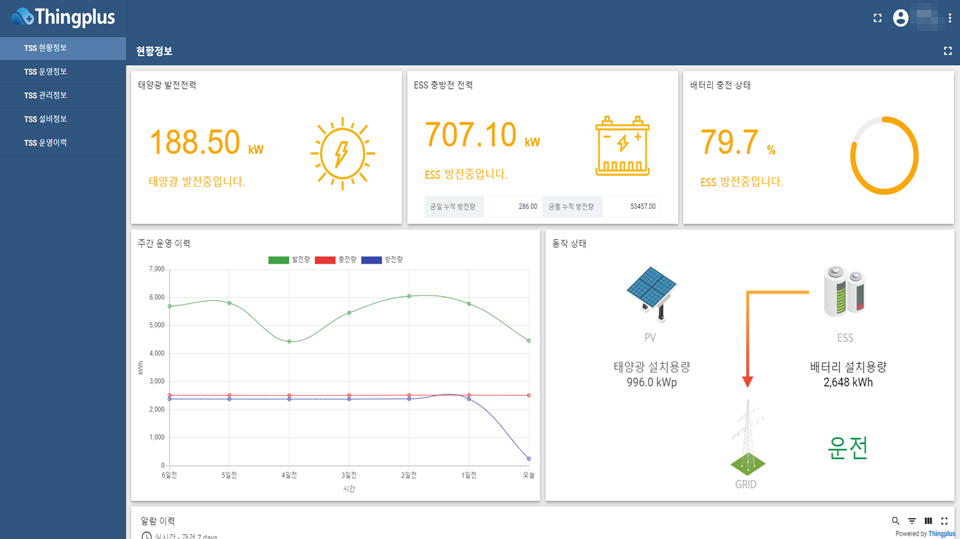
Solar power generation monitoring
4) Energy Savings and Environmental Monitoring at Once
The problem:
Despite operating many large laser processing machines and dust collectors, the company lacked the means to quantitatively manage power consumption and environmental impact. It wanted to pursue ESG management but needed data-based evidence for improvement.
The solution:
– Eco-friendly equipment and dust collectors introduced through a smart eco-factory program
– Meters installed to measure the power savings of key machines
– Real-time air pollution monitoring through dust sensors
The results:
– Optimized equipment investment by making full use of government support programs
– Concrete ESG goals grounded in real-time analysis of energy use and environmental impact
– Recognized as a leading example of green management in the industry
“A smart factory manages not just productivity but the environment. Data is ESG.”
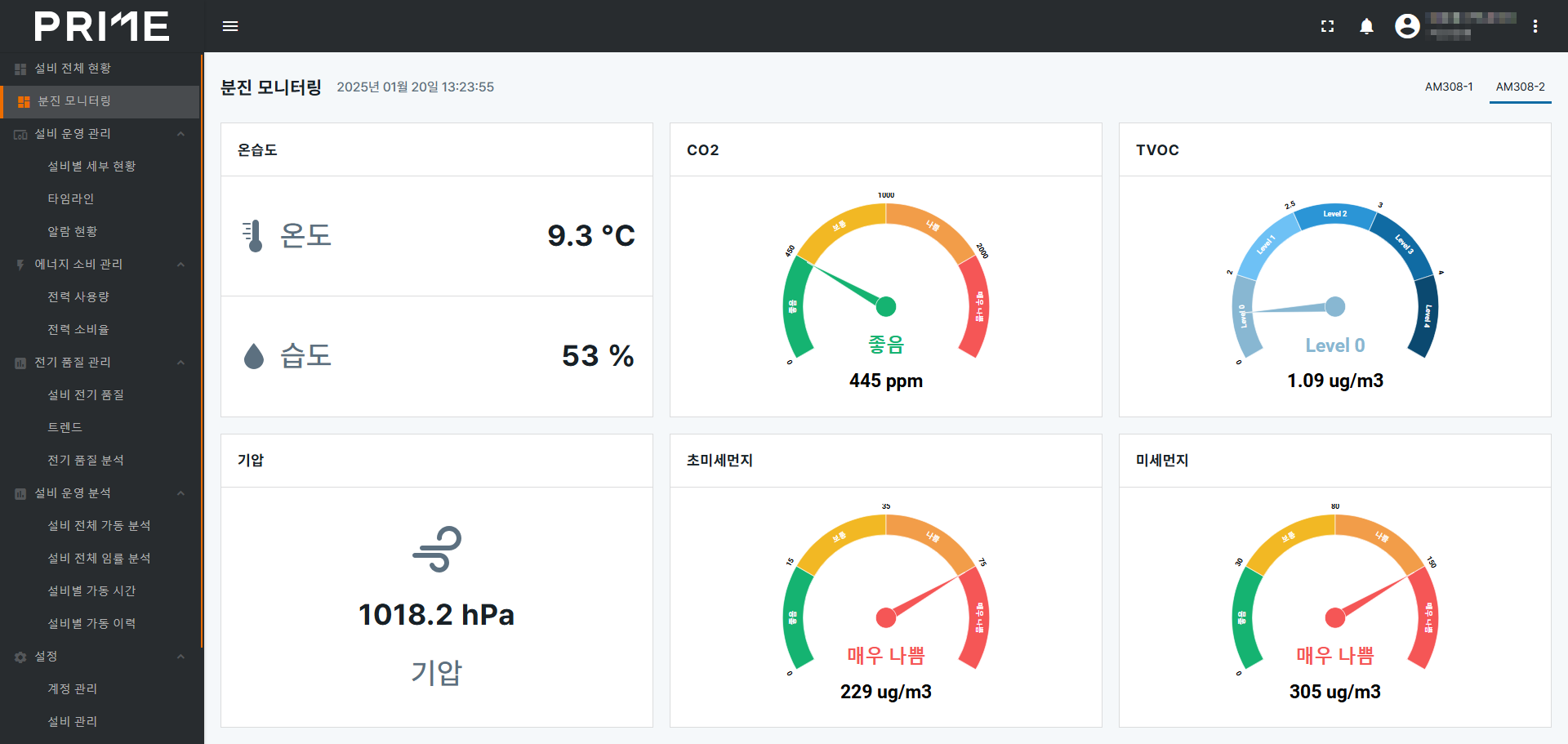
Power and dust monitoring
Retail and Stores: Understanding Customers and Spaces Through Data
Offline stores remain the heart of the consumer experience. Yet few stores truly know who visits, when, and how often. Connecting sales to customer data still mostly relies on intuition.
The Thingplus IoT platform visualizes how stores and facilities are used, providing the tools to optimize everything from marketing strategy to staffing.
1) Store Visitor Analytics
The problem:
Store performance (sales) could be checked in numbers, but the customer traffic behind those numbers could not. It was also hard to judge whether events and promotions were actually working.
The solution:
– Automatic entry/exit counting sensors
– Real-time and cumulative visitor data collection
– Statistics by time of day, by day, and by store
– Analysis of the correlation between visitor trends and sales
The results:
– The causes behind sales changes can now be analyzed
– Marketing and event impact analysis, sharpening strategy
– Optimized staffing and focused management by time of day
– More sophisticated decisions built on customer behavior data
“The data starts the moment a customer walks in.”
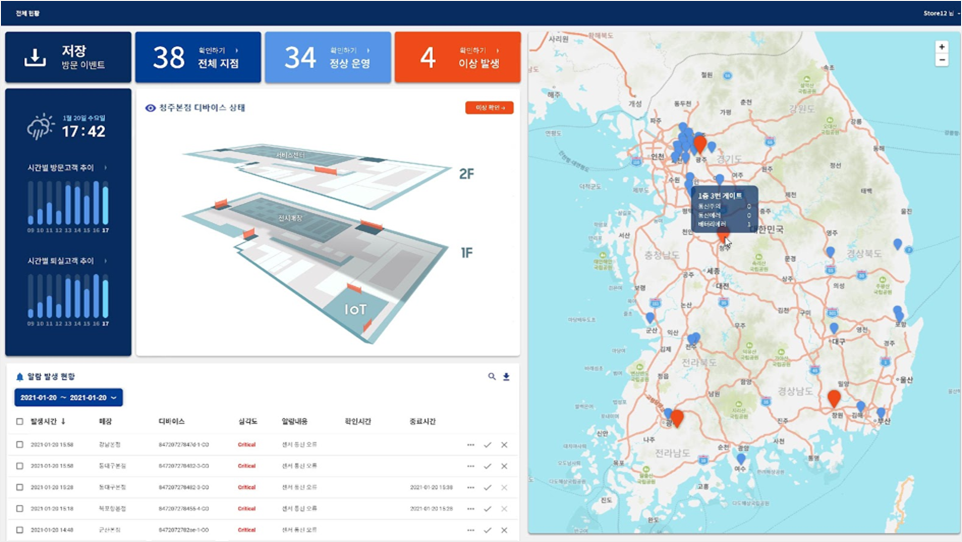
Store visitor analytics dashboard
2) Restroom Usage Analytics
The problem:
In large buildings, tracking restroom usage and supply levels depended heavily on staff, and problems were often only noticed after complaints came in.
The solution:
– Sensors detect restroom user counts and supply status in real time
– A dashboard shows usage across the whole building at a glance
– Alerts when usage spikes, enabling proactive response
The results:
– Predictable supply replacement timing and minimal waste
– More efficient use of management staff
– Consistently pleasant facilities, raising customer satisfaction
“Even restrooms are now managed on data. The smallest spaces shape the quality of your operations.”
In retail and services, the key to competitiveness goes beyond installing sensors — it is turning the entire space into data.
Thingplus uses IoT to bring store flows, customer patterns, and facility conditions together in a single view.
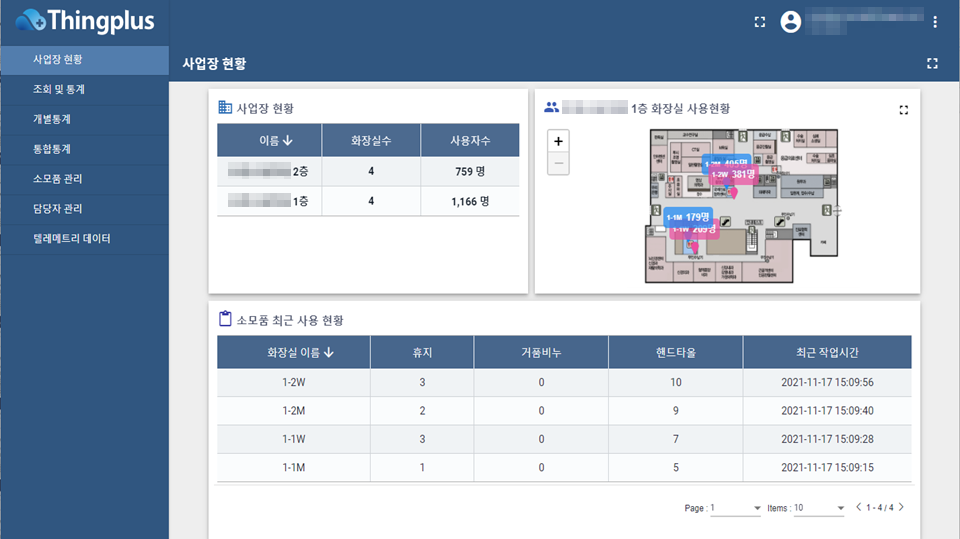
Restroom usage analytics
Safety and Environmental Management: Systems That Predict and Respond
For risks like fire, infectious disease, and flooding, responding after the fact is rarely enough to prevent losses.
IoT technology makes it possible to detect these risks in advance and to build systems that respond automatically or send alerts.
Across a range of safety and environmental applications, Thingplus supports the shift from after-the-fact response to advance prevention through sensor-based real-time monitoring and data analytics.
1) Switchgear Fire Management
The problem:
Electrical rooms and switchgear are often called a blind spot for fire: early warning signs are hard to catch, and ordinary alarms cannot respond immediately.
The solution:
– Real-time detection of fire warning signs via temperature and smoke sensors
– Real-time monitoring of smart automatic fire extinguishers
– Region-by-region device status analysis and an alert system
The results:
– Fires detected in advance with immediate response possible
– Extinguishers kept in optimal operating condition
– Cost savings by preventing false activations
– Unmanned, contact-free safety management for hazardous areas
“Detecting a fire is no longer enough. What is needed is a smart system that suppresses it automatically.”
2) Worker Temperature Monitoring (Smart Patch)
The problem:
After COVID-19, the need to monitor workers’ health in real time grew, but daily questionnaires and manual temperature checks were inefficient and often missed people.
The solution:
– Automatic temperature measurement through smart patches
– Alerts when a temperature anomaly is detected
– Location data and temperature statistics
– A temperature management dashboard covering every site
The results:
– Early response to infectious disease and prevention of spread
– Safety secured for front-line workers
– A foundation for sustainable safety management
– Adopted as a model case for smart disease prevention
“Even one worker’s temperature is important data. A single small sensor reduces risk across the entire workplace.”
3) Road and Stream Drainage Monitoring
The problem:
During heavy rain, poor road drainage caused hydroplaning and traffic accidents, while pollutants accumulating in storm drains affected urban water quality and the environment.
The solution:
– Sensors measure storm drain load in real time
– Warning alerts when thresholds are exceeded
– Data-driven nonpoint-source pollution analysis and automated reports
The results:
– Drainage issues recognized in advance, preventing traffic accidents
– Fewer site visits, cutting maintenance costs
– An established environmental quality management system for public facilities
– A practical example of smart city infrastructure
“Down to the unseen pollutants in the water, IoT can manage even the safety of a city.”
In safety and environmental management, the key is moving beyond simple monitoring to immediate alerts and automated response.
Thingplus collects data through sensors, then analyzes and visualizes it in the cloud to deliver a prevention-first management system.
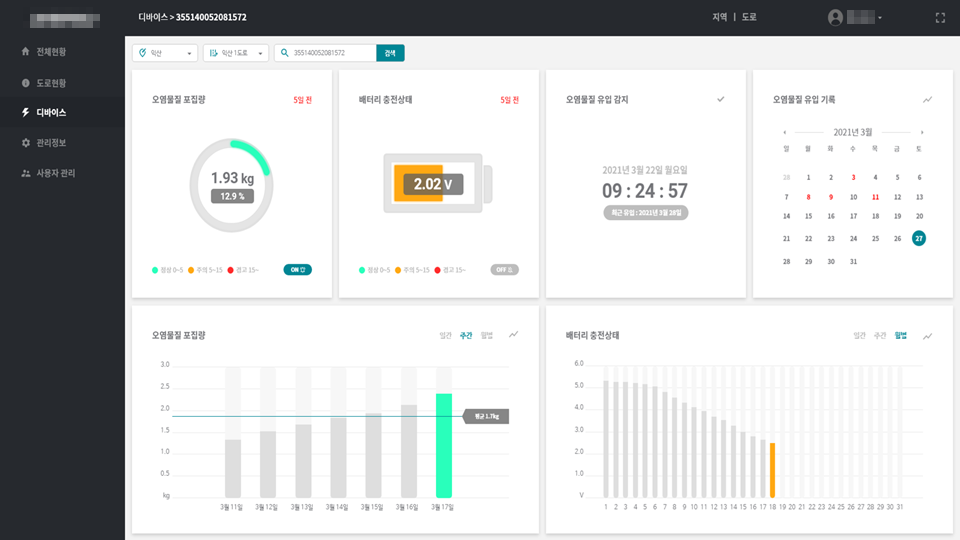
Drainage monitoring
Smart Farms: Managing Farms and Fish Farms with Data
Agriculture and aquaculture no longer rely on experience and instinct alone. Smart farms that sense environmental conditions such as temperature, humidity, soil, and water quality in real time and connect them to automated control systems are now a reality. The Thingplus IoT platform improves productivity, quality, and efficiency through sensor-based data collection and analysis and automated response.
1) Smart Greenhouse: Automated Environmental Control
The problem:
Workers had to manually measure and manage the environmental factors that affect crop growth, such as temperature, humidity, and CO₂ — a significant burden.
The solution:
– Sensors for temperature, humidity, soil condition, CO₂, and solar radiation installed in the greenhouse
– Real-time data collection and analysis
– Automated ventilation, irrigation, and shading through an integrated control system
The results:
– Precision control of the crop growing environment
– Reduced dependence on labor
– Lower risk of pests, disease, and poor harvests
– Higher yields and better quality
“Crop conditions are now managed with data. The greenhouse is no longer just a plastic tunnel.”
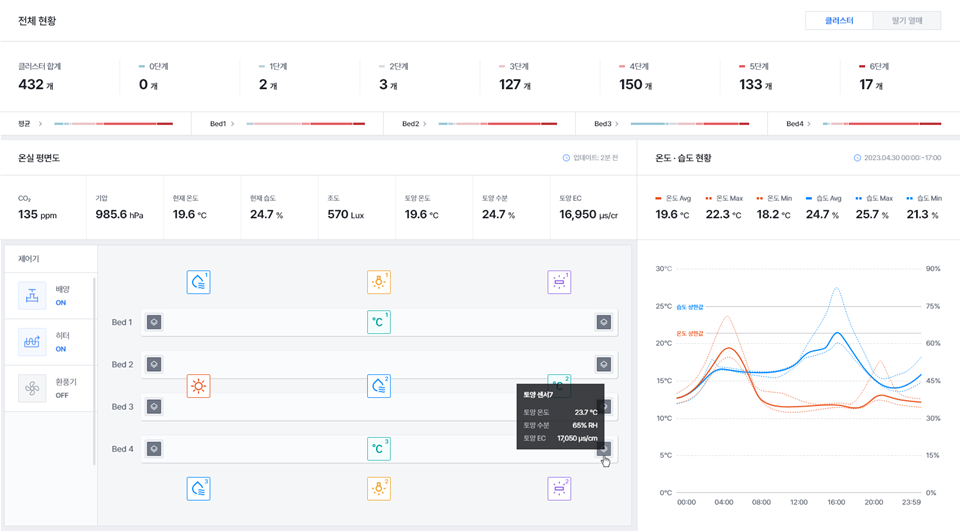
Smart farm dashboard
2) Smart Fish Farm: Real-Time Water Quality Monitoring
The problem:
Water conditions that directly affect fish mortality — temperature, pH, dissolved oxygen (DO) — had to be measured manually at intervals, making it hard to respond quickly to changes.
The solution:
– EC, pH, temperature, and DO sensors installed
– Long-range monitoring over low-power LoRaWAN communication
– A real-time water quality dashboard with configurable alerts
The results:
– Early recognition of and response to water quality anomalies
– Lower fish mortality
– Reduced labor costs and more efficient operations
– Stable productivity and quality
“Fish farms have entered the era of real-time monitoring. IoT notices changes in the water first.”
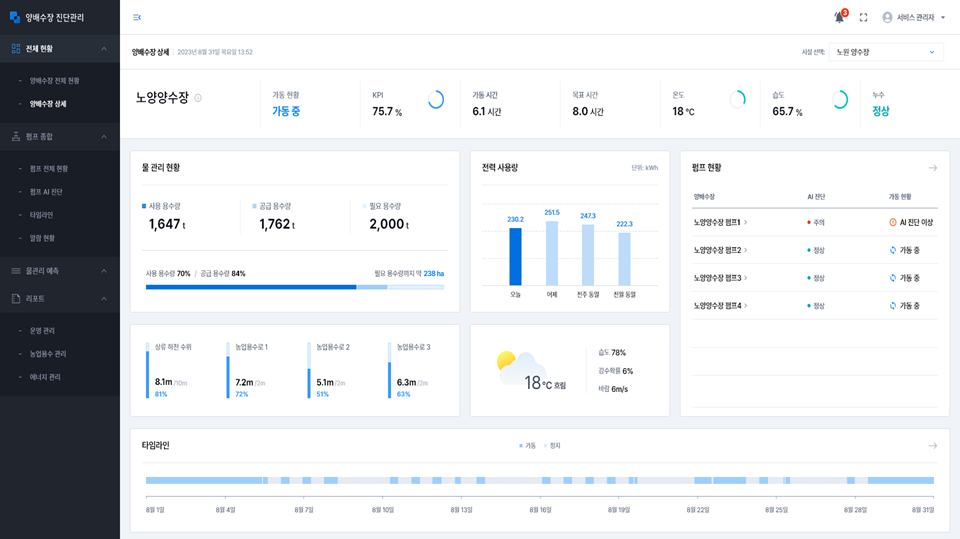
Fish farm management dashboard
The Practical Benefits of IoT Adoption
The many field cases built on the Thingplus IoT platform all carry a single, common message:
Reveal the problems you could not see through data, and let the system, not a person, respond first.
The technologies differ case by case, but the benefits they create fall into five broad categories.
1) Lower Operating Costs & Higher Productivity
– Equipment failures prevented through predictive maintenance
– Fewer site visits, cutting travel and maintenance costs
– Energy efficiency management, optimizing power use
2) Digital Transformation of People-Centered Work
– Automation of repetitive guidance, reporting, and inspection tasks
– Minimal management headcount, freeing people for higher-value work
3) Better Customer Experience and Satisfaction
– Faster CS response, fewer customer complaints
– Greater user convenience in stores and public facilities
– Marketing strategies built on customer behavior data
4) Early Recognition of and Response to Risk
– Early detection of hazards such as fire, infectious disease, and flooding
– Rapid response through automatic alerts and remote control
– A safety management system centered on accident prevention
5) A Foundation for ESG Management
– Energy savings, pollution monitoring, and waste prevention
– Smart operations that strengthen public value and sustainability
– Lower adoption costs through government support programs
IoT, in short, is not simply about connecting machines. It is a catalyst for digital transformation that changes how you operate, how you respond to incidents, how customers experience you, and how your company meets its responsibilities.
Closing Thoughts
IoT is not a matter of choice.
It is a survival strategy — one you must adopt to stay competitive, prepare for uncertainty, and earn your customers’ trust.
As the Thingplus cases show, IoT is especially valuable for organizations like these:
– Manufacturers with many processes and much equipment
– Work environments where safety and hygiene are critical
– Retail and service businesses with offline customer touchpoints
– Organizations pursuing energy savings and ESG
You do not need to automate everything from day one.
It is fine to start with a single sensor and a single monitoring screen. What matters is starting to see your field data.
And you can take that first step with Thingplus.
“IoT is not just a technology. It is a new set of eyes that changes the field.”