Factory Energy Management System (FEMS) Market Size Analysis
Market research on the Factory Energy Management System (FEMS) is surprisingly scarce. In Korea, the most recent domestic study is the 2013 Survey on Domestic EMS Adoption published by the Ministry of Trade, Industry and Energy in 2014; overseas, EMS market data exists, but reports that cover FEMS specifically and in detail are hard to find.
So this time, following July’s post on the latest FEMS trends and market analysis, we will gather the publicly available data on the global FEMS market and then estimate the size of the Korean market from domestic sources.
The Global FEMS Market
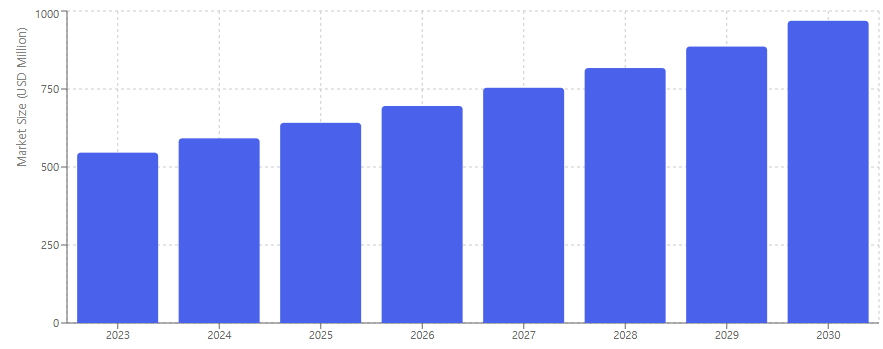
The global factory energy management system market was estimated at USD 546 million as of 2023, and is projected to grow at a compound annual growth rate (CAGR) of 8.4% over the 2024-2030 forecast period to reach USD 968.6 million by 2030. The source is ‘Factory Energy Management System – Global Market Share and Ranking, Overall Sales and Demand Forecast 2024-2030‘.
Meanwhile, another report, ‘Global Factory Energy Management System (EMS) Market Report Offering Dynamic Business Growth 2024- 2032‘, estimates the market at USD 1,143.23 million as of 2023 and forecasts a CAGR of 9.25% over 2024-2030, reaching USD 2,123.76 million in 2030.
With a twofold difference between the two reports’ estimates, it is hard to place full confidence in either one, but both agree in expecting a high compound annual growth rate.
The FEMS Market by Region
Another report, ‘Factory Energy Management System (EMS) Market Size Predictions Based on Regional Trends’, publishes its market outlook broken down by region. The Asia-Pacific region, the one of greatest interest to us, is growing the fastest.
Asia-Pacific: Rapid Adoption and Growth
EMS adoption is rising quickly across Asia-Pacific, with countries such as China and India recognizing its value. Adoption jumped a remarkable 40% over the past year, driven largely by rising energy costs and the push for industrial competitiveness. The trend signals a strong commitment to smarter energy use.
North America: Leading the Market
North America leads the EMS (energy management system) market, propelled by strict regulation and the movement toward sustainability. Statistics point to a compound annual growth rate (CAGR) of 10% through 2030. Many factories are adopting EMS solutions to cut operating costs and comply with environmental standards.
Europe: Striving for Sustainability
In Europe, the transition to renewable energy is unmistakable. Countries such as Germany and the United Kingdom are using EMS to integrate solar and wind energy into their production processes. A recent survey found that 65% of European manufacturers are investing in EMS technology, showing a strong commitment to sustainability.
Latin America: An Emerging Market Opportunity
Latin America is emerging as an important player in the EMS market. As their industries modernize, countries such as Brazil and Mexico are focusing on energy efficiency, motivated by economics and environmental policy. Recent data shows that 30% of companies in the region plan to adopt EMS solutions within the next five years.
Middle East and Africa: Challenges and Innovation
Despite challenges such as infrastructure constraints, the Middle East and Africa are gradually embracing EMS technology. Oil price volatility is raising awareness of energy conservation. Organizations in the region are adopting cloud-based EMS solutions with real-time energy monitoring, aiming to improve energy management efficiency by about 25% within the next two years.
The Korean Market
As noted at the outset, there is no recent report that sizes the Korean FEMS market, but one government document offers a clue: the Energy Efficiency Innovation Measures for Small and Mid-Sized Companies for the Transition to a Low-Consumption, High-Efficiency Industrial Structure, published by the Ministry of Trade, Industry and Energy in December 2022. To quote one passage from the report:
– (MOTIE) FEMS construction and support program: (’23) KRW 6.52 billion, 75 companies supported
Industrial complex FEMS deployment program: (’23) KRW 21 billion, 210 companies supported
– (Ministry of SMEs and Startups) Carbon-neutral smart factory support program: (’23) KRW 3 billion, 15 companies supported
In other words, government support programs spent KRW 30.52 billion on FEMS construction in 2023. Adding private-sector spending gives the total market size: assuming roughly 1.5 to 2 times the government figure, we can estimate it at around KRW 45 billion to 70 billion.
Closing Thoughts
FEMS has established itself as an important solution in the pursuit of energy efficiency and sustainability, both globally and in Korea. The global market is expanding steadily at high growth rates, and the Korean market keeps growing as well on active government support and private participation.
With energy efficiency increasingly recognized as a decisive factor in corporate competitiveness, FEMS adoption is becoming a necessity rather than a choice. The market is expected to expand further alongside advances in FEMS technology, and this change will be an important step toward a sustainable future.
We look forward to the efficient, eco-friendly industrial environment FEMS will bring, and we hope interest and investment in this market continue.
✅ Related Content Worth Reading