What Is Smart Manufacturing? The Concept and Benefits of an Innovative Approach to Production
Manufacturing is changing fast. Smart manufacturing is the technological innovation at the center of this change — a production approach that leverages a range of the latest technologies to maximize production efficiency, improve quality, and reduce costs. In this article, we cover the concept and benefits of smart manufacturing, and how it differs from the smart factory.
1. The Concept of Smart Manufacturing
What is smart manufacturing?
Smart manufacturing is a technology that optimizes production processes by integrating advanced technologies such as artificial intelligence (AI), the Internet of Things (IoT), big data, and cloud computing. Where traditional manufacturing relied on human experience and manual work, smart manufacturing builds automated, data-driven systems to create a more efficient and flexible production environment.
Key Technology Elements
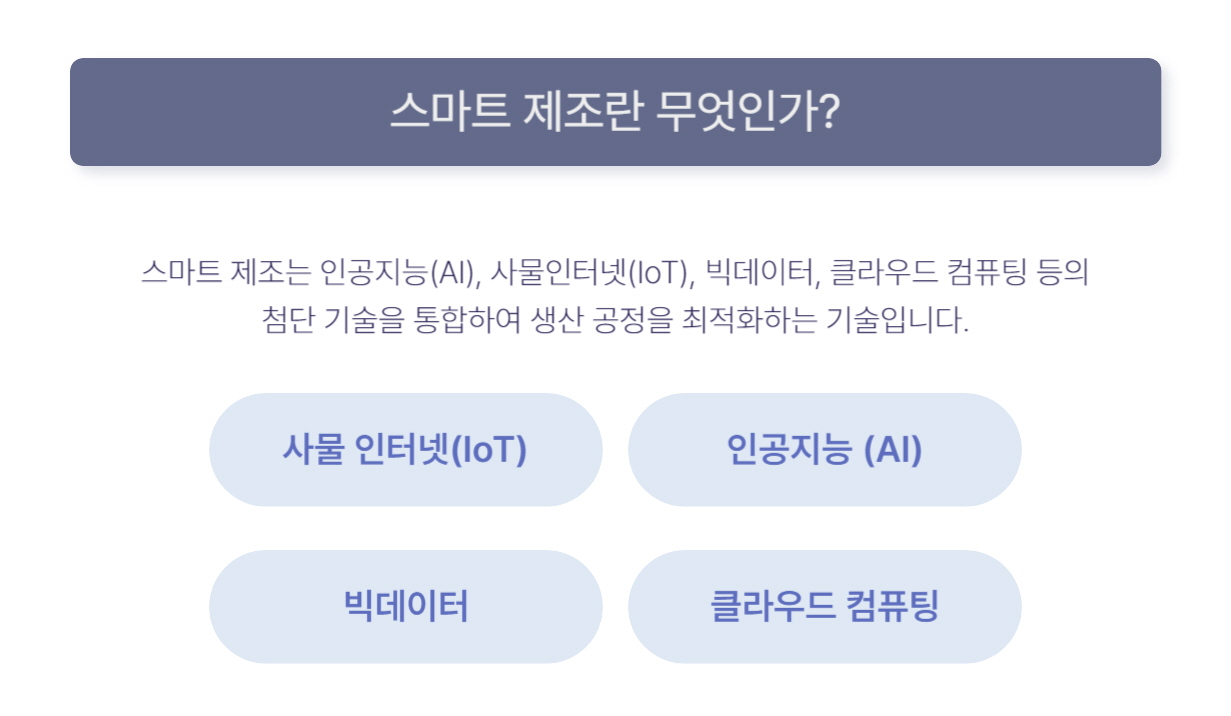 – Internet of Things (IoT): Devices across the factory are connected to collect data in real time, enabling monitoring and control of process conditions.
– Artificial intelligence (AI): Analyzes data to increase process efficiency, and uses predictive maintenance to anticipate and prevent machine failures.
– Big data: Analyzes large volumes of data in real time to suggest optimal production methods and respond quickly to market changes.
– Cloud computing: Stores data securely and makes it accessible anytime, anywhere, adding flexibility to production processes.
2. The Difference Between Smart Manufacturing and the Smart Factory
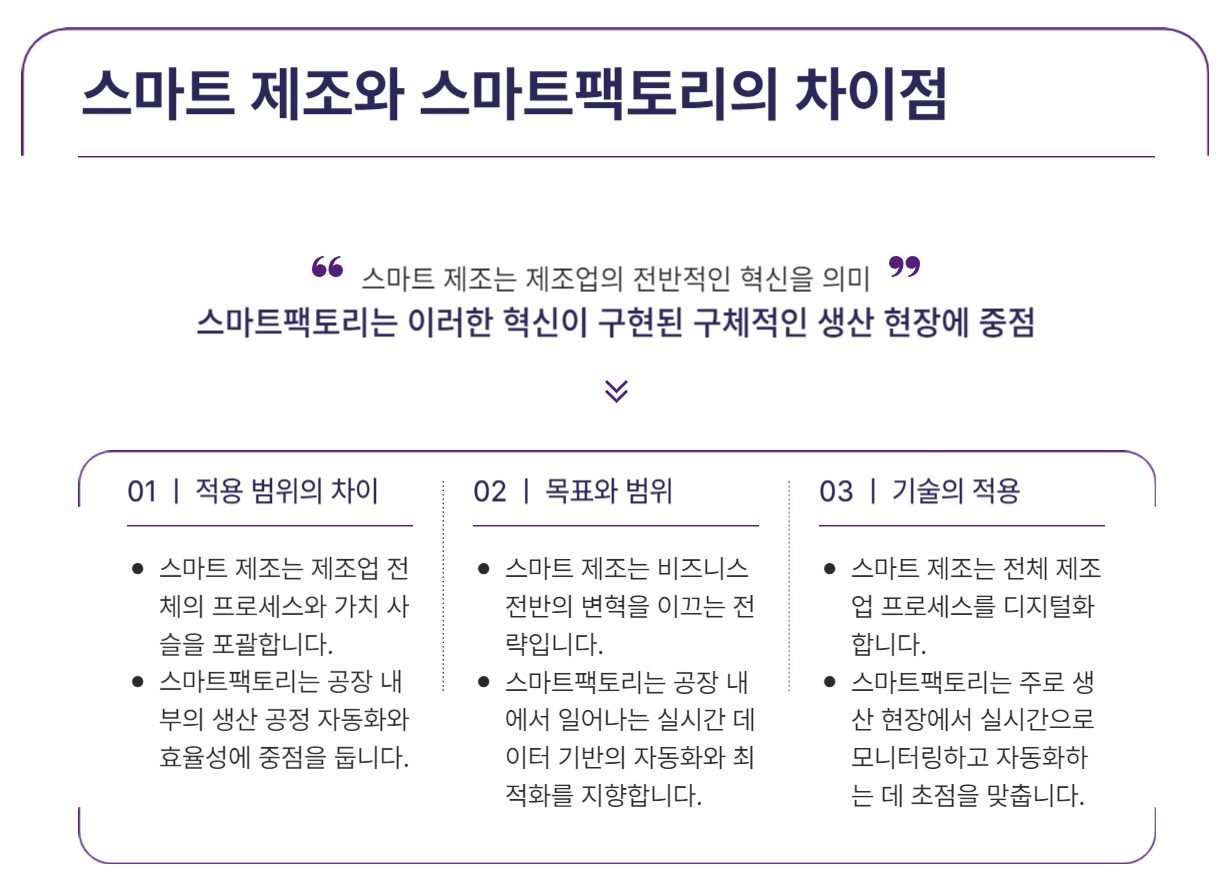
Smart manufacturing and the smart factory are often used interchangeably, but they differ in concept and scope. Smart manufacturing refers to the overall innovation of the manufacturing industry, while the smart factory focuses on the specific production sites where that innovation is implemented.
1) Difference in scope
– Smart manufacturing encompasses the entire process and value chain of the manufacturing industry. Its goal is to optimize the whole supply chain, from raw material sourcing to final product delivery.
– The smart factory focuses mainly on automating and improving the efficiency of production processes inside the plant. Its core is improving physical production processes by connecting manufacturing equipment, machines, and robots.
2) Goals and reach
– Smart manufacturing is a strategy that drives transformation across the entire business. It aims for comprehensive change, covering how the company operates, manages its supply chain, and serves its customers.
– The smart factory pursues real-time, data-driven automation and optimization within the plant. Its focus is on increasing efficiency and flexibility inside the factory.
3) How technology is applied
– Smart manufacturing digitalizes the entire manufacturing process by applying artificial intelligence, IoT, and big data analytics at every stage — extending to research and development, design, marketing, and distribution.
– The smart factory focuses primarily on collecting data on the production floor and using it to monitor and automate production equipment and processes in real time.
3. The Benefits of Smart Manufacturing
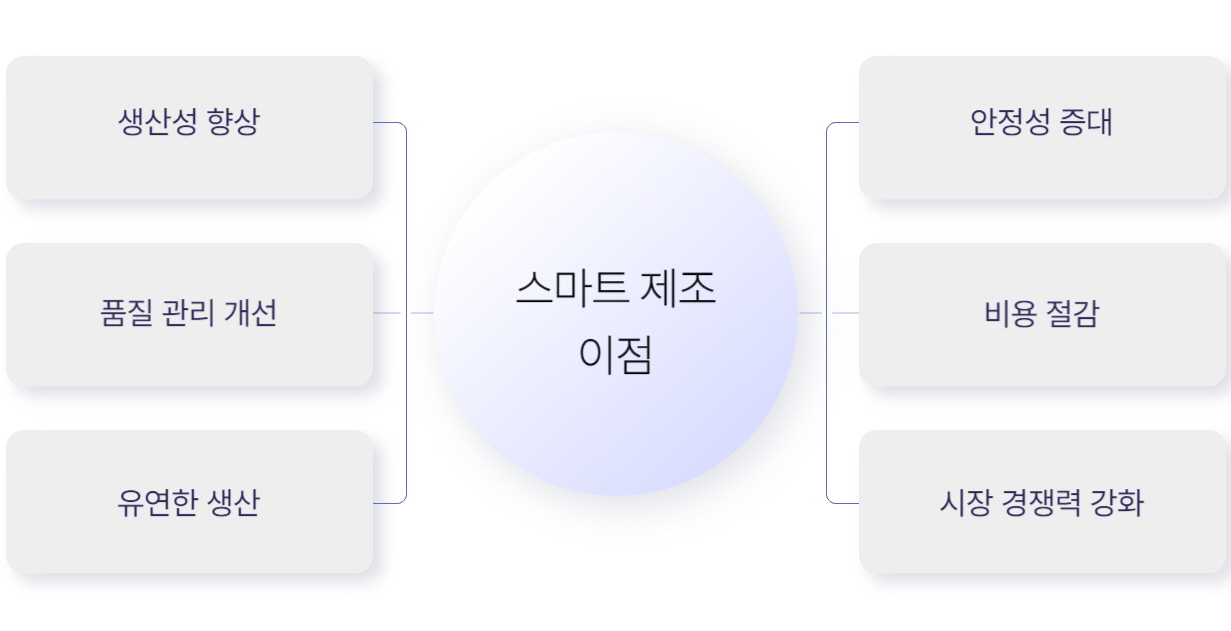
Smart manufacturing goes beyond simple automation — it is a technology companies must adopt to stay competitive. Its benefits include the following.
1) Higher productivity
Smart manufacturing uses automated machinery and robots to complete work faster and more accurately. This increases production speed and reduces costs.
2) Better quality control
Real-time data monitoring makes it possible to quickly detect and resolve product quality issues. This reduces defect rates and increases customer satisfaction.
3) Cost savings
Smart manufacturing enables more efficient use of resources, cutting energy and raw material costs. Predictive maintenance also minimizes equipment downtime, reducing operating costs.
4) Flexible production
Smart manufacturing provides a flexible production system that can respond quickly to shifts in market demand. It also adapts easily to customized customer requirements, enabling efficient production of a diverse product mix.
5) Improved safety
With AI and automation, robots take over hazardous tasks, improving worker safety. Real-time data monitoring also strengthens safety management across the workplace.
Closing Thoughts
Smart manufacturing is a core technology that overcomes the limits of traditional manufacturing and points the way to the factory of the future. By building innovative production systems powered by automation, AI, and IoT, companies can achieve higher productivity, lower costs, better quality, and more. It is important to understand the difference between smart manufacturing and the smart factory and to clearly recognize the goals and scope of each. With that understanding, manufacturers can drive sustainable growth.
✅ Recommended Reading
Key Technologies of Smart Manufacturing: The Convergence of IoT, AI, and Automation