The Future of Digital Twins and Smart Factories: Transforming Industry
A digital twin is a digital replica of a physical object or system, and the technology is driving innovation across industrial sites. The smart factory is a concept that creates an optimized manufacturing environment through automation and data-driven decision-making, and it is closely tied to digital twins. As these two technologies come together, they are producing remarkable gains in efficiency, productivity, and quality — not only in manufacturing but across many industries. So how will digital twins and smart factories evolve from here?
The Future Outlook for Digital Twins and Smart Factories
Digital twins will continue to evolve through their combination with artificial intelligence, cloud computing, and edge computing. AI-powered digital twins will enable more sophisticated data analysis and prediction, and can be applied not only to factories but to cities, energy, healthcare, and many other sectors. Edge computing in particular allows data to be processed on site without relying on the cloud, supporting fast decision-making and real-time response.
The smart factory will evolve into a fully autonomous operation. With every device and process in the plant connected, and real-time monitoring through digital twins combined with AI-based analytics, factories are likely to become fully automated with minimal human intervention. Productivity will rise dramatically, quality issues will be prevented before they occur, and people will be free to focus on more creative and strategic work.
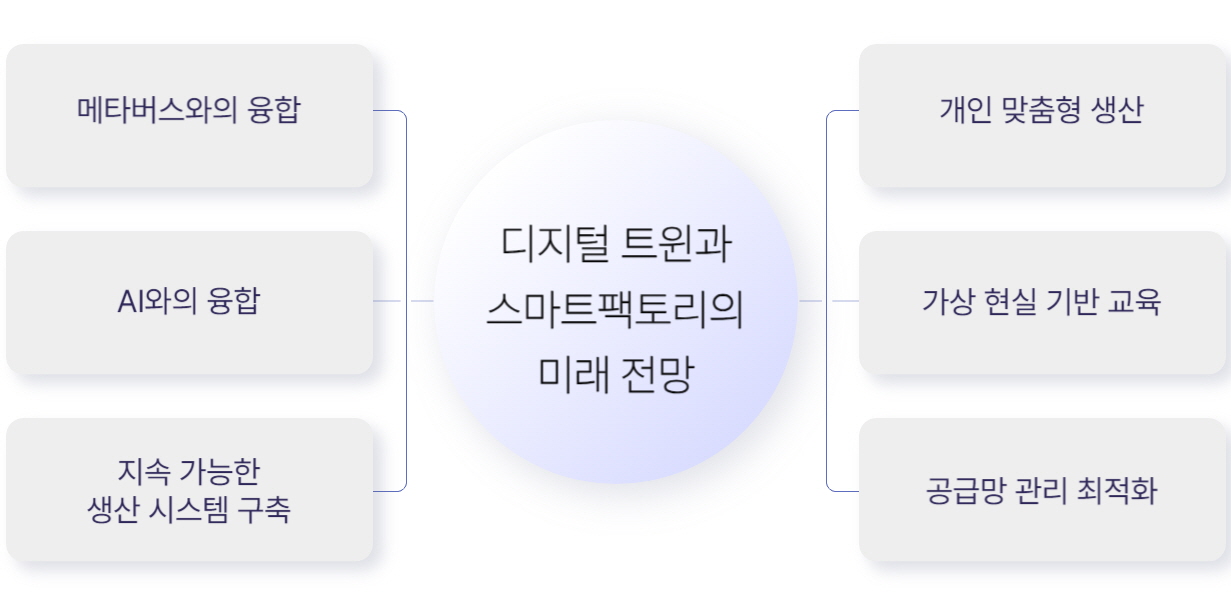
– Convergence with the metaverse : Digital twins can combine with the metaverse to create more immersive virtual spaces. Users can explore a real factory in a virtual space, run simulations, and solve problems.
– Convergence with AI : Through convergence with artificial intelligence, digital twins will become even smarter. Digital twins with self-learning capabilities can evolve on their own from data and improve prediction accuracy.
– Building sustainable production systems : Digital twins can contribute to sustainable production systems by optimizing energy consumption and reducing waste.
– Personalized production : Producing personalized products tailored to consumer demands becomes possible. Digital twins can support high-mix, low-volume production systems and flexible responses to fast-changing markets.
– Virtual reality-based training : Digital twins can power virtual reality-based training systems. Workers can experience realistic tasks in a safe environment and build their skills.
– Supply chain optimization : Digital twins can provide visibility across the entire supply chain and improve logistics efficiency. Optimizing inventory management and transportation planning reduces costs and improves customer satisfaction.
How Will Digital Twins Change Our Lives?
Digital twins are expected to be used well beyond smart factories, across a wide range of industries. In urban planning, construction, healthcare, and more, digital twins can power simulation, prediction, and optimization. The result will be safer, more convenient lives for all of us.
Within the smart factory, digital twins deliver the following benefits.

– Predictive maintenance : Digital twins monitor the condition of factory equipment in real time and detect early warning signs, preventing problems such as machine failures. This reduces maintenance costs and maximizes equipment uptime.
– Production process optimization : Digital twins analyze data from the entire production line to identify bottlenecks and suggest ways to fix them. This is critical to maximizing production efficiency.
– Design validation and optimization : Using digital twins at the design stage of a new product or process lets you test and optimize multiple scenarios before building a physical prototype. This saves time and money while improving product quality.
What to Consider When Adopting Digital Twins
To adopt digital twins successfully, the following points should be considered.

– Data quality : Securing accurate, reliable data is essential.
– Security : Thorough preparation against data breaches and cyberattacks is required.
– Talent development : Organizations need to develop people who can work with digital twin technology.
– Investment costs : Building a digital twin requires a significant investment.
Closing Thoughts
The combination of digital twins and smart factories is sparking innovation across industry. More companies will adopt these technologies in the future, and as the accuracy and performance of digital twins improve, smart factories will become increasingly autonomous. This will make it possible to achieve three goals at once: lower costs, higher productivity, and better quality.
Industry will therefore accelerate toward full digital transformation centered on digital twins and smart factories — playing a key role not only in manufacturing but also in logistics, energy, construction, healthcare, and beyond.
✅ Recommended Reading