Smart Factory and Digital Twin ┃ Concepts and How They Connect
The smart factory and the digital twin are two key concepts driving manufacturing innovation alongside the Fourth Industrial Revolution. The two terms are closely connected and play an important role in maximizing the efficiency and quality of modern manufacturing. In this article, we look at the fundamentals of the smart factory and the digital twin, and how the two are related.
What Is a Smart Factory?
A smart factory is a plant in which every element of the production process is digitalized and automated using information and communication technology (ICT). Advanced technologies such as IoT (Internet of Things), big data, and artificial intelligence (AI) collect and analyze production data in real time to increase operational efficiency. This improves the flexibility, speed, and quality of production while contributing to cost savings and higher productivity.
What Is a Digital Twin?
A digital twin is a digital replica of a physical object or system. Like a mirror, this digital replica reflects all the attributes, states, and real-world data of the actual object in real time, and is used to predict and optimize the performance of the real system through various simulations and analyses. For example, a digital twin of production equipment can predict maintenance timing or improve process efficiency.
For example, if you create a digital twin of a car, every component, design specification, and driving data point can be accurately reproduced in a virtual space. This enables a wide range of simulations — adding new features, predicting failures, or finding optimal driving routes.
How the Smart Factory and Digital Twin Are Connected
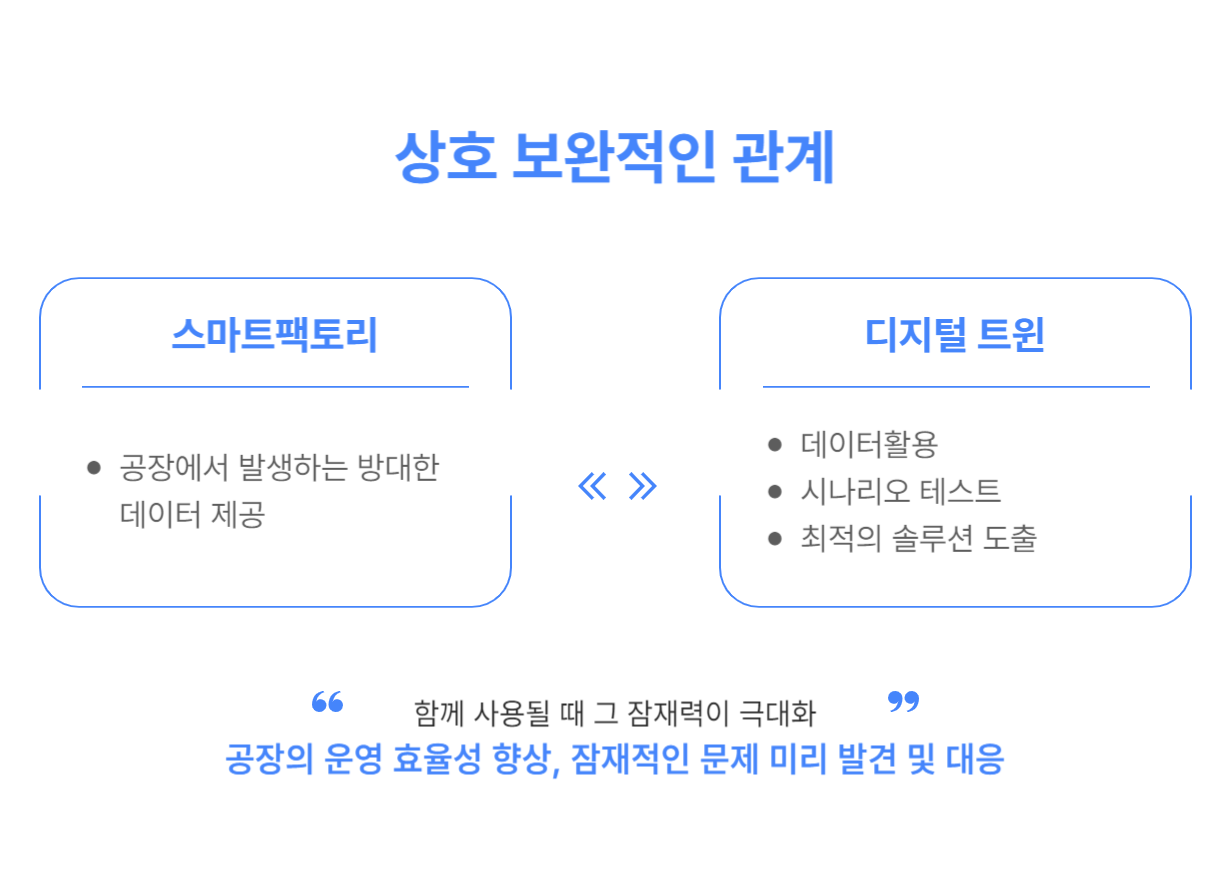
The smart factory and the digital twin form a mutually complementary relationship, and their potential is maximized when they are used together. The smart factory generates vast amounts of data from the plant floor, while the digital twin uses that data to test various scenarios in a virtual environment and derive optimal solutions. This increases operational efficiency and makes it possible to spot and address potential problems in advance.
Smart Factory and Digital Twin: What Is the Relationship?
The smart factory is an intelligent plant that optimizes manufacturing processes and boosts productivity using advanced technologies such as IoT, AI, and big data. The digital twin is one of the smart factory’s core technologies, performing the following roles.

– Real-time monitoring : Monitors the status of every machine, piece of equipment, and product in the factory in real time, detecting early warning signs and enabling rapid response when problems occur.
– Simulation : Before building a new production line or changing a process, virtual simulations through the digital twin can predict optimal outcomes and minimize risk.
– Optimization : Optimizes production planning, materials management, energy use, and more to increase production efficiency.
– Predictive maintenance : Predicts machine wear and takes preventive action before failures occur, avoiding production stoppages and reducing maintenance costs.
Examples of Digital Twins in the Smart Factory

– Production line design : Before building a new production line, digital twins are used to design the layout and predict productivity.
– Quality control : Monitors product quality in real time and analyzes the causes of defects to drive quality improvement.
– Energy management : Monitors energy consumption in real time and suggests optimal operating strategies to improve energy efficiency.
– Safety management : Identifies hazards in advance and improves safety systems to keep workers safe.
Closing Thoughts
The smart factory and the digital twin are core technologies leading the future of manufacturing. By bringing the two together, companies can build more efficient, flexible production environments and secure a competitive edge. It will be worth watching how the evolution of these two concepts continues to transform manufacturing.