Challenges in Building a Smart Factory and How to Solve Them
The smart factory is a core technology leading the future of manufacturing, capable of maximizing productivity and efficiency. Building one, however, means facing a range of challenges. In this article, we focus on the major problems that can arise when building a smart factory and the solutions for each.
1. The Difficulty of Technical Integration
A smart factory delivers results only when its many IoT (Internet of Things) devices, sensors, and software systems are connected organically. Integrating new technology with existing legacy systems, however, can be complex and time-consuming. This integration challenge is one of the biggest obstacles to building a smart factory.
Solutions

Solving technical integration problems requires a phased approach. First, thoroughly analyze the current state of existing systems and introduce integratable modules one step at a time. Choosing systems that use standardized protocols also minimizes the compatibility issues that can arise during integration.
2. Security Issues
Because a smart factory collects and processes large volumes of data in real time, it is highly exposed to cybersecurity threats. Hacker attacks and data breaches can deal a serious blow to productivity and damage a company’s credibility.
Solutions
Strengthening security requires network segmentation, data encryption, and regular security audits. Running training programs to raise employees’ security awareness is also important. Adopt the latest security solutions and real-time monitoring systems so potential threats can be detected and addressed quickly.
3. The Complexity of Data Processing and Analysis
A smart factory must process and analyze large volumes of data collected from many sources in real time. The volume and complexity of this data can make it difficult to manage and analyze.
Solutions

Adopting AI and machine learning is an effective way to make data processing and analysis more efficient. These technologies process large volumes of data quickly and accurately and help extract meaningful insights. Cloud-based data management systems can also provide flexibility and scalability.
4. High Initial Investment Costs
Building a smart factory requires a substantial initial investment. This cost burden can be a major challenge, especially for small and mid-sized companies.
Solutions
To reduce the initial cost burden, consider a gradual smart factory rollout. Rather than building every system at once, it is wiser to start with the most critical areas and plan additional investment based on the results achieved. Actively using government and industry support programs to secure funding can also be a good strategy.
5. Workforce and Skills Shortages
Building a smart factory requires highly specialized skills and people. Most companies, however, lack staff with these skills, making it difficult to move smart factory projects forward smoothly.
Solutions
Collaborating with outside experts is essential to solving the talent shortage. Companies should also run continuous education and training programs to upskill internal staff. Over the long term, partnering with universities and specialized institutions to develop talent can be an important strategy.
6. Resistance to Organizational Culture Change
Because adopting a smart factory brings major changes to existing ways of working and organizational culture, employees may resist. This is one of the main factors that can block a successful smart factory rollout.
Solutions
Minimizing resistance to cultural change requires a change management strategy. First, clearly communicate why the change is needed and what its benefits are, and involve employees in the change process. Provide ample education and training before new systems are introduced so employees can adapt to the change.
Closing Thoughts
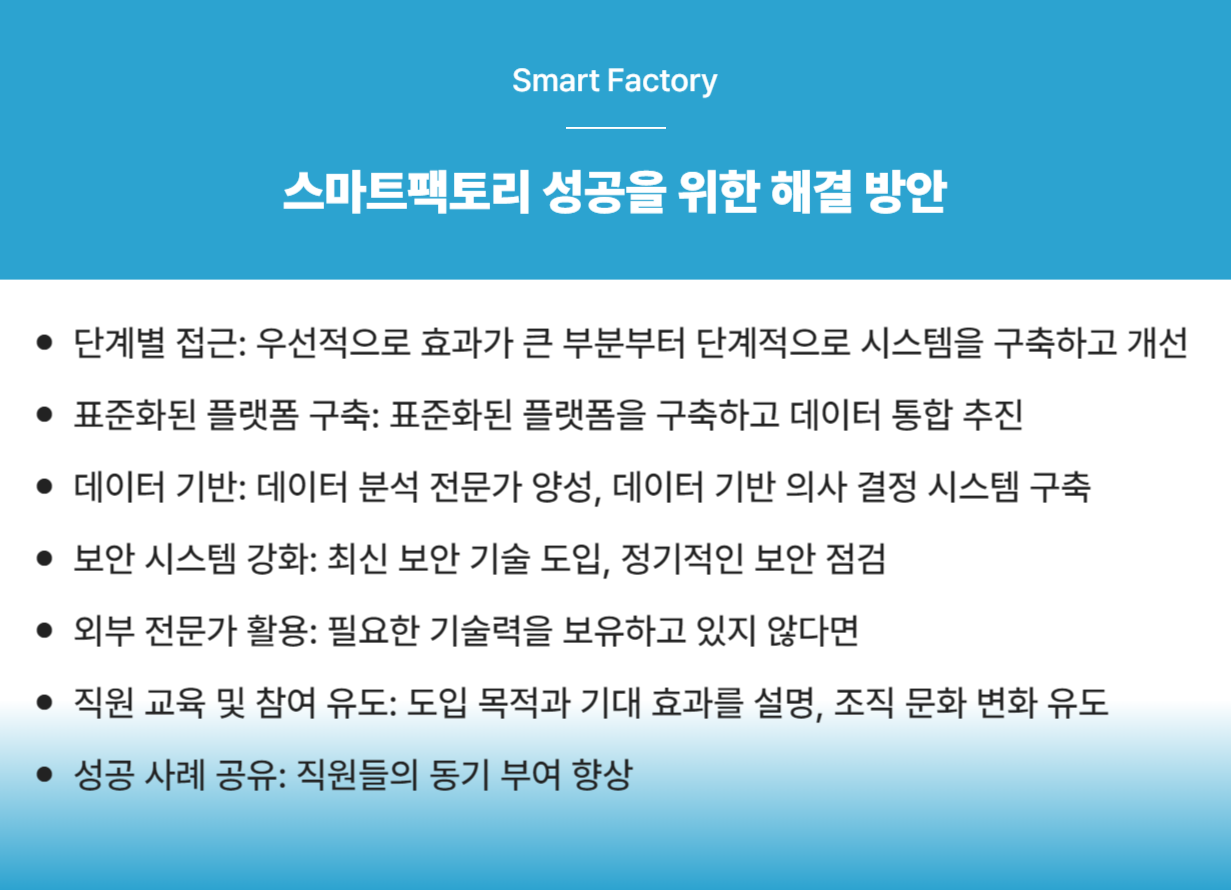
Building a smart factory is an essential step in manufacturing innovation, but it comes with challenges spanning technical integration, security, data management, cost, workforce and skills shortages, and organizational culture change. Solving these problems requires a phased approach and systematic preparation. Continuous education, technology investment, and change management are essential to a successful smart factory build — and through them, companies can equip themselves with a far more competitive production system.
✅ Recommended Reading