Smart Factory Market Trends, Outlook, and Implications
With the arrival of the Fourth Industrial Revolution, the role of the smart factory is drawing more attention than ever. The Fourth Industrial Revolution — which builds systems of mutual communication between production equipment and products through the Internet of Things (IoT) and optimizes the entire production process — is shifting the manufacturing paradigm from factory automation, where production facilities move passively according to pre-programmed instructions, to the smart factory, where production equipment actively decides how to work based on the product and the situation. At the heart of the Fourth Industrial Revolution is flexible production based on cyber-physical systems. Machine-to-machine communication and distributed systems are transforming traditional low-mix, high-volume production into customer-tailored, high-mix, low-volume production.
Advances in smart factory technology are expected to reshape the global manufacturing competitive landscape. In Korea, the Ministry of Science and ICT, the Ministry of Trade, Industry and Energy, and the Ministry of SMEs and Startups are pursuing policies to promote smart factory adoption. Expectations for the growth of the domestic smart factory market are rising steadily, and cases of collaboration with related companies are beginning to appear.
In this article, we review the state of the smart factory market and examine the challenges companies must solve and the effective strategies they need for successful smart factory implementation.
Smart Factories: The Future Competitiveness of Manufacturing
A smart factory is an automated, digitalized plant that integrates every stage of production, from product planning to sales, using ICT (information and communication) technologies such as the Internet of Things (IoT), artificial intelligence (AI), and big data, producing customer-tailored products at minimal cost and time. The smart factory improves productivity and saves energy through process automation and a flexible production system that supports high-mix production, while also aiming for a human-centered working environment. It is a concept that raises efficiency across the entire product manufacturing process, and the overall system structure is as follows.
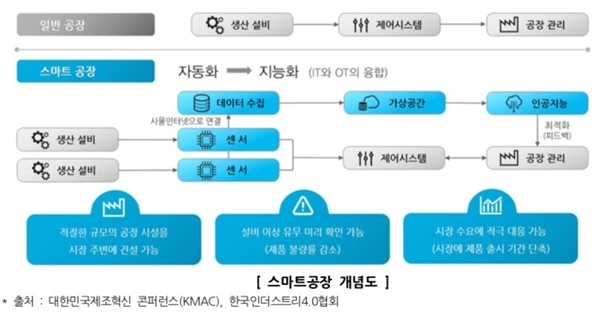
Smart factory concept diagram / Source: Korea Manufacturing Innovation Conference (KMAC), Korea Industry 4.0 Association
The smart factory, continuously evolving in combination with AI and big data, is a concept distinct in nature from factory automation. In the era of factory automation, production equipment was controlled by a centralized system; in the smart factory era, each machine judges and executes the task appropriate to its individual process on its own. Furthermore, the various sensors and devices on the industrial site are evolving into AI production systems that gather data themselves and use big data analysis to push productivity to its maximum.
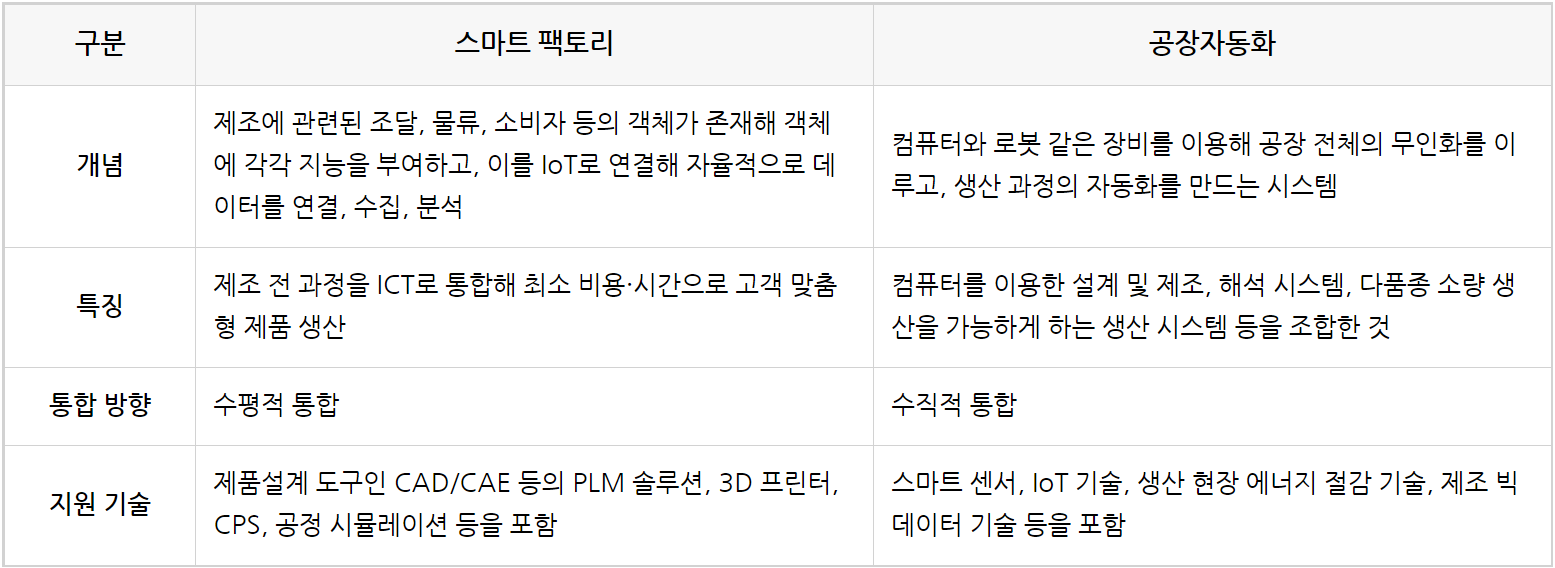
The Scope of the Smart Factory
Is it a ‘smart factory’ just because the production process changes? A smart factory encompasses every manufacturing-related process — from product planning and development to mass production, and from order to finished-product shipment. It includes not only application systems but every part of factory operations, down to shop-floor automation and control automation.
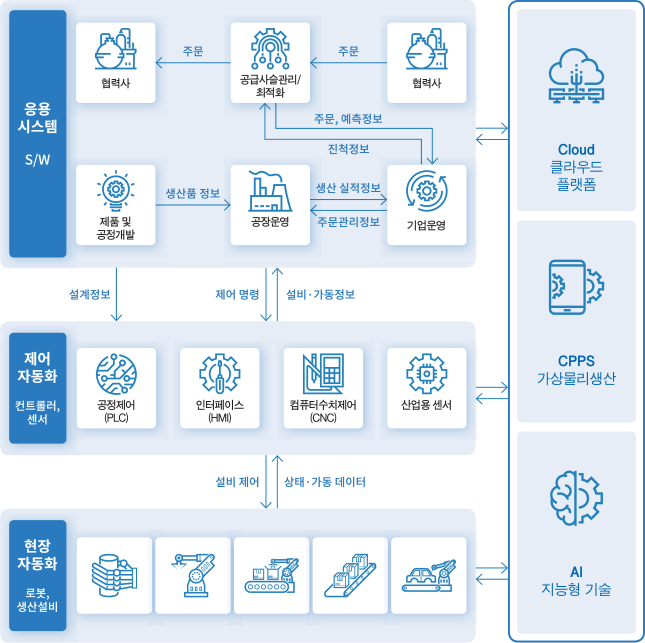
Scope of smart factory application / Source: Smart Manufacturing Innovation Promotion Agency
Requirements for Building a Smart Factory
These are the five essential requirements for building a smart factory and advancing it level by level.
- Digitalization of 4M + 1E
Each element of 4M + 1E (Man, Machinery, Material, Method, Environment) must be recognized as digital values in real time, provide measurable information, and be able to communicate through networking
- Integration
Aim for horizontal integration that enables end-to-end information exchange across social networks and the value chain, and vertical integration from the lowest level — machinery — up to the enterprise business level
- Intelligence
Solutions such as algorithms or artificial intelligence must be used to provide optimal or predictable solutions
- Creation of engineering knowledge
Information must be continuously acquired and stored, and on that basis manufacturing knowledge for automation must be progressively created
- Connectivity with smart systems
Must be able to connect with the smart products of the future in accordance with communication standards
Given the complexity of hardware construction and the difficulty of software implementation, a smart factory cannot be achieved simply by applying a few of the latest converged technologies on site. Therefore, for a flexible transition of existing processes and environments to a smart factory, you need to identify the specific technologies required and judge whether they can be applied in your current plant environment.
Smart Factory Market Size
The total global smart factory market was approximately 90.7 billion KRW as of 2020, with a compound annual growth rate of 4.2%. By region, the APAC (Asia-Pacific) market is the largest, while the overall size of North America and Europe is relatively smaller. Looking at annual growth rates, however, the expansion of the North American smart factory market exceeds the global rate, while the APAC region’s growth rate is comparatively modest.
In 2017, Korea accounted for 6.6% of the global smart factory market, but from 2018 its share plateaued at 6.0–6.1%. Accordingly, its compound annual growth rate has also fallen short of global and other national levels.
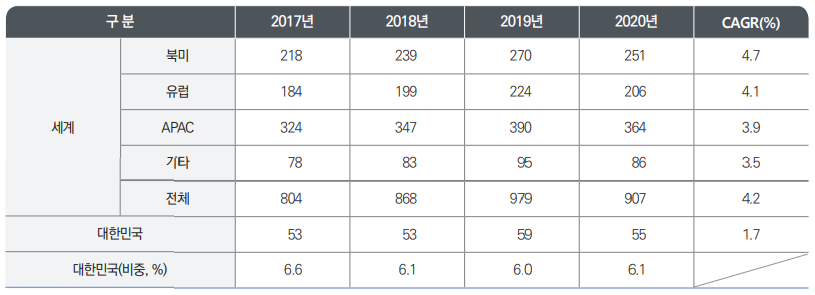
Smart factory market by year and region (Unit: 100 million KRW, based on a USD exchange rate of 1:1200)
However, looking at the smart factory market outlook from 2021 onward presented by MarketsandMarkets, Korea’s market share increases noticeably, and its compound annual growth rate over that period is also relatively high. This forecast is attributed to ① the advancement of manufacturing solutions across Korean industry driven by the digital revolution, ② the presence of numerous electronics companies with advanced technology, and ③ the establishment and execution of government policies promoting artificial intelligence and smart factories.
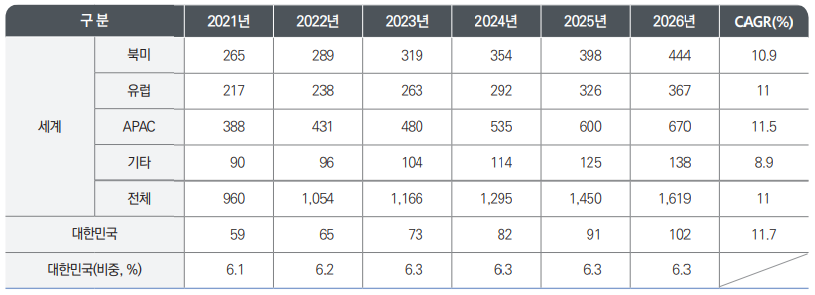
Smart factory market outlook by year and region (Unit: 100 million KRW, based on a USD exchange rate of 1:1200)
Looking at the regional outlook, growth rates of 8.9%–11.5% stand out, far exceeding the 3.5%–4.7% compound annual growth rates of 2017–2020. The APAC region’s advance is especially striking in both size and growth rate, with other regions showing similar annual growth. The total smart factory market in 2026 is projected at 161.9 billion KRW; compared with 80.4 billion KRW in 2017, the market doubles in size over ten years.
The domestic IT solution market for smart manufacturing was tallied at approximately 2.2 trillion KRW in 2022. With a growth rate of about 18%, it is projected to reach roughly 2.6 trillion KRW in 2023. Given how quickly new IT technologies are developed and adopted, success in 2023 is expected to hinge on advanced technology development — such as MES+ for AI-powered real-time productivity and defect analysis and optimization, and whole-value-chain optimization through integration between existing systems like ERP, SCM, and MES.
The Smart Factory by Maturity Level
Is it a ‘smart factory’ just because the production process changes? A smart factory encompasses every manufacturing-related process — from product planning and development to mass production, and from order to finished-product shipment. It includes not only application systems but every part of factory operations, down to shop-floor automation and control automation.
Smart factories are classified by ‘system smartization level (Basic – Intermediate 1 – Intermediate 2 – Advanced)’ according to the degree of ICT utilization and capability.
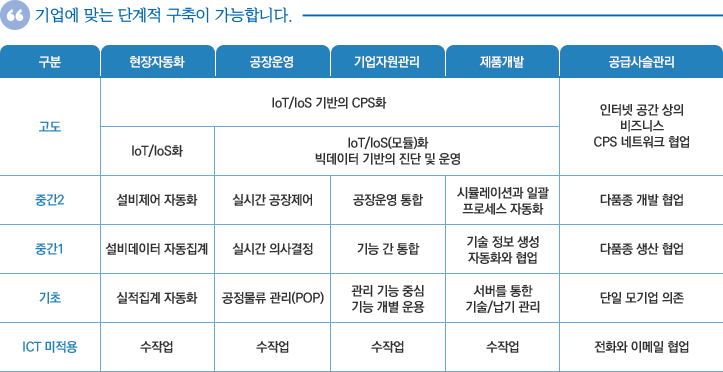
Domestic smart factories are divided into five levels in total, as shown above, and phased implementation is encouraged for companies that find it burdensome to adopt every stage of the smart factory from the start. The government is running a variety of programs for smart factory construction aimed at upgrading aging processes, ensuring safety, and improving working conditions; combined with market shifts and technological advances, many companies are now pursuing and implementing smart factory adoption. Effective smart factory construction requires not only the capabilities of the technology supplier but also the adopting company’s thorough self-assessment and active cooperation.
Reasons companies hesitate to adopt smart factories include burdensome costs, concerns about data leaks, and vague fears about environmental change. Nevertheless, transforming traditional manufacturing plants into smart factories will establish itself as an essential choice for long-term cost reduction, profit creation, and the advancement of the business operating environment — and companies that adopt early and accumulate know-how in smart factory operation will be positioned to achieve sustainable growth in their industries.
Implications
There is no need to worry about the advanced level from the very first step of considering smart factory adoption. Because a smart factory can be implemented gradually according to a company’s capacity and circumstances, what matters is choosing and focusing on the level and functions appropriate to your situation. Many SMEs are currently building the basic level, which can be started easily at relatively low cost, and are satisfied with results that exceed expectations. Even at the basic level, you can monitor equipment operating status and receive real-time information on power usage and electrical quality and safety. Before and after adopting a smart factory — would that not make a clear difference?
Think Big, Small Start!
Start data-driven manufacturing innovation with Thingplus.
Daliworks helps manufacturers implement smart factories through the Thingplus AIoT platform. Thingplus is a SaaS platform that generates, collects, integrates, analyzes, and utilizes data, delivering customized AIoT services through differentiated white-labeling features such as the Dashboard Organizer, Widget Composer, and Rule Editor.
Thingplus converts key equipment and system data from the physical environment to the digital environment through data digitization — the prerequisite for digital transformation. Beyond real-time data monitoring, it provides integrated management of equipment and device operations and data control, helping you manage operational risk and improve business efficiency with AI analytics.
Smart factory vertical services powered by Thingplus:
– Equipment Operation Monitoring Service
– Manufacturing Process Environment Monitoring Service
– AI Motor Diagnostics Service
Want to learn more about Thingplus? Contact us today!