DT Success Stories | Carbon Neutrality, Supply Chain Modernization, Healthcare Innovation
Digital transformation — known as DT or DX. DT has now become the surest way to respond to a rapidly changing environment by applying evolving digital technologies to business. This shift encompasses every type of digital application, from cybersecurity to artificial intelligence (AI) and automation. It is expected to lead companies to higher gross margins relative to revenue and greater profits. The primary goal of any digital transformation is to expand digital capabilities and make the business more efficient. The ultimate aim of these activities is to drive revenue growth.
Since the spread of COVID-19, large enterprises around the world have moved quickly on digital transformation, while small and medium-sized enterprises have struggled with a range of difficulties. Major countries are supporting SME digital transformation through measures such as improving access to information, funding the adoption of digital technology, and strengthening digital capabilities. Overseas SME digital transformation cases fall broadly into three categories: improving production efficiency, enhancing customer experience, and introducing new business models.
Korean SMEs need all-out efforts to quickly grasp and leverage the global digital transformation trend and secure competitiveness. Companies should identify digital transformation initiatives from the perspectives of production efficiency, customer experience, and new business models, and build momentum by taking advantage of policy support.
With that in mind, here are digital transformation success stories to inspire SMEs.
Achieving Carbon Neutrality Through Digital Energy Transformation

Global energy company Shell is using digital transformation to catch two rabbits at once: business performance and carbon neutrality.
Energy giants like Shell are under pressure to cut carbon emissions. Shell is shaping its future technology strategy around new technologies such as blockchain, IoT, and edge computing, and working to achieve carbon neutrality by 2050.
In particular, the company is using artificial intelligence as a catalyst to reach its long-term environmental goals. It is driving digital transformation with a hybrid cloud and the Databricks data lake platform. Shell’s ability to use AI is rated as outstanding compared with other companies. Experts praise Shell for operating a dedicated AI organization (Center of Excellence) and participating in open-source projects such as OpenAI, assessing that it has already moved beyond the early stages of AI adoption.
On Shell’s AI team, hundreds of data scientists develop AI technology on Databricks’ Spark-based platform. They build algorithms for a wide range of uses: shortening the cycle time of subsurface processing, optimizing asset utilization, and predicting when various pieces of equipment will fail.
Shell monitors carbon emissions through data streams on the Databricks AI platform, and has already used data analytics to cut the carbon emissions of a single liquefied natural gas (LNG) facility by 130 kilotons per year. That is the equivalent of taking 28,000 vehicles off the road for a year. In the face of the climate crisis, low-carbon energy systems are set to attract even more attention.
? https://www.ciokorea.com/news/270903
Supply Chain Modernization Improves Productivity by More Than 50%

Lohia Group is using supplier visibility and spare parts traceability to help the company, its suppliers, and its customers all ‘win-win’.
With efficient supply chain operations becoming ever more critical to business success, India’s Lohia Group — which works with more than 2,000 suppliers and stocks more than 35,000 parts — was struggling to manage its suppliers and streamline its supply chain. Active in textiles and flexible packaging for more than 30 years, the company sells end-to-end machinery for those industries.
Without an integrated system, Lohia Group could not control vendor supply, and as a result inventory grew and imbalances emerged. There were also mismatches between inventory availability and customer deliveries. Even in the warehouse, there was no visibility into which stock was where.
The problem was made worse by the fact that lead times for certain parts needed to fulfill customer orders ranged from 4 to 8 months. Because parts took so long to deliver, customer requirements would sometimes change in the meantime. And since the company relied on Excel and email, processes could not be corrected quickly.
In addition, about 35% of the parts associated with each customer order are customized to the customer’s specific requirements. Long lead times and a lack of supplier visibility made planning the procurement of these parts difficult, and with no way to forecast demand, the company was stuck holding unbalanced inventory — too much or too little.
Improving Efficiency and Customer Experience Through Supplier Management
Lohia Group built a supplier management solution to manage inventory and create a win-win environment for Lohia and its suppliers. The goal of the solution was to automate most of the work done by the company and its suppliers, eliminating the manual effort required in the procurement process.
With the new solution deployed, Lohia can now see changes in real time — when inventory is unavailable, when a customer has not paid, or when a delivery is delayed. Every change is communicated to suppliers, who can pull schedules forward or push them back accordingly. Thanks to this visibility, the company reduced inventory by 10% and saved approximately 2.4 million dollars.
The supplier portal also automated tasks such as scheduling and gate entry, boosting productivity and efficiency. Schedules are generated automatically through MRP (material requirement planning), providing visibility 3 to 4 months ahead. This helped the company plan raw material requirements in advance and deliver parts on time; as a result, parts shortages fell by 15% and productivity increased 1.5-fold. Customer deliveries also improved significantly, building trust.
Custom features such as automatic scheduling and FIFO (first-in, first-out) inventory valuation were also built. To help suppliers adopt the solution, Lohia assigned a support team to each supplier for 2 to 3 days to train them on using the portal. By showing suppliers the benefits they could gain over the following 2 to 3 months, the portal now has 200 participating suppliers providing 80% of its parts.
Improving Productivity by Streamlining Warehouse Operations
Lohia Group also faced traceability problems with spare parts at its key warehouse in Kanpur, India. With inventory scattered across multiple locations and most processes handled manually, the operation suffered from inefficiency and inaccurate deliveries.
Another bottleneck was that contract workers were illiterate and the company relied too heavily on employee experience. To solve these problems and integrate supply chain logistics with warehouse and distribution processes, the company deployed the SAP EWM application in the cloud. It also optimized warehouse processes using barcodes, QR codes, and Wi-Fi-based RF-enabled devices, and synchronized warehouse processes by integrating them with tracking capabilities.
To secure traceability, the entire inventory was barcoded. The system can now identify which orders are ready to ship and in what sequence. Previously, no one knew where in the warehouse a given part was stored, wasting enormous amounts of time. Because the new solution provides routes and sequences, workers no longer wander the aisles.
Finally, the company implemented aATP (Advanced Available-to-Promise), which responds to order-related inquiries in sales and production planning. Available within the EWM solution, this capability provides answers based on current inventory and planned or expected stock receipt dates.
The result was improved visibility across the warehouse and inventory in transit. The EWM dashboard helps warehouse managers control inbound, outbound, inventory overview, resource management, and physical inventory. Where one person could previously ship 30–32 parts a day, one person can now dispatch 47–48 parts a day — a productivity improvement of more than 50%. The entire process is now 100% accurate, with no wrong supplies. Total processing time for inbound and outbound processes was also cut by 25%.
? https://www.ciokorea.com/news/269583
How Digital Transformation Is Changing the Medical Field
People want modern, specialized medical care. They want to go to world-class institutions like Memorial Sloan Kettering Cancer Center. At the same time, they want the intimate, connected, familial feeling of knowing — and being known by — their local doctor. This is the village doctor paradox.
But digital transformation can bring the two together. If we can blend and integrate clinical science, technology science, logistics science, behavioral science, and data science, we can resolve the village doctor paradox and deliver a next-generation care model that feels like a village doctor while providing access to specialized treatment. This is the future of healthcare — and the challenge of our generation.
Since the pandemic, interest in contactless healthcare has grown alongside the acceleration of the digital healthcare paradigm. A wide range of new medical technologies and solutions incorporating advanced technologies — contactless automation, IoT (Internet of Things), big data, and artificial intelligence (AI) — are drawing attention.
AI Makes Life Easier for Patients and Staff Alike
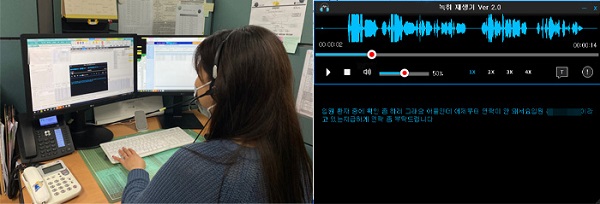
As artificial intelligence (AI) technology is actively adopted in medical settings, it is improving not only staff productivity but also the convenience of patient consultations and care.
Korea University Guro Hospital introduced an AI-based speech recognition consultation analysis solution and an appointment booking callbot solution.
The appointment booking callbot solution — the first of its kind introduced by the hospital — lets returning patients who do not require in-depth consultations check, change, or cancel appointments by talking with the AI callbot ‘KUMI’. It is available 24 hours a day, 365 days a year, and is easy to use even for older users unfamiliar with AI systems.
The AI-based speech recognition consultation solution lets patients leave a voice message outside regular consultation hours — at night or on weekends — or when consultations are delayed; the recorded voice is converted to text for the consultation staff, enabling more accurate and prompt guidance for patients.
The strengths of these solutions have translated into high patient satisfaction. According to a satisfaction survey conducted by Korea University Guro Hospital after deployment, satisfaction was high at 87.5%. Satisfaction with the convenience of using the hospital was especially high — patients can now handle appointment tasks (confirmation, changes, cancellations) themselves 24/7/365 — and the hospital’s enhanced smart hospital image scored 84.4%.
The call center response rate improved from 88% to 98%, and thanks to the higher response rate, unnecessary callbacks fell from 2,000 to 150 per month. Consultations per agent decreased by 30% and call duration was cut by 30%, improving the working environment for existing consultation center staff.
The adoption of AI-based solutions improved the overall service quality of call center appointment booking, increasing patient convenience and resolving much of the friction patients previously experienced — an outcome the hospital itself rates positively.
With AI-based solutions, patients gain convenience while staff focus on high-engagement work that truly requires consultation — ultimately increasing the efficiency of hospital operations.
? https://www.yakup.com/news/index.html?mode=view&cat=13&nid=276993
What Does the Shift to a Platform Strategy Mean?
Ultimately, the healthcare industry also needs to shift to a platform strategy. But to do so, you must understand what shifting to a platform strategy means and how to execute it. That starts with a deep understanding of what a platform should be.
A ‘platform’ is a set of pre-integrated capabilities that do something meaningful for someone. There are two keywords here. The first is pre-integration. This is far harder than post-integration. Deciding what to integrate in advance takes a great deal of technical leadership. The second is that it can only be done in someone’s context. A platform serves a specific group and delivers an integrated experience that is meaningful to that group. In short, you must think from the perspective of the end-user group and about which capabilities must be pre-integrated to meaningfully support that group.

DaVita is a healthcare giant that provides kidney dialysis services. DaVita supports world-class integrated care at scale and is transforming service delivery at every point of the patient journey. DaVita’s digital transformation strategy focuses on building a consumer-centered model that tailors chronic disease management to each patient’s constantly changing condition.
Kidney disease claims more than 250,000 lives each year and is a leading cause of death in the United States. About 37 million people in the US are known to have chronic kidney disease (CKD), yet many leave it untreated. Left untreated, CKD not only worsens but can lead to more serious problems such as hypertension, diabetes, chronic kidney failure, or end-stage renal disease (ESRD). For many patients at this stage, the solution is kidney dialysis or a transplant — both of which significantly affect quality of life. According to the US Centers for Disease Control and Prevention (CDC), 360 people in the US begin dialysis treatment for kidney failure every 24 hours.
There are more than 2,800 outpatient dialysis centers in the US and about 400 across 11 countries worldwide. This year alone, dialysis provider DaVita has served nearly 200,000 patients in the US. Treating chronic kidney failure patients through its large network of dialysis centers is the Fortune 200 company’s core business, but DaVita is also working to reduce the need for dialysis treatment and transplants, not just manage CKD. And here, IT plays a critical role.
DaVita’s digital transformation goal is the development of a new technology platform and clinical documentation system that enables deep integration across its entire application landscape and improves its ability to capture data throughout patient care. It took years to develop and is now being deployed, with completion expected in 2023. Through it, DaVita is also providing physician partners, clinical teams, and patients with digital capabilities to proactively improve the quality of care patients receive.