Cloud Strategy Through the 2023 Cloud Market Outlook
How Did Korea’s Cloud Service Market Fare in 2022?
In its recently published ‘2H21 Cloud Services Country Report-South Korea,’ IDC Korea announced that the domestic public cloud service market was projected to grow 17.8% year over year to reach KRW 3.0226 trillion in 2022.
The market is expected to record a five-year CAGR of 15.5%, reaching KRW 5.101 trillion by 2026. As enterprises expand their cloud-based workloads, growing requirements for cost and resource optimization, together with government cloud policies encouraging domestic cloud providers to participate in the market, have driven this growth.
Domestic cloud service technologies are showing significant growth across applications, data, AI and automation, and platforms. Most enterprises are replacing their next-generation applications with cloud-based ones, expanding convenience across the business. Companies offering mobile apps such as Baemin, Yanolja, and Socar are expanding integrated, customer-centric services around super-app strategies, while financial companies are securing new business touchpoints through MyData-driven technology. Large enterprises are also adopting cloud-based metaverse platforms across a growing variety of use cases.
Global Cloud Market Outlook for 2023
Gartner forecasts that global enterprise spending on public cloud will reach a total of $591 billion in 2023. That is a full 20% increase over 2022, when spending stood at $490 billion. IaaS revenue is expected to reach $150 billion in 2023, recording its highest growth rate ever—29% more than the $115 billion of 2022.
In Europe, the Middle East, and Africa (EMEA), public cloud service spending is projected to rise from $110 billion this year to $131 billion next year. That represents annual growth of 18.2%. Cloud software spending is expected to account for 34% of total enterprise software spending in EMEA.
The multicloud management market is also forecast to grow at a solid 25% per year through 2028. Key factors include the uncertainty of relying on a single cloud service, the need for higher levels of governance and security, and the ever-increasing complexity of cloud computing technology. The multicloud management market includes both AIOps and general cloud management tools, and the number and variety of tools will fundamentally continue to grow.
Korea’s Cloud Market Outlook for 2023
Korea’s public cloud market is projected to record a five-year CAGR of 15.5%, reaching KRW 5.101 trillion by 2026.
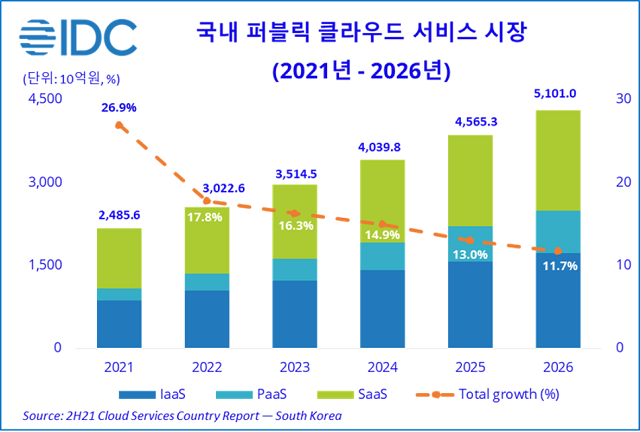
Korea’s public cloud services market / Source: IDC
Looking at individual segments, the IaaS (Infrastructure as a Service) market is expected to see continued market entry and data center expansion by domestic cloud providers as government cloud transition policies continue. In the PaaS (Platform as a Service) market, demand for RPA, AI, ML, and database-based PaaS offerings is expanding across industries, and the adoption of platforms that can turn them into business insight is expected to spread steadily. The SaaS (Software as a Service) market will see continued new demand for VDI supporting remote work environments and for stronger cloud and network security, while enterprise budgets are likely to remain highly volatile depending on economic conditions.
In turbulent times, companies typically cut back on new contracts and spending initiatives, yet the cloud market is expected to keep booming. As Korean companies continue to digitalize, benchmarks for assessing a company’s digital maturity—such as the Digital Agility Index—have emerged and are exerting significant influence on business strategy. This trend is a major factor shifting the cloud market’s center of gravity from IaaS toward PaaS and SaaS, and it is expected to have a positive effect on sustaining the cloud market’s continued growth.
Moreover, with a broad economic downturn expected, enterprise digitalization is likely to reshape the competitive landscape of the cloud services market. Public cloud providers should therefore respond proactively by continuously creating additional value they can deliver to enterprises.
Cloud Strategy for 2023
As recession fears mount, many companies are cutting parts of their budgets. According to Gartner’s report, however, cloud spending will keep growing through 2023. So what should enterprises do, and how should they respond to cloud computing’s continued growth? Let’s take a look.
The global pandemic drove most companies to move as quickly as possible into the safe harbor of the public cloud. The result is the explosive growth in cloud computing we have witnessed since 2019. Cloud migration will continue, with IaaS as the primary target, and no recession seems likely to slow it down. Companies cannot stop migrating to the cloud, because staff who have been laid off are hard to bring back. Compared with the days when every downturn meant workforce cuts—and IT staff were the first to go—the cloud is a far healthier response.
However, this has led to new problems, including a lack of cloud ROI. The direct causes were severe complexity, insufficient planning around strategic cloud cost management, and inadequate learning. Solving these problems is set to be a major task for 2023.
Looking more closely, the difficulty many companies now face with cloud computing is that there are simply too many cloud services to track and manage. This turns into a complexity problem, most of which arises in multicloud environments. Companies move to multicloud for many reasons. The problem comes when they pursue multicloud through best-of-breed configurations without any plan for how those services will be used after adoption.
This cloud complexity problem can be solved through the strategic use of technology and an improved approach to complexity management. What matters most is building a common technology layer on top of public cloud providers’ services, or on legacy and edge systems, to reduce excess capacity. This layer hosts common services such as a single security system, a single data management system, FinOps, and a single cloud operations system. This is not an attempt to solve every problem inside each public cloud provider’s walled garden. The technology must live in a common layer, known as the supercloud or metacloud.
These strategic cloud trends make it possible to resolve complexity by leveraging common services and a common control panel. At the same time, a common FinOps layer lets you monitor costs, apply governance, optimize, and ultimately keep cloud spending under control. Once the complexity and cloud cost management problems are solved, the ROI problem takes care of itself. The cloud services adopted over the past three years and new cloud-based applications will become better optimized and return more value to the business.
Cloud computing has transformed into a truly strategic technology and become an essential element of business success. In other words, cloud computing is now the ‘table stakes’ for taking a business to the next level. Given the scale of innovation expected across every industry, this is undeniable. Depending on who executes it, digital transformation is returning 100 times the investment—and business leaders and investors now know it.
What is interesting is that companies that succeed with cloud computing and those that fail spend the same amounts. What determines success or failure is mostly the skill of the people carrying out cloud deployment projects, not the technology itself. People still make the biggest difference.
Proper planning and a comprehensive strategy determine the success or failure of cloud computing. It is not a question of budgeting for cloud projects, but of properly understanding how cloud technology works. Enterprises must solve countless small problems, and by continually solving them they can unlock more strategic value from their use of cloud computing.
The change in 2023, therefore, will be about practical planning and execution, not merely discussing concepts. Most companies need to move faster. That means applying and committing strategy, budgets, and plans where they are needed—in short, using cloud computing technology more strategically. Either way, now is the time to end the cloud trial-and-error phase and set a new strategic direction.