Digital Transformation Trends Across Korean Industries
In this post, we look at digital transformation trends across major industries in Korea.
The Hotel Industry Pushes Ahead with Digital Transformation
As contactless services become part of everyday life, the hotel industry is turning to digital transformation to strengthen guest convenience. The aim is to appeal to the mobile-savvy MZ generation while expanding contactless services to reinforce infection control and speed up hotel check-in procedures.
Hotel guests grew accustomed to contactless services through the pandemic. Hotels are responding by running leaner teams efficiently, digitally transforming the portions of work that can be automated, and using hotel revenue management systems to raise the quality of guest response and service.
As part of this movement, LG Electronics is supplying its CLOi robot solution, accelerating the digital transformation of hotel services in earnest. The CLOi robot handles personalized concierge service in hotel lobbies, introduces nearby attractions, and delivers food within the lobby. KT has likewise supplied the N bot—a hotel robot combining its voice-based AI GiGA Genie with robotics—to venues including the Novotel Ambassador Seoul Dongdaemun. The robot moves around the hotel delivering requested items to guest rooms.
Meanwhile, during the period when overseas travel was restricted by COVID-19, demand for domestic tourism exploded and the ‘hocance’ culture of vacationing at hotels took root, sharply raising the share of reservations made through domestic OTAs at business hotels and luxury hotels alike. This brought to the fore the need for tools that manage selling prices across domestic and international OTAs to attract guests and manage guest reviews efficiently.
As digital transformation becomes the trend in the traditionally analog hotel and lodging industry, hotels are getting a major boost in operational efficiency and revenue through automated systems such as AI robots and hotel revenue management systems.
Paradise Hotel Busan Launches ‘Paradise TALK,’ the Industry’s First Integrated Chat Consultation
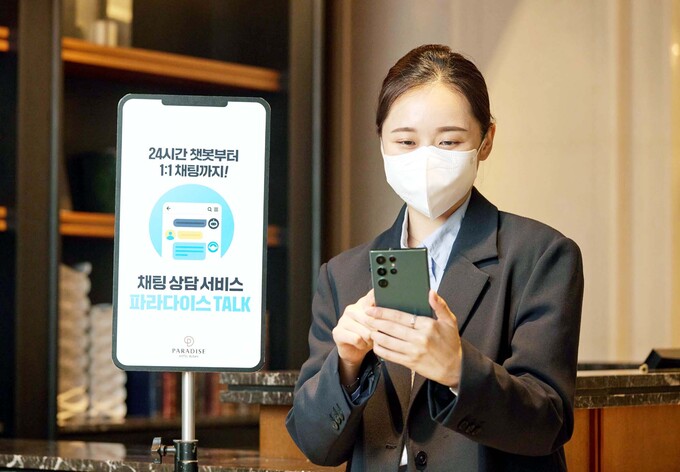
Paradise Hotel Busan launches Paradise TALK
Paradise Hotel Busan has launched ‘Paradise TALK,’ the hotel industry’s first integrated chat consultation service spanning multiple channels. The hotel has been building out advanced digital systems to improve guest service, including an ‘AI serving robot’ and ‘smart self check-in/check-out.’ It is also preparing mobile keys and a QR concierge, accelerating a full-scale digital transformation across its hotel services.
Lotte Hotel World Operates a ‘Guide Bot’ That Greets Guests in the Lobby
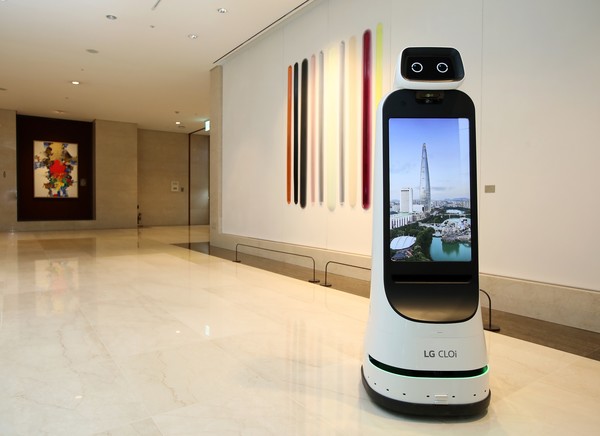
Lotte Hotel introduces the guide bot
Lotte Hotel World delivers a differentiated experience with a guide bot that welcomes guests in the lobby. Since last year, Lotte Hotel World has rolled out a range of digital transformation services, including delivery robot service, unmanned currency exchange kiosks, and AI speakers.
The guide bot provides personalized concierge service in the hotel lobby. It introduces the hotel’s main facilities and nearby attractions, and if a guest searches for a destination within the lobby, it escorts them there, guiding the way with voice directions. Guests can even use a docent service that explains the artworks displayed around the lobby. With this rich content, guests can enjoy a contactless hotel stay without any staff assistance.
Hanwha Hotels and Resorts Signs MOU with LG Electronics to Advance Digital Transformation
Hanwha Hotels and Resorts recently signed a memorandum of understanding (MOU) with LG Electronics covering technology exchange and robot solution deployment to advance digital transformation in hotel services. New forms of digital transformation technology will also be applied at ‘Matie,’ the lifestyle hotel brand debuting in the Osiria complex in East Busan. Every step—from reservation to check-in, in-room services, and check-out—goes digital, with the focus on improving guest convenience. In particular, Hanwha Hotels and Resorts plans to introduce an in-hotel delivery robot solution.
Furniture Industry: Online Value on the Rise
The landscape of the furniture industry is being redrawn. The corporate value of the online platform ‘Ohou (Today’s House)’ recently overtook the established furniture companies. It is the result of transcending a limitation inherent to manufacturers—carrying only their own products—and forecasts now point to a charge led by platforms with online-centered business structures.
Indeed, according to Statistics Korea’s online shopping trends, online furniture transactions reached KRW 5.6263 trillion last year, up 12.7% from the prior year (KRW 4.9944 trillion)—more than KRW 2 trillion larger than in 2019 (KRW 3.4756 trillion). An industry insider explained, “Over the past two years, COVID-19 and the ripple effects of real estate policy combined to rapidly grow the number of consumers buying furniture online. It was a tailwind for the whole market, but it also created the perfect conditions for companies that grew up online to take off.” Established players accordingly plan to go after the online market as well.
Hanssem Drives Digital Transformation
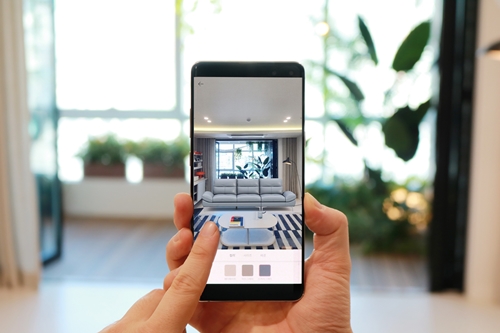
Hanssem Real 3D Viewer
Hanssem plans to transform itself into an IT-driven living-tech company that fuses online and offline. Through digital transformation, it intends to bring its existing offline strengths online as well. Its online mall has introduced a virtual reality (VR)-based service that lets consumers place furniture directly into their own spaces.
Hyundai Livart’s Next-Day Delivery Service

Livart next-day delivery service
Hyundai Livart is attacking the online market by strengthening its delivery system. It operates a ‘next-day delivery service’ that delivers purchased furniture the very next day, centered on the Seoul metropolitan area. It also invested KRW 139.5 billion to build a large-scale logistics center.
The furniture industry sees it this way: established companies, having confirmed the growth of the online furniture market, are racing to establish themselves in it, but manufacturing’s inherent limitation—the difficulty of carrying anything beyond their own brands—means platform companies with no restrictions on brand onboarding are likely, over the long term, to reshuffle the market rankings.
Financial Firms Aim to Become Comprehensive Financial Platforms!
Financial companies are accelerating their leap toward becoming comprehensive financial platform companies. With competition intensifying against big tech firms like Kakao and Naver—which are expanding their influence in financial markets armed with platforms of massive reach and user numbers—the moves reflect a sense of crisis: fail to create differentiated services that break down the boundary between finance and non-finance, and you can be pushed out of the market at any time.
From Shopping and Delivery to Used-Car Trading… Banks Make ‘Bold Moves’
Until now, financial holding companies and banks have focused on enterprise-wide ‘digital transformation,’ concentrating on large-scale reorganizations, talent recruitment and development, and system improvements—work that is still ongoing. Having built an internal foundation for digital transformation through much trial and error, banks and holding companies are now openly attempting to expand beyond traditional finance into lifestyle financial platforms.
Woori Financial Group Unveils an Integrated Auto Finance Platform

Woori Financial Group launches ‘Woori WON Car,’ an integrated auto finance platform
A project led by Woori Financial Capital with participation from three subsidiaries including Woori Bank and Woori Card, the service provides new-car loans, used-car loans, credit loans, and refinancing loans all at once with a single inquiry, and recommends personalized financial products. Registering a vehicle number under your own name also unlocks car management services such as vehicle information, current market value, and regular inspection schedules.
Earlier, on the 19th of this month, Woori Bank partnered with convenience store chain 7-Eleven to launch ‘My Convenience Store,’ the banking sector’s first service for ordering and delivering convenience store products through its mobile banking app; since August it has also offered ‘My Parcel,’ a one-stop parcel platform covering everything from booking to payment.
Hana Bank Rolls Out a New-Car Quote Service
Hana Bank partnered with auto finance platform Cardong and, on the 10th, added a ‘new-car quote service’ to its mobile banking app that easily calculates quotes by model and options. It lets users check auto financing as well as tax benefits and various subsidy programs in one place. Hana Bank had previously launched a direct used-car trading service, followed by a direct used-car auction service.
Shinhan Bank Launches a Food Delivery Platform

Shinhan Bank launches its food delivery platform ‘Ttaenggyeoyo’
With the launch of its food delivery app ‘Ttaenggyeoyo,’ Shinhan Bank became the first in the financial sector to throw its hat into the delivery app market. It charges no merchant onboarding fees or advertising costs and has lowered brokerage commissions to around 2%—on par with public delivery apps—aiming for a quick landing in the market.
A Showdown with Big Tech Looms
Banks are expanding lifestyle-oriented non-financial services to turn the tables in a platform competition where they have been on the defensive against big tech.
With clear limits to traditional financial platforms alone, the strategy is to bolt on lifestyle services one by one—even if they do not help profitability right away—to draw in new customers over the mid to long term and capture as much non-financial data as possible. On that foundation, they plan not only to create competitive, differentiated products and services but also to be reborn as independent, comprehensive financial platforms that are not subordinated to companies with powerful platforms like Kakao and Naver.
Experts predict that 2022 will be a year in which every firm pours everything into building platform competitiveness, because in the era of the Big Blur—where the boundary between finance and non-finance dissolves—the sense of crisis that failing to change means falling behind or being weeded out is stronger than ever.
Financial authorities are also signaling covering fire through deregulation to promote banks’ digital transformation and platformization. In announcing its 2022 work plan, the Financial Services Commission said it would consider expanding ancillary businesses such as platform operations so banks can smoothly enter new businesses. It also plans to provide support through the regulatory sandbox program, which exempts or defers regulations.
Food Ingredient Distribution Accelerates Digitalization
Recently, players from startups to conglomerates have been jumping in to speed up the digital transformation of the food ingredient distribution industry. Korea’s food ingredient distribution market is worth as much as KRW 55 trillion, yet most of it still runs on analog processes.
A wide range of companies are actively digitalizing the food ingredient market—from startups that manage operating costs with IT solutions, to B2B platforms with early-morning ingredient delivery systems, to AI-powered ingredient ordering systems.
CJ Freshway Applies an Ingredient Recommendation Algorithm
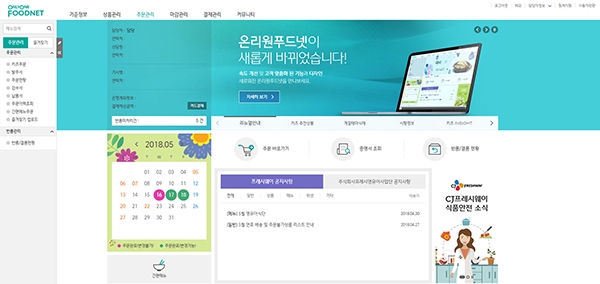
CJ Freshway, Online FoodNet
CJ Freshway’s online ingredient ordering platform ‘OnlyOne FoodNet’ is a dedicated system used by roughly 14,000 client companies when trading ingredients with CJ Freshway. OnlyOne FoodNet has accumulated vast data, from client information to purchase histories, and to put that data to full use it developed an AI algorithm specialized in recommending ingredients based on purchasing data.
Since introducing the personalized ingredient recommendation service, revenue generated through its ‘value-for-money product recommendations’ has reached about 90% of all product recommendation revenue. Playing on the fact that buyers usually repurchase familiar products rather than trying new ones, it recommends cheaper or more on-trend ingredients based on purchase data. The service is currently being piloted with select clients and will expand to all clients within the second half of the year.
Daesang Renews Its Comprehensive Food Ingredient Online Mall
Daesang recently revamped its comprehensive food ingredient online mall and renamed it ‘Best On.’ In line with e-commerce trends, the goal is to make online shopping for bulk ingredients more convenient.
Best On focuses on making shopping more accessible for food service professionals, adding specialized sections by business type and brand pavilions. It also introduced a personalized service that analyzes customer data to recommend the right ingredients, and a subscription delivery service that brings specific products on the dates customers choose. It is also launching an online-to-offline (O2O) service linking the online mall with physical stores: order by 2 p.m. and receive same-day delivery through a nearby offline store.
A Food Ingredient B2B Platform with Free Early-Morning Delivery from Wholesale Markets

Food ingredient B2B platform ‘FoodPang’
When restaurant owners order supplies through the app, the food ingredient B2B platform ‘FoodPang’ delivers them free of charge in the early morning, based out of wholesale markets in Seoul and Busan. Direct shipping from the wholesale market—without complicated middle layers of distribution—keeps ingredient prices reasonable. Same-day auction prices are conveniently updated through the app.