As ESG Management Spreads, IoT Takes Center Stage

Today, every company is paying attention to ESG (Environmental, Social and Governance) management. ESG was the common keyword in the 2022 New Year addresses of Korea’s major companies, and the government has made ESG disclosure mandatory for large corporations starting in 2025.
Regulation is not the only reason companies must embrace ESG management. Going forward, ESG is expected to play an even greater role in corporate value and valuation. The investment community has already made ESG a priority investment metric: as of 2020, ESG-based assets were worth 45 trillion KRW. And because ESG is a global trend, suppliers and stakeholder groups must also keep pace with the ESG movement if they do not want to fall behind in the GVC (Global Value Chain).
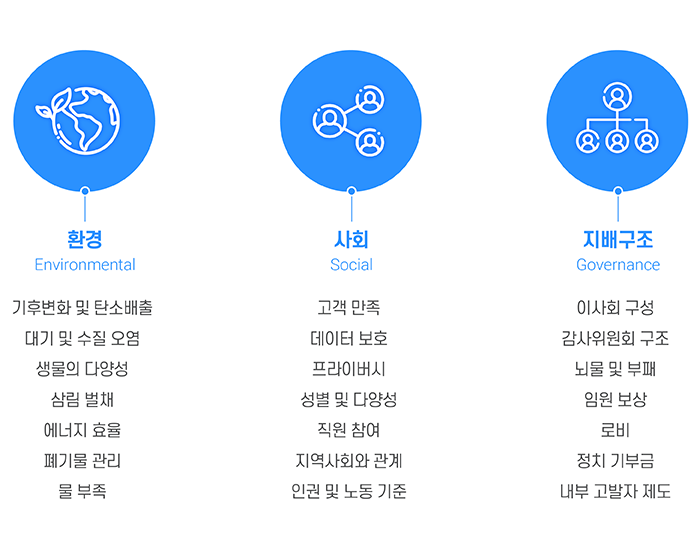
ESG stands for Environmental, Social, and Governance – a paradigm in which companies look beyond financial indicators such as revenue and profit to care for the environment and society and to pursue transparency in corporate governance. Fundamentally, ESG is a ‘value’ that pursues sustainability based on these three principles, but for companies subject to mandatory disclosure, it is also a kind of ‘standard.’
Many experts advise that ESG delivers the best results when it takes shape as a well-orchestrated system from a business perspective rather than as a matter of regulation. Ultimately, what matters is how well ESG is embedded in the business strategy over the long term. Each company is working to strengthen its ESG competitiveness in its own way – and IoT technology has become one of the most popular choices.
IoT as a Strategic Enabler of ESG
Whether used as an investment metric, a regulatory standard, or a management strategy, ESG demands quantified, measurable figures. That is why digital transformation is essential – and IoT is necessary – for companies seeking to realize ESG.
IoT helps make the collection and reporting of ESG metrics more accurate and streamlined. Environmental indicators such as carbon emissions, energy efficiency, water quality and waste management, and indoor air quality can be precisely measured and cross-checked using IoT sensors. This makes it easy for companies to determine whether they are meeting their targets or whether action is needed to improve efficiency.
IoT is also useful for improving ESG performance. By securing and monitoring accurate data with IoT sensors, companies can discover areas for improvement and capture opportunities for optimization. Setting alarms for when conditions drift out of the optimal range allows action to be taken proactively.
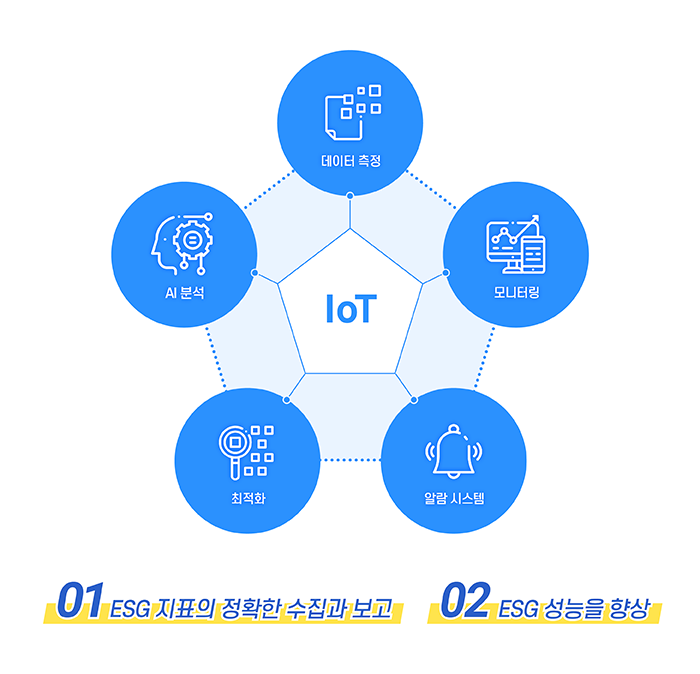
In manufacturing, the key ESG issue is reducing environmental impact. Applying IoT technology makes it possible to develop systems that cut carbon emissions, run on low power, and maximize energy efficiency. Specifically, monitoring and controlling the factory’s manufacturing environment through IoT devices improves equipment efficiency and reduces greenhouse gases, while adopting an EMS (Energy Management System) that meters the power consumption of key equipment, analyzes electrical energy usage, and monitors peak loads can raise energy efficiency.
Logistics, too, can cut carbon emissions by adopting IoT-based smart transportation systems – for example, managing the traffic conditions of transport vehicles and optimizing loads and delivery routes to shift toward eco-friendly logistics. IoT also offers answers to the safety issues that have recently become a hot-button topic. With a string of warehouse fires raising material losses and public concern, there are growing calls to create safer working environments for employees. With IoT sensors, warehouses can automatically detect whether workers are present and cut power accordingly, achieving energy savings and fire prevention at the same time. Going further, IoT services that detect fires from temperature changes and extinguish them automatically allow business risks to be managed preemptively.
IoT can also be actively applied to solving social problems. It is rapidly expanding into areas such as elderly-care IoT services that help prevent solitary deaths among seniors living alone, IoT monitoring solutions that serve as extra eyes for firefighters and police, and municipal IoT systems for managing vacant houses.
Daliworks, Korea’s leading IoT solution company, is actively developing ESG-support solutions based on its IoT platform Thingplus. Its environment-focused smart factory and smart energy offerings are designed to reduce carbon emissions, enable low-power operation, and maximize energy efficiency.
Daliworks also supports social contribution services that improve working conditions, give back to local communities, and protect the vulnerable. Representative examples include a smart patch service that measures and monitors workers’ body temperature in real time, a drainage monitoring service that tracks in real time the load of nonpoint-source sediment accumulating in road and stream storm drains, and an electric wheelchair safety management service that uses AI analytics to detect the rider’s safety status and any equipment anomalies.
Soonho Lee, CEO of Daliworks, said, “If IoT networks are used as a social safety net, they can admirably complement today’s safety net, which lacks physical resources. As ESG management deepens, moves to leverage IoT to realize corporate innovation and sustainable growth are expected to accelerate.”
by IT World