Wrapping Up DECENTER, the Korea-EU Joint Research Project
The project “Development of IoT-Linked Distributed Edge-Cloud Technology Supporting AI Applications,” carried out over three years by a Korean consortium led by the Korea Electronics Technology Institute (KETI) and an EU consortium led by FBK (a research institute in Italy), has come to a close.
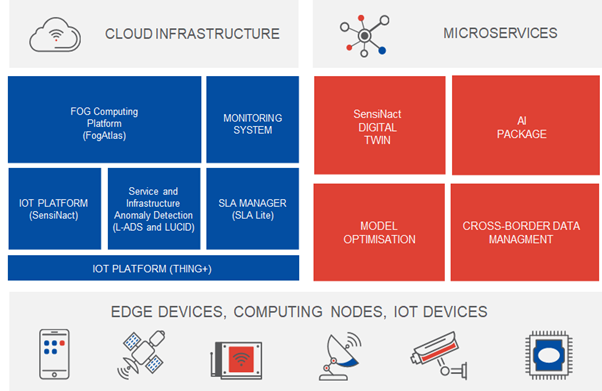
Key deliverables of the DECENTER project
The project was launched in June 2018 with the goal of developing IoT-linked distributed edge-cloud technology that supports AI applications through the processing of heterogeneous IoT data and distributed processing between cloud and edge, in order to enable the efficient development and adoption of AI services now used across many fields.
It was a challenging project that required considering many technologies together – cloud, edge, AI, and IoT – including fog computing for edge/cloud resource management, blockchain-based cross-border resource management, and distributed AI for IoT service integration. Collaborating with research institutions from countries as diverse as Italy, France, Spain, and Slovenia was no easy task either.
On the Korean side, KETI, Daliworks, Gluesys, LG Uplus, and Seoul National University took part in the project. Daliworks focused its research on the cloud/edge infrastructure architecture and the IoT platform, contributing primarily to the design of a microservices architecture that makes diverse AI applications easy to use.
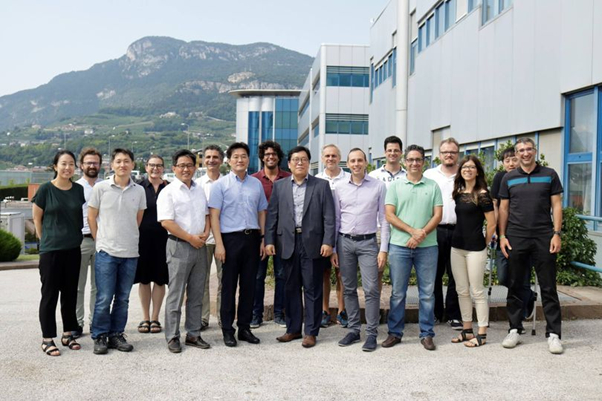
The first plenary meeting (FBK, Trento, Italy)
Starting with the first meeting in Trento, Italy, the project proceeded through conference calls every two weeks and produced a wealth of results, including core patents and papers as well as numerous software deliverables and standards proposals. Through four use cases, it demonstrated how the technology can be applied to real IoT services.
Regrettably, all offline meetings were cancelled from last year due to COVID-19, but everyone gave their best in their respective areas to deliver results, and the project was rated Excellent in the final EU review, which was held online. (The first review took place at the EU in Brussels, Belgium.)
Forming a consortium and collaborating with global research institutes gave us the opportunity to learn a great deal – systematic project management, management of research deliverables, and online collaboration practices – and we believe this experience will be a great asset for future global projects.