[Smart Cloud Show 2018] Cloud Services Evolve…
‘From Technology Focus to Business Fit’
Cloud services are evolving. Where the industry once pursued technical change through the ‘edge,’ overcoming drawbacks such as security and connection latency, it is now reinventing itself by finding the business areas where each cloud’s characteristics fit best.
At session presentations of ‘Smart Cloud Show 2018,’ held at the Westin Chosun Hotel in Sogong-dong, Jung-gu, Seoul on the 19th, information technology (IT) industry experts agreed that the future of the cloud can be found in business applications rather than technology.
Yoonseok Choi, Executive Director at IT market research firm Gartner Korea, said, “Every year we survey priorities among the world’s most promising technologies, and cloud is consistently ranked as a key area. Going forward, the cloud must focus on business value rather than technology.”
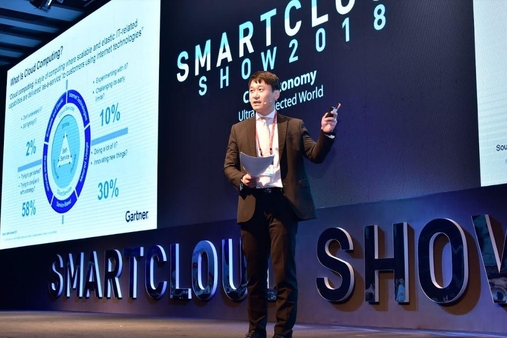
Gartner Korea Executive Director Yoonseok Choi speaks at the ‘Smart Cloud Show 2018’ event held at the Westin Chosun Hotel in Sogong-dong, Seoul on the 19th. / ChosunBiz DB
The cloud is storage where computer files are saved not on the machine where the work was done, but on central computers accessed over the internet. With the cloud, needed data can be retrieved anytime, anywhere – not just on the computer where it was created.
As of 2018, the cloud is divided by business function into IaaS (Infrastructure as a Service), SaaS (Software as a Service), and more. The greatest advantage of the cloud is that individuals, companies, and institutions can achieve cost efficiency through it.
Hyunseok Shin, Division Head at SK C&C, explained, “The ways the cloud is adopted are extremely diverse. In fields like gaming and e-commerce, where demand is hard to predict and highly volatile, there are inevitably aspects of the work that require the cloud.”
Indeed, IoT specialist Daliworks provides cloud-based services for smart farms, smart factories, smart buildings, and more. The cloud proves effective even on farms producing crops at scale.
Applied to smart farms for watering and temperature control, the cloud offers clear advantages in agriculture, where labor costs weigh heavily. Combining the strengths of IoT and cloud services in this way makes it possible to deliver energy monitoring and analytics services for solar installations, buildings, factories, and ordinary homes.
Daliworks CEO Soonho Lee said, “Cloud services cannot replace everything, but there will be fields that have no choice but to use the cloud. Customers building IoT services and the SaaS-based users who need them will keep growing in number, and the market will grow with them.”
by ChosunBiz