Safer Work, Optimized Factory Operations: Manufacturing Process Environment Monitoring
In the era of the Fourth Industrial Revolution, future-minded manufacturers must ask which disruptive competitive advantages will radically reshape the industrial ecosystem. Manufacturing was once dismissed as a declining ‘smokestack industry,’ but Korean manufacturing in fact has a long history of technological adaptation and product innovation. Its core technologies are already highly efficient, giving it world-class manufacturing competitiveness, and for several years now smart transformation — fusing advanced ICT into manufacturing plants to create high added value — has been under way in earnest.
The smart factory is a future-oriented plant that attaches sensors to its equipment, collecting, analyzing, and monitoring all kinds of data in real time to control its processes on its own. Building one requires collecting data on the work environment and production machinery, analyzing it, and feeding it back to predict potential failures and part replacement timing — which calls for a system that monitors the state of the work environment and production machinery. With such a system in place, environmental data such as temperature, humidity, and atmospheric pressure in the production environment can be recorded and monitored. The arrival of diverse smart devices is making this ever more efficient.
No Longer Optional: The Smart Factory
The smart factory integrates the entire process — product planning, design, production, and more — with technologies such as IoT, 5G, and cloud computing, producing customized products in minimal time and at minimal cost. To minimize human-driven variability, factory data is optimized and the plant’s condition can be checked through real-time monitoring. Where automated production systems optimize only unit processes, the smart factory exchanges data freely across all processes, achieving holistic optimization.
As IoT reaches across industry, sectors such as the smart home, smart grid, and smart car are growing. Among them, the smart factory is gaining importance as major economies announce manufacturing-centered policy directions and investment plans — and the Korean government, for its part, is supporting the adoption and spread of smart factories at some 18,000 small and mid-sized companies by 2022.
The State of Smart Factory Adoption
The Smart Manufacturing Innovation Promotion Team (the Promotion Team) of the Ministry of SMEs and Startups has supported smart factory adoption and diffusion since 2014. Beyond building smart factories, it also plans to advance them. As the figure below shows, ‘Level 1’ and ‘Level 2’ smart factories digitize the information a plant produces, ‘Level 3’ enables real-time monitoring of the plant, and ‘Level 4’ allows real-time automatic control. ‘Level 5’ is the smart factory in its completed form.
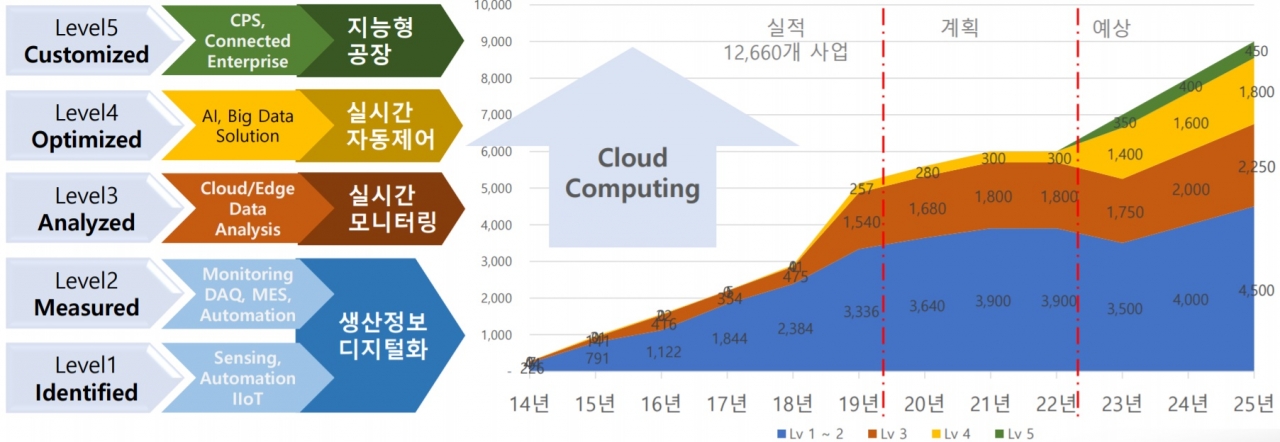
If the plan holds, ‘Level 5’ factories are expected to spread from 2022. At that stage, a cyber-physical system (CPS) is built on the ‘connected enterprise’ (linking customer data with the smart factory). CPS refers to a form in which objects, spaces, and systems are connected and combined with artificial intelligence (AI).
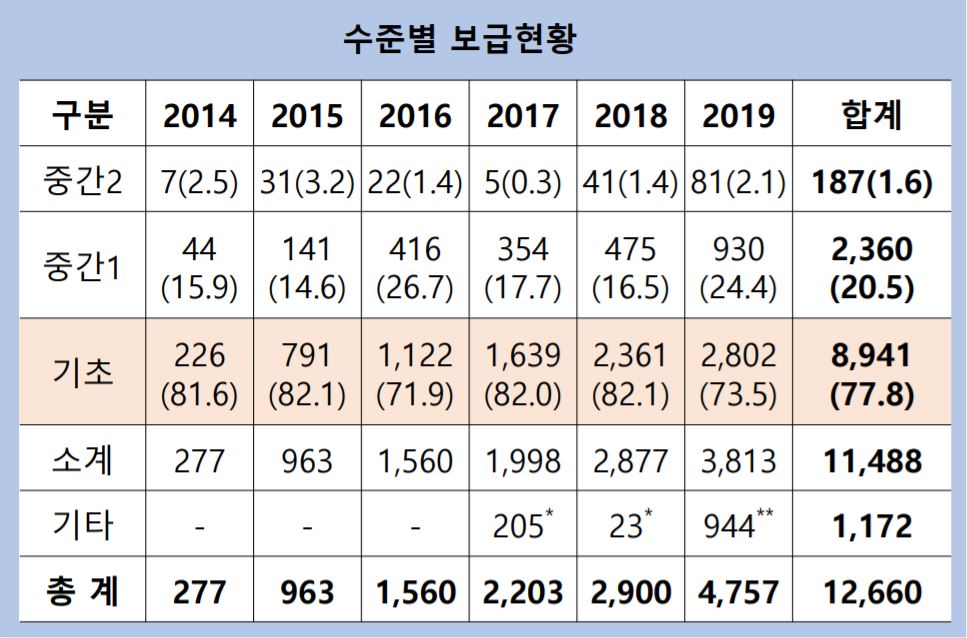
On a cumulative basis over the five years from 2014 to 2019, the basic stage combining Level 1 and Level 2 accounted for 77.8%, Level 3 for 20.5%, and Level 4 for 1.6%. Starting this year, the Promotion Team is storing and analyzing the raw data measured at Level 3-and-above companies in the cloud, creating value from the data and expanding to higher levels.
What Is Manufacturing Process Environment Monitoring?
The smart factory collects every scrap of data, large and small, through sensors and cameras placed throughout the plant. From this data, AI identifies where defects occurred and which machines or equipment show warning signs. It then keeps defective items from moving to the next process, controlling the entire line smoothly. In a smart factory, every facility and device is connected wirelessly, exchanging information and monitoring, analyzing, and judging every process in real time to create the optimal production environment.
Monitoring, then, is essential to the smart factory. For small and mid-sized manufacturers focused on parts production in particular, conditions during production — temperature, humidity, air pressure — can affect the finished product, making environmental management critical. Yet if inspection results for finished parts are recorded by hand, errors can creep in, and problems such as measurement delays can follow. What is needed is a production environment monitoring and automatic recording system that enters measurements automatically and manages them in real time.
The Thingplus Manufacturing Process Environment Monitoring & Analysis Service
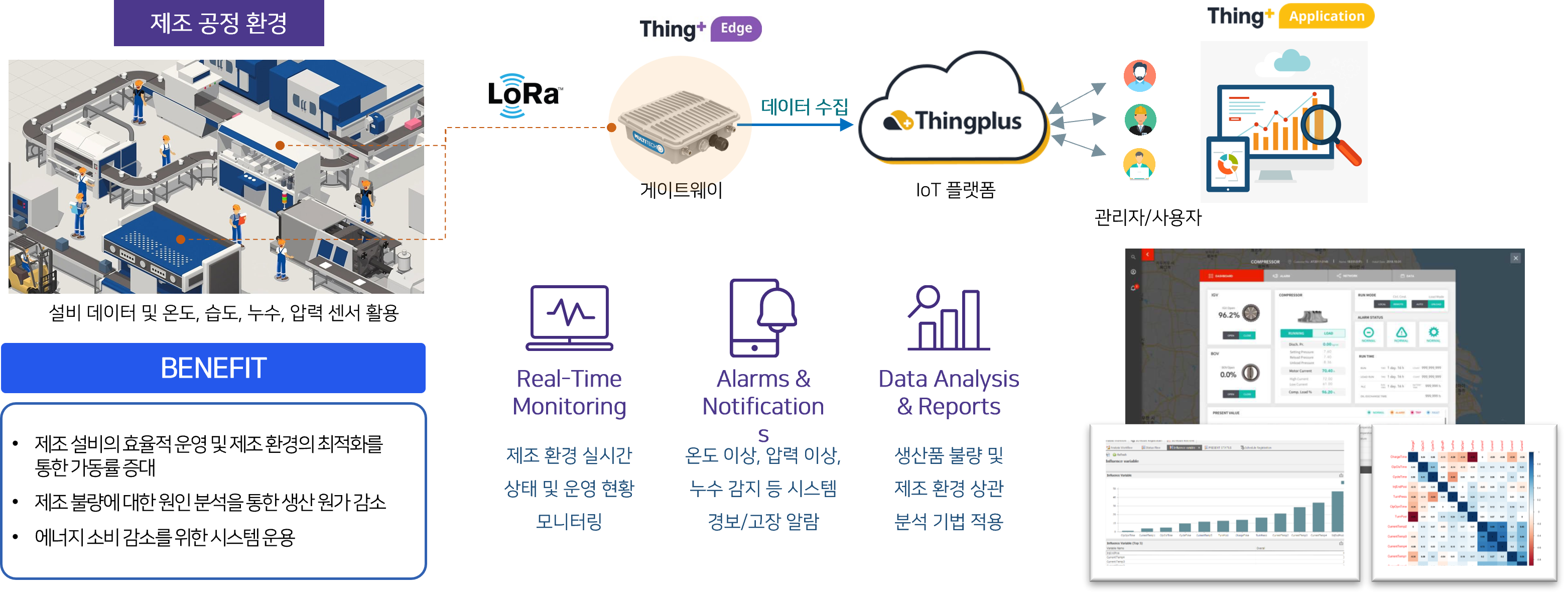
The Thingplus manufacturing process environment monitoring & analysis service optimizes equipment operation through AI analysis of manufacturing equipment and factory environment data, and provides root-cause analysis of manufacturing defects as well. With IoT monitoring of dust, gases, CO2, water, and other hazardous pollutants inside the plant, it raises work safety while optimizing factory operations and maintaining a suitable factory environment.
First, factory environment data is monitored in real time, and environmental changes on the production floor are detected the moment they occur. Sensor devices collect air quality, Co2, temperature and humidity, fine dust, and more inside the plant, moving beyond one-off spot checks to a continuous picture of the factory environment. Immediate alarms when issues arise also protect workers from a range of hazardous situations.
Second, in production environments where consistency matters, sensor-based data collection — consistent and stable, in place of manual measurement — verifies that there is no contamination or unacceptable environmental change, so products and raw materials are stored and handled with rigor. This keeps the manufacturing environment at its best. For factories handling large quantities of flammable materials, where accident risk runs high, an environmental monitoring regime is all the more urgent. Early detection of fires, leaks, and the like prevents major accidents and minimizes human and material losses.
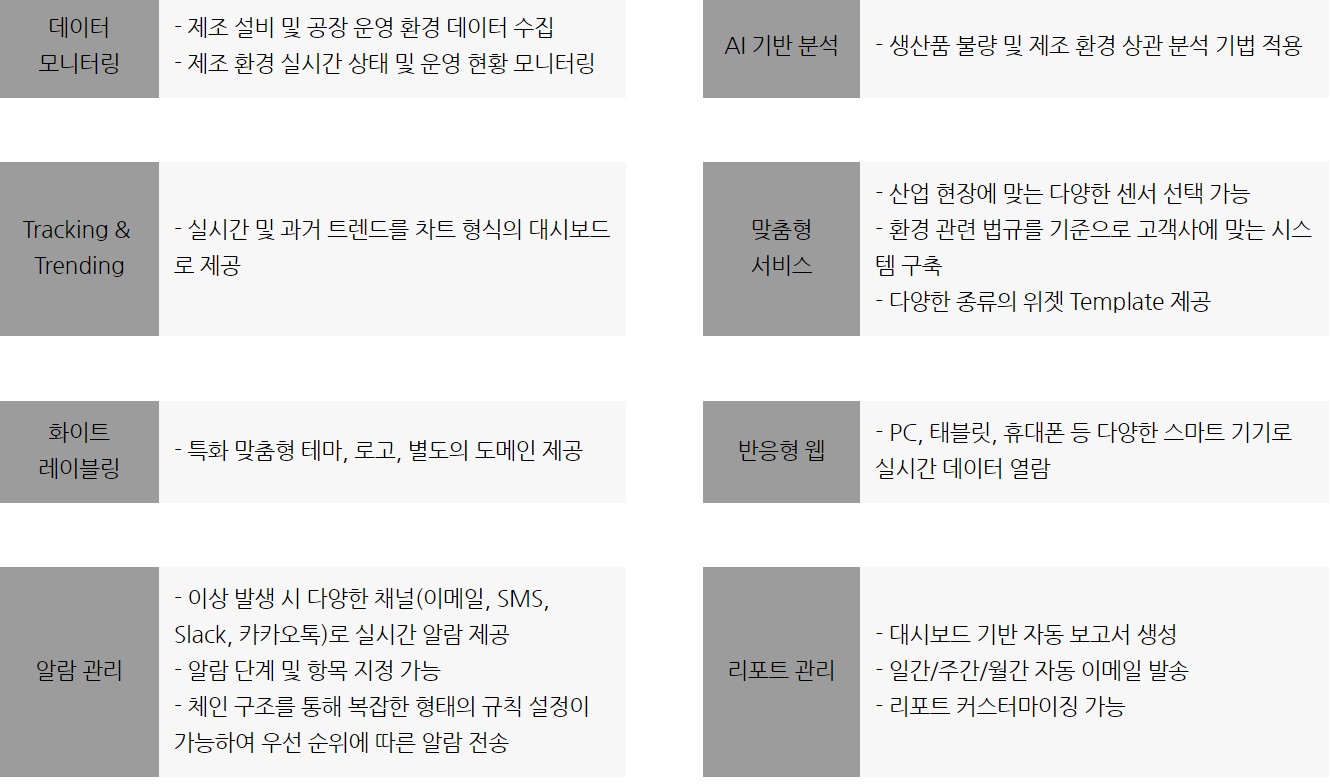
- Key Features
Thingplus supports the entire process of adopting the manufacturing process environment monitoring & analysis service — from consulting and service/system design to communications/device recommendations and service delivery. If you would like to know more about how to get started, contact Thingplus!