The First Step Toward the Smart Factory: The Equipment Operations Monitoring Service
Traditionally, the word ‘smart’ was a modifier reserved for objects with sensing, control, and actuating capabilities. These days, ‘smart’ has long since taken over everyday life — applied not just to devices but to nearly everything, moving beyond a modifier to become almost a byword. Manufacturing is no exception: there are ‘smart manufacturing,’ ‘smart factory,’ ‘intelligent factory,’ ‘smart SCM,’ and more, with wide-ranging definitions of what they mean and what they cover.
So what exactly is a smart factory, and why do companies want to adopt one?
What Is a Smart Factory?
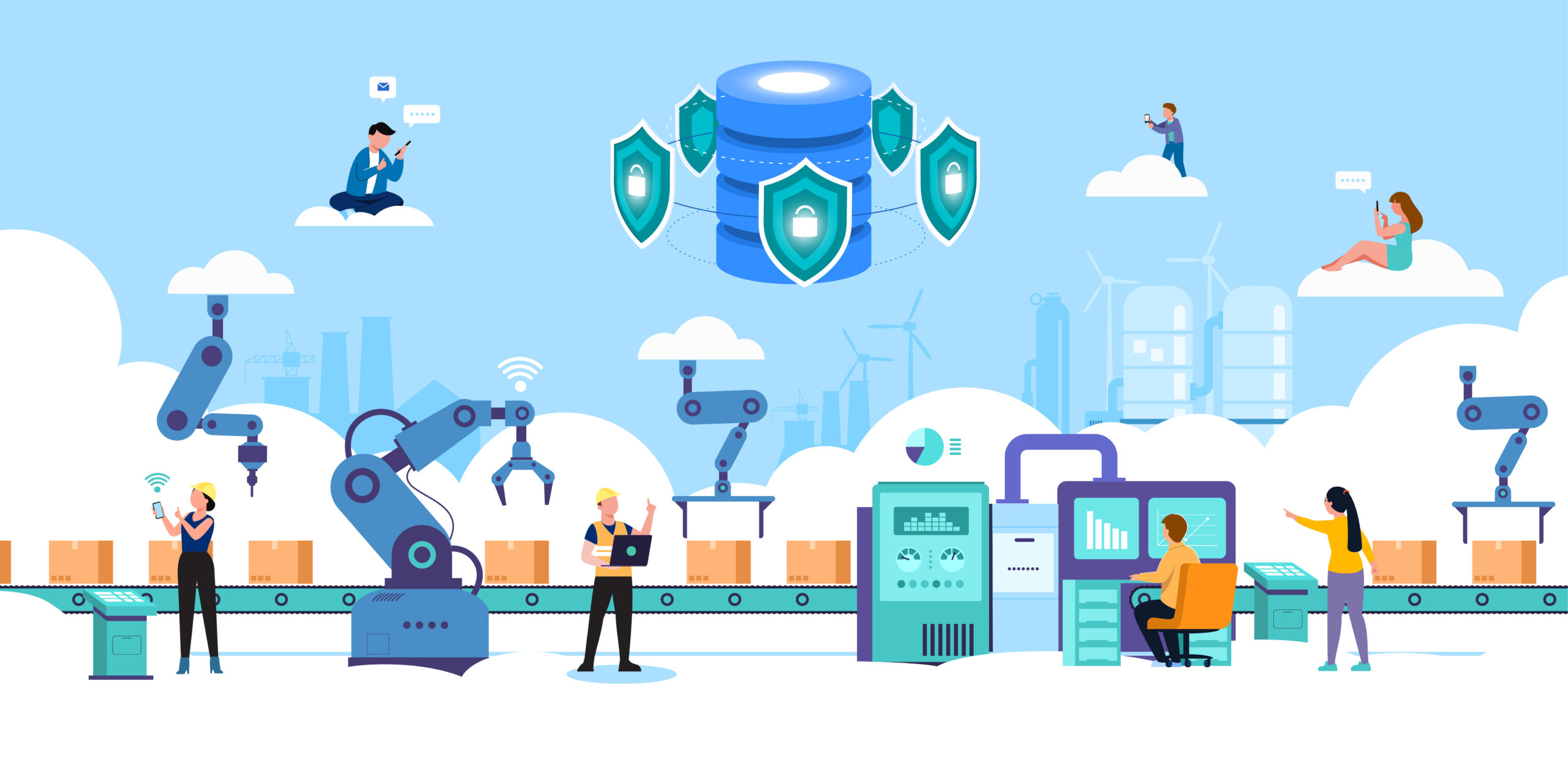
A ‘smart factory’ — literally a ‘clever’ + ‘factory’ — is a human-centered, advanced intelligent factory that integrates every stage of production, from product planning to sales, with ICT (information and communications technology) to produce customer-tailored products at minimal cost and time.
Why Adopt a Smart Factory?
Put another way, a smart factory is ‘a factory that responds flexibly to changing manufacturing conditions based on its production strategy, and runs production operations reliably through QCD (Quality, Cost, Delivery) and constraint management from an integrated Supply Chain Management (SCM) perspective.’ The purpose of adopting one, then, is to equip the production site with a system of proactive choice and execution so it can respond flexibly to internal and external change — shifting to an operating environment more efficient than today’s. Naturally, each company’s target level will differ, since current operating environments and industry characteristics differ.
Characteristics of a Smart Factory
What sets a smart factory apart from a conventional one can be explained through its characteristics — the five characteristics of a smart factory are as follows.
Proactivity : A once-passive factory responds proactively (shifting from one-way to two-way)
– Executes actions based on its own judgments, such as deriving new data correlations, issuing inventory-reduction work orders, and relocating long-held stock
Intelligence : Breaking away from the no-brain system
– Exercises decision-making power, judging for itself as conditions change
– Periodic judgments via batch jobs
– Derives output from input data according to master decision criteria
Agility : Guaranteed system performance as a production operating system
– Improved real-time processing
– Fast responsiveness in manufacturing-operations functions such as alerts, action lead times, and information sharing
Connectivity : Expanded operation of production-related reference data (in quantity and quality)
– Reviews and uses large, diverse data sets as related data domains
– Links with functions (e.g., CEP across the collect, store, process, and use cycle)
Considerations When Adopting a Smart Factory
The prevailing approach to smart factories centers on grafting on the latest IT technologies. Yet what this approach produces often falls short of a true smart factory, and risks turning into something no one on the front line — plant operations managers or staff — actually wants. This can be traced to insufficient consideration of Operation Technology (OT), a critical element of the technical requirements, and to overlooking the importance of Automation Technology (AT).
To transition successfully from a conventional production site to a smart factory, performance requirements must first be considered from an operating-strategy perspective, and the quantitative results the smart factory is meant to deliver must be defined at a concrete level.
Pre-Adoption Checklist for Evaluating a Smart Factory
1. Does it strengthen service from the customer’s perspective?
2. Is the cost-effectiveness (financial return) superior to the alternatives?
3. Distinguish areas of inefficiency to fix from areas to advance
4. Can the human capabilities needed to operate it be met?
5. Is the rationale sound — why does it have to be a smart factory?
6. Are there mitigation plans for the risks foreseen in adoption?
7. Has internal consensus been built on why adoption is necessary?
8. Does it need to be adopted now?
9. Is there a plan for the surplus resources adoption will create?
10. What are the pressing issues?
Direction for Pursuing a Smart Factory
To come close to the level expected at the outset (at investment review), it is essential to start from a hard, honest reckoning with reality. When adopting a smart factory, do not make adoption itself the goal; instead, give concrete shape to the factory you actually want to realize, and pursue that. And on the technology side, do not put too much weight on IT — spread ample attention across OT and AT as well.
Benefit Substance over show (avoid making adoption an end in itself)
Assess Build the implementation model on a clear-eyed view of where you stand
Strength Let people do what people do best, and systems do what systems do best
Balance Avoid local optimization: implement with balance across all functions
Sustainable A foundation for continuous advancement: avoid letting the adopted model end as a one-off event
People Start by reinforcing operating capabilities: aim to reflect real operational know-how
Flexible Link to strategy: build a system that responds nimbly to internal and external change
Simple Simple operations: every complex system eventually breeds operational problems
Start Small Start small: a big-bang approach carries too much risk to be suitable
The First Step in Building a Smart Factory: Equipment Operations Monitoring
The smart factory is the future of manufacturing, and remote equipment operations monitoring is the first step toward building one. Factory equipment comes in many varieties, and monitoring the condition of equipment at remote sites is no easy task. The biggest challenge ahead for managers is to find the most efficient way, on a limited budget, to capture production status from equipment of different brands and communication protocols, implement remote monitoring and control, raise the efficiency of process monitoring and control, and cut maintenance costs.
Expected Benefits
Remote monitoring support
Monitor equipment operations in real time anytime, anywhere, and see shop-floor information at a glance for truly visible management. Instant alarms when anomalies occur minimize equipment failures, improving equipment availability and operational stability.
Optimized production performance and uptime
Power sensors monitor equipment condition in real time, detecting hard-to-pin-down fault patterns so maintenance can be performed in advance — maximizing uptime as a result. Preventing unexpected failures and massive losses minimizes downtime, and an efficient spare-parts strategy reduces maintenance costs.
Higher equipment efficiency
By analyzing data from the equipment operations monitoring service, you can revise utilization plans or redeploy equipment based on utilization rates. This minimizes stoppage time and maximizes productivity.
Productivity management and energy efficiency
Track and manage the KPIs that matter most on the shop floor. Productivity indicators such as equipment operating hours and utilization can be checked in real time, keeping a continuous eye on the state of current processes. Effective visualization of shop-floor energy consumption also enables efficient energy management and lower energy costs.
The Thingplus Equipment Operations Monitoring Service
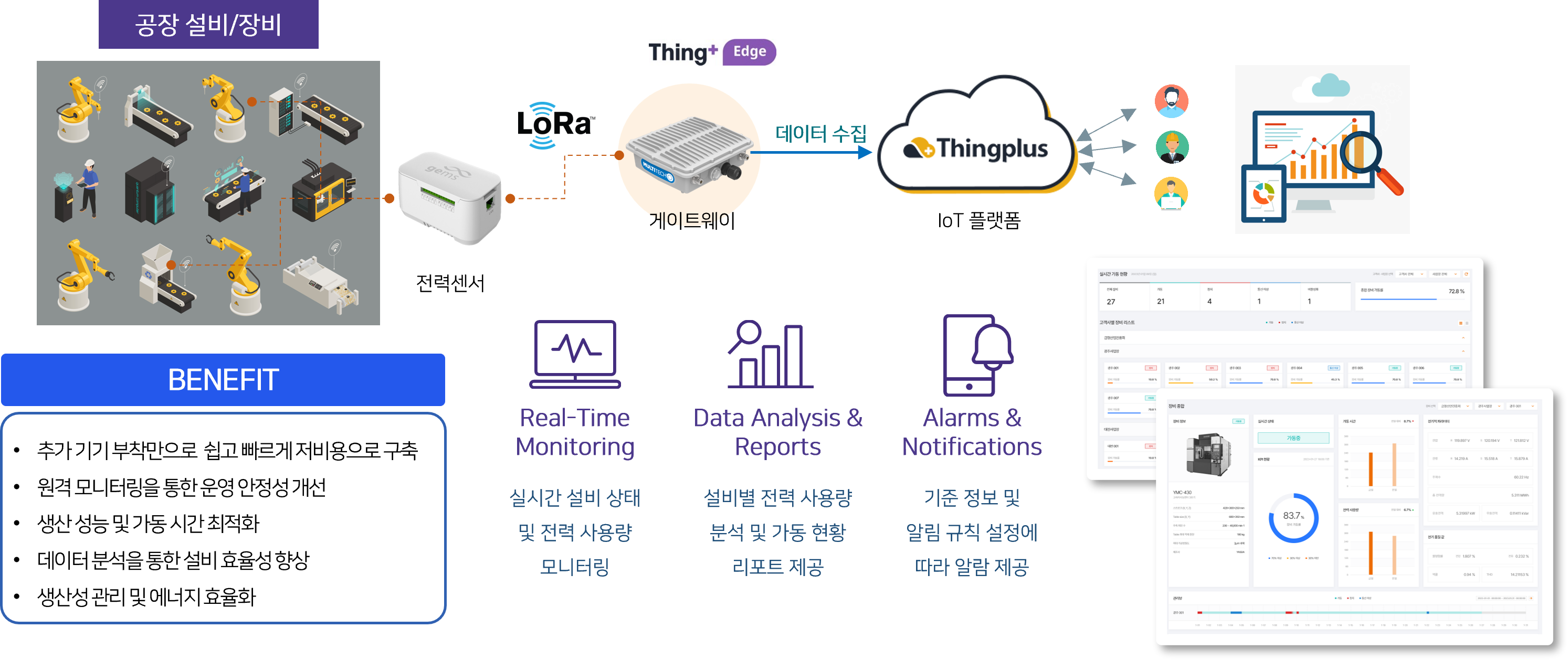
When work sites are far away, environments are harsh, and manufacturing teams are small, keeping equipment uptime where you want it is hard. The Thingplus equipment operations monitoring service is a real-time equipment monitoring system that supports efficient equipment operation, from data collection through real-time monitoring. Using power sensors, it collects and stores the varied data generated while equipment runs, and provides real-time monitoring that visualizes a wide range of equipment information based on that data.
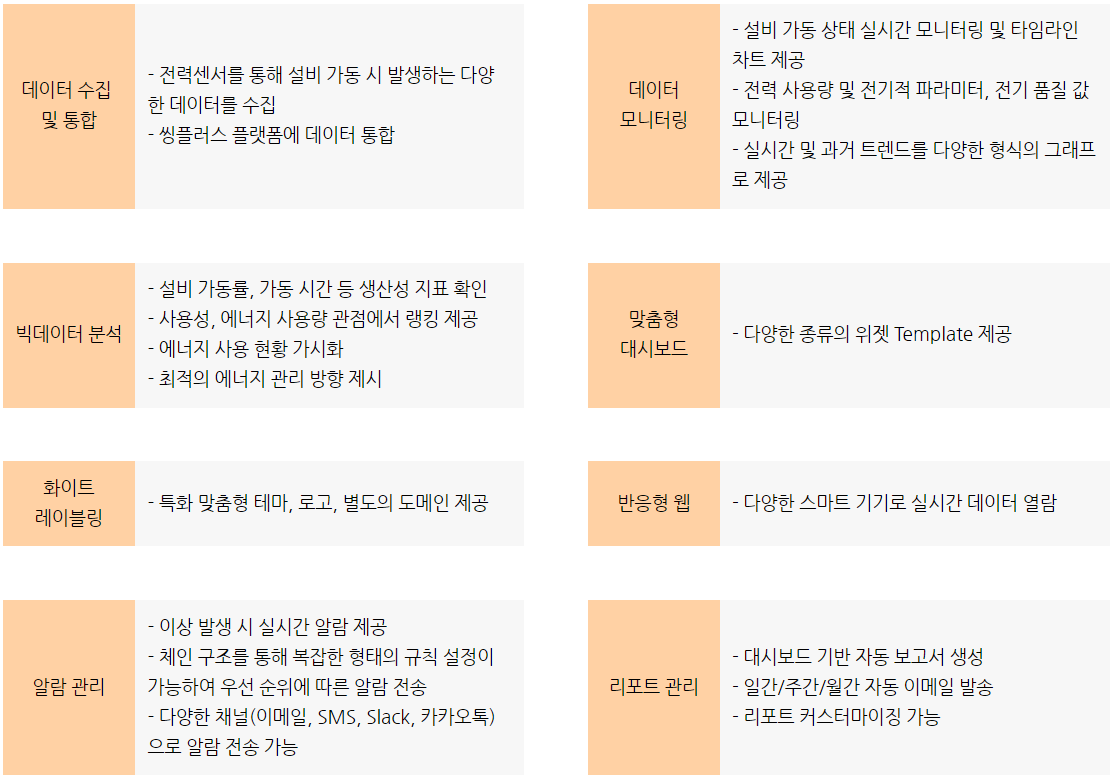
With the Thingplus equipment operations monitoring service, you can consolidate data, check equipment operating status in real time, and — through instant notifications when problems occur mid-operation — recognize and respond as quickly as possible. Managers can review utilization across the whole factory and for individual machines, explore ways to use assets more efficiently, and plan additional purchases of high-utilization equipment. An energy management dashboard showing power consumption and peak demand also supports efficient, systematic energy management.
Key Strengths
Equipment status at a glance
The dashboard shows not only real-time operating status for every piece of equipment you own, but also a rich set of data in various graph formats — operating status timeline charts and daily/weekly/monthly operating summaries among them.
Real-time equipment condition monitoring
Wherever there is an internet connection, operating status can be monitored in real time from a variety of smart devices. Based on the collected data, it monitors run/idle operating states (machining, stopped, communication fault, etc.), equipment name and ID, the program currently running, and start/end times.
Analytics and statistical reporting
A variety of statistical and analytical reports are generated from the collected data: daily/weekly/monthly equipment reports by period, plus real-time production resource reporting (equipment operating status, utilization, and rankings).
Fast, easy digital transformation
It is cost-effective because all it takes is installing power sensors on the equipment you already use. With such simple installation, even small companies can build an early-stage smart factory at an economical, reasonable cost.
Key Features
Thingplus supports the entire process of adopting an equipment operations monitoring service — from consulting and service/system design to communications/device recommendations and service delivery. If you would like to know more about how to get started, contact Thingplus!