Smart Aquaculture: Streamline Operations and Grow Revenue at Once
The smart aquaculture industry emerged as an alternative to capture fisheries, which face the limits of fish stocks as seafood consumption keeps climbing. With the Fourth Industrial Revolution and the convergence of technologies, smart aquaculture is now advancing rapidly.
Thingplus, too, has been developing a service around an AI-based smart aquaculture platform, built to minimize operational risk and fit the realities of Korean fisheries. We would like to share what we learned along the way.
Fishing Villages in 2021
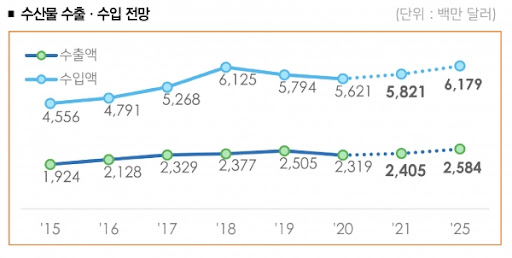
The UN Food and Agriculture Organization (FAO) estimates that farmed seafood accounts for about half of global seafood consumption and projects that it will exceed 60% of total consumption by 2030. Yet even as global demand for seafood grows, coastal fishery output is declining due to overfishing and climate change. The journal Science went so far as to predict that without systematic, structural reform and countermeasures across the fishing industry, marine fish stocks will be completely depleted by 2048.
Korea’s annual coastal fishery production is likewise in steady decline. The depletion of fishery resources in the East, West, and South Seas is an ongoing problem, and analyses of its causes vary — most prominently environmental pollution including global warming, and illegal overfishing.
Industries futurists predict will lead the global market
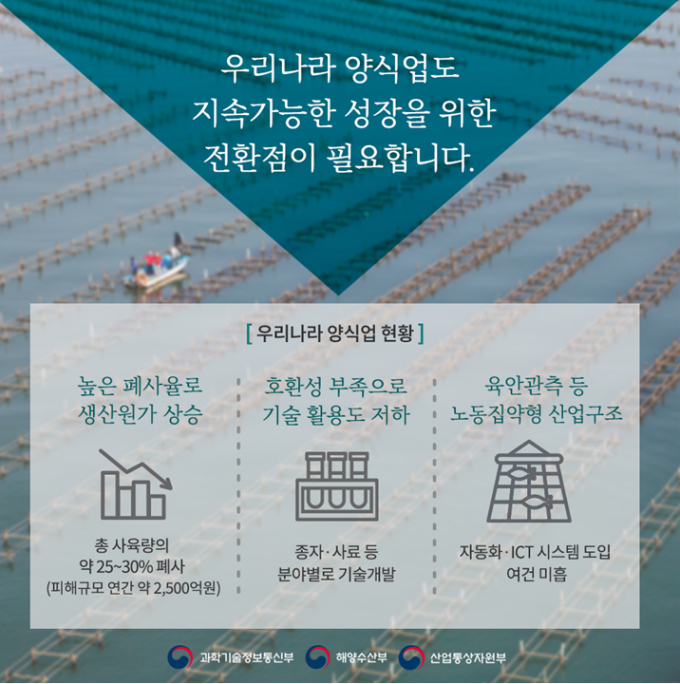
Yet according to a recent analysis by the Ministry of Oceans and Fisheries, beyond external factors, structural problems within the Korean fishing industry are also closely tied to falling seafood production. The fishing villages that form the industry’s foundation are struggling with a shrinking and aging fishing population. For a labor-intensive industry this is a heavy blow, and the state of these fishing villages acts, together with declining fish stocks, as a core driver of falling production.
The decline of fisheries and fishing villages, rooted in primary industry, is in some sense inevitable as industries develop. That is precisely why we must chart a new direction for the fast-changing future of our fisheries and fishing villages — and one such alternative is revitalizing the smart aquaculture industry.
Why Smart Aquaculture Is Needed
Externally, too, the fishing industry is under pressure, for reasons such as these:
1. Accelerating market opening through the WTO/FTA and similar frameworks
2. Stricter sanitary requirements in cross-border seafood trade and tightening international fishery regulations
3. Countries increasingly nationalizing their fishery resources, and emerging fishery powers expanding through large-scale investment in the sector
4. A widening technology gap with advanced fishery nations
Given this internal and external environment, the traditional way of fishing has hit the limits of its growth, and so the need to create new growth engines and develop new business models has come strongly to the fore.
Meanwhile, as global demand for farmed seafood rises, the world aquaculture industry is projected to grow 37.5% by 2030 versus 2016 in production terms, and the global economic ripple effect of aquaculture technology is estimated to reach roughly KRW 223 trillion as of 2025 — a high-growth industry by any measure.
Above all, smart aquaculture technology aims not only to raise production but to develop and spread data-driven, sustainable, eco-friendly farming methods. It addresses the environmental load, vulnerability to natural disasters, and seafood safety issues from antibiotic overuse that have dogged conventional aquaculture, enabling the transition to an environmentally friendly, sustainable industry. Further goals are better reproducibility of every farming technique and greater efficiency in the production process.
AquaFarm 4.0 strategy
The Korean government’s current policy for fostering smart aquaculture can be read as an effort to make the industry advanced, intelligent, and large-scale by grafting Fourth Industrial Revolution technologies — IoT, ICT, big data — onto conventional fish farming, solving pressing problems and securing sustainability. Adopting smart aquaculture is fast becoming a necessity, not a choice.
What Is a Smart Fish Farm?
A smart fish farm applies Fourth Industrial Revolution technologies to create an aquaculture production system that realizes maximum production efficiency, scale, and eco-friendliness through automation and intelligence. The table below classifies the components and technologies of a smart fish farm, and it shows that IoT technology is the most essential element of a smart fish farm. Based on information gathered from a range of sensors, water quality, feeding, and growth can be managed, and decision-making across growing activities can be systematized through data analysis, application, and integrated management. If conventional aquaculture is a labor-intensive industry, smart aquaculture is a technology- and capital-intensive knowledge industry.
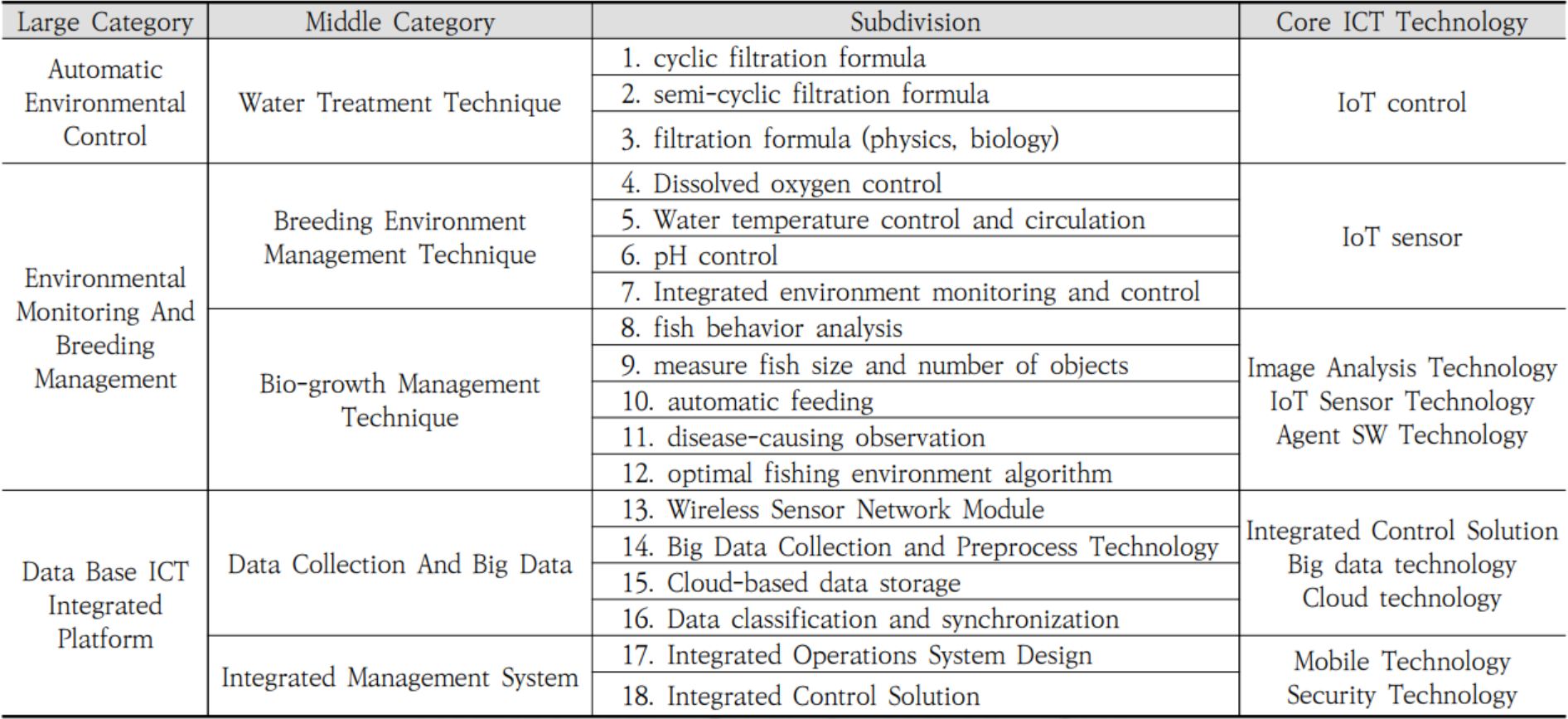
Smart fish farm components and technology classification
From the fish farmer’s perspective, traditional aquaculture meant humans making the judgments and humans doing the labor. Research has since moved past the stage of humans judging while machines labor, toward machines judging and machines laboring. At the same time, the concept is expanding beyond a narrow system for optimizing the growth of a particular species toward a smart platform spanning the entire ecosystem — discovering superior seed stock, raising it in smart farms, and carrying it through to sales and distribution.
What You Get with the Thingplus AI Smart Fish Farm!
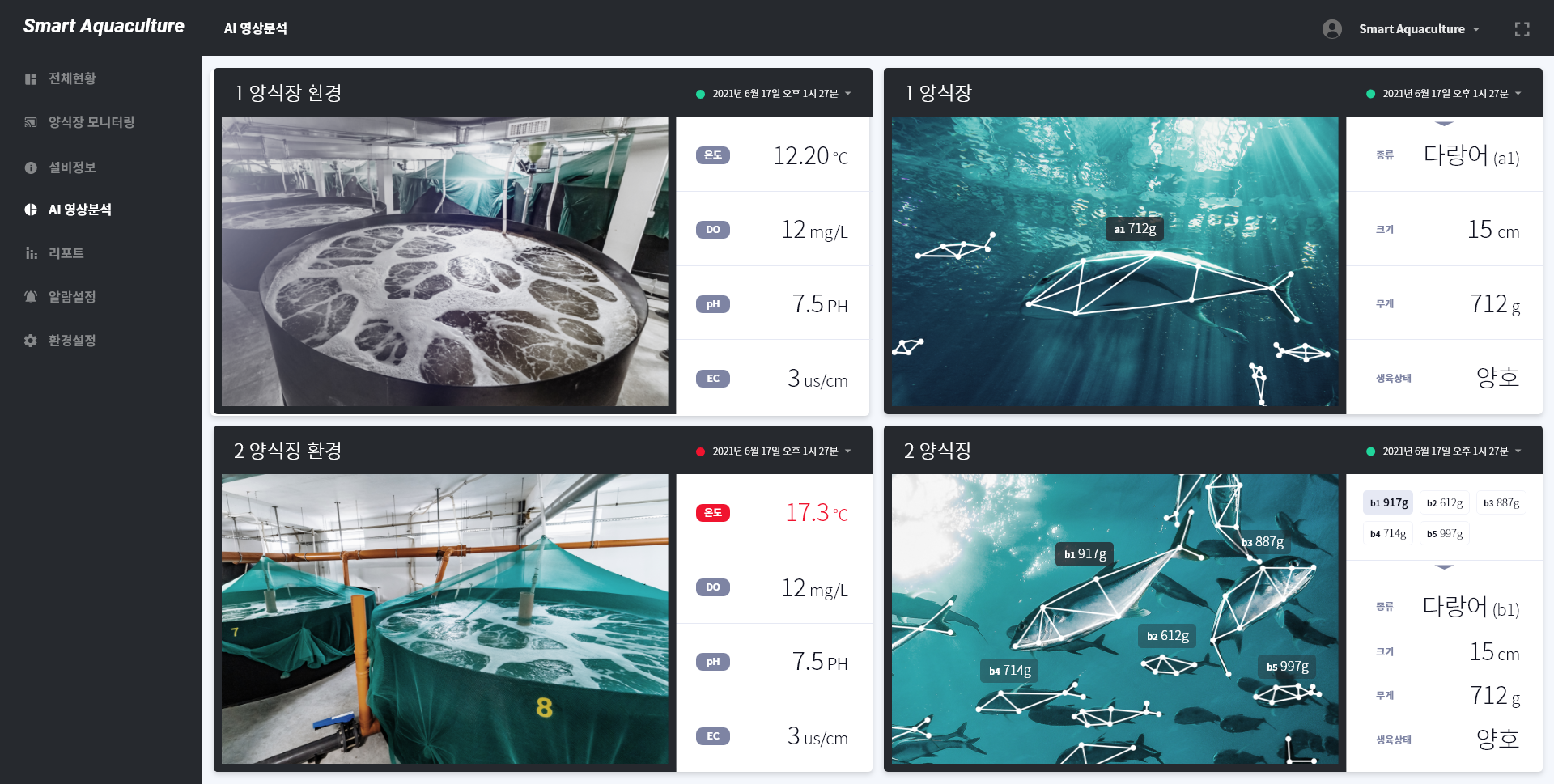
Sample smart fish farm screen
Thingplus is an AI cloud platform that maximizes production through tailored management, using artificial intelligence built on big data analysis. Combining the Internet of Things (IoT) and information and communication technology (ICT), it monitors the rearing process of farmed species in real time while collecting and managing growth data. Sensors for water temperature, dissolved oxygen, pH, and more are installed in each tank, so the water environment is monitored in real time and can be controlled automatically against setpoints. Going further, image processing devices are installed to measure rearing conditions, collecting and analyzing data and providing real-time control.
Rearing Environment Measurement and Automatic Control
Measuring and analyzing the rearing environment in real time and controlling it automatically against setpoints is one of the core technologies of smart aquaculture. It is the largest part of a smart farm’s business case and where the greatest added value is created. Thingplus has rearing environment measurement technology that uses sensors for water temperature, dissolved oxygen, and hydrogen ion concentration at the farm. This allows tank conditions to be monitored in real time and the operating environment (water temperature, DO, pH, EC) to be understood. In addition, proprietary technology that analyzes feeding activity and biological traits such as weight and size through underwater video cameras enables tailored management and maximum production. Every sensor and device raises an alarm on anomalies and issues alerts for water quality risks and operating environment problems, so risks from all kinds of environmental change can be addressed in advance.
Automating the Production of Farmed Species
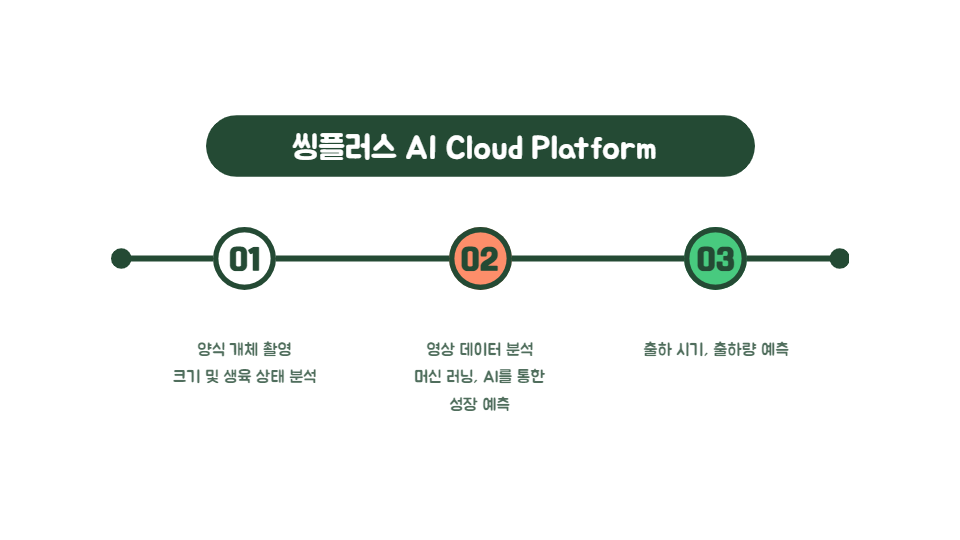
Thingplus smart fish farm service flow
Thingplus monitors farmed individuals in real time through video. It gauges each individual’s size and color and analyzes growth condition. Going a step further, it brings in artificial intelligence to predict the growth of farmed species through machine learning, helping manage shipment timing and volume. This elevates growth management for farmed species and enables more evolved business management, and by linking with a distribution management platform, the volume and timing of shipments can be adjusted.
Now Is the Time to Adopt a Smart Fish Farm
Traditional aquaculture has relied on visual observation and experience. Today, adopting a smart fish farm that turns the entire farming process into data and manages it has become essential. Adopt a smart fish farm quickly and easily with Thingplus!