The Power of Data and Connectivity Transforming Agriculture
Agriculture is no longer an industry that looks only to the land. Climate change has unpredictable effects on crop growth, and rural aging goes beyond labor shortages to threaten the very sustainability of farm operations. On top of that, social complaints and regulatory pressures such as livestock odor and aquaculture pollution have become a heavy burden on farms. Amid these complex challenges, the smart farm is evolving beyond simple automation into a way of understanding agriculture through data and solving problems through connectivity.
Sensors collect data, that data is interpreted in real time, AI and algorithms make operational decisions, and systems can be controlled remotely. Within this flow, Thingplus has been building ‘smart farm technology that truly works in the field.’
In this article, we explore case studies from a variety of sites, including a strawberry farm, to see how Thingplus solved agricultural problems with technology and improved productivity, efficiency, and environmental responsiveness along the way. See for yourself how Thingplus transformed agricultural sites — not through technology for its own sake, but through a way of solving problems.
Case ① Strawberry Farm – Visualizing Growth Data
Strawberry farming requires careful observation of crop growth, with environmental conditions such as water, temperature, humidity, and sunlight precisely adjusted for each growth stage. It has long been seen as a field where the experience and intuition of skilled workers matter most, but Thingplus introduced a data-driven growth visualization system that made an entirely new way of operating possible.
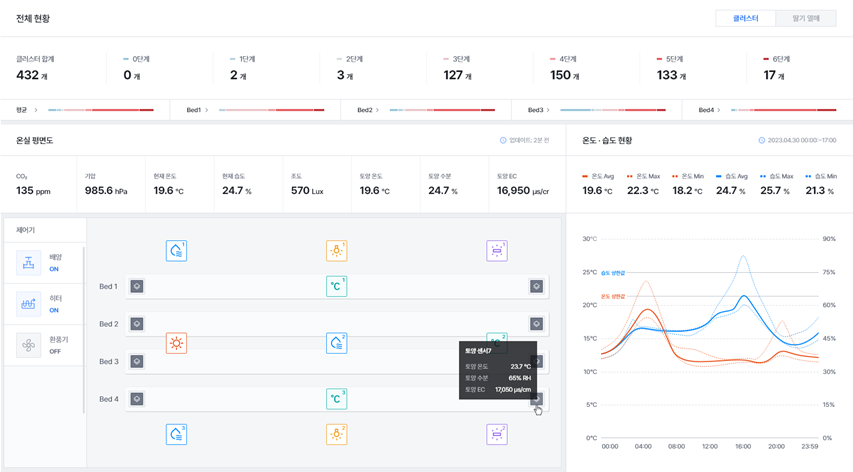
Monitoring strawberry growth and environmental conditions
At the strawberry farm running Thingplus, sensors installed on each bed and position collect growth-environment data such as temperature, humidity, and soil moisture in real time. Rather than being presented as raw numbers, this data is expressed through a visualized interface that makes the flow of crop growth easy for anyone to understand. Growth stages are shown as graphs and images, and even the number, position, and fruit development of strawberry clusters can be checked position by position.
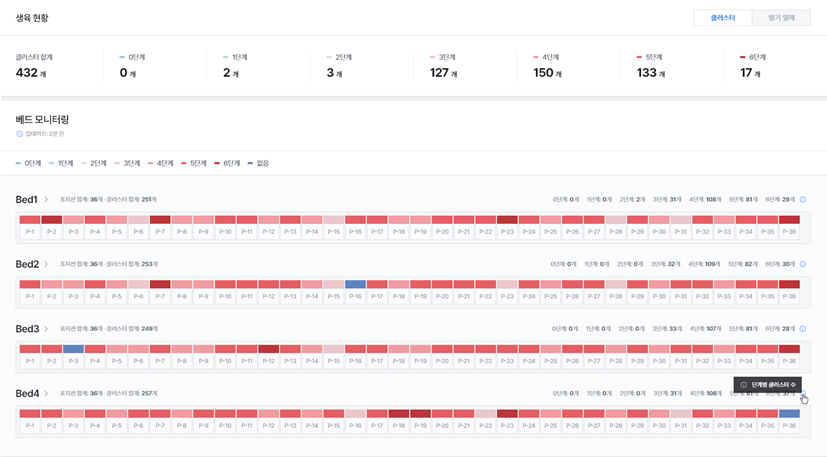
Strawberry growth status
Most notably, this system turned experience-dependent farm operations into a data-driven decision structure. Farmers used to rely on a veteran’s instinct to decide when to water or open covers; now they can make those calls quantitatively, viewing sensor readings alongside actual growth status. Because growth images and temperature-humidity data can be compared side by side, it is also easy to analyze which period’s conditions had the greatest impact on growth.
Thingplus also presents growth trends as cumulative graphs, visually showing crop growth over time. This enables analysis of averages, maximums, and minimums in crop growth, creating an environment where workers can judge and act based on data. The data can be exported to Excel through the CSV download feature for reuse or reporting, further improving the transparency and efficiency of farm operations.
Through this system, the farm owner gained the ability to reduce growth variation and predict disease outbreaks in advance. Less-experienced workers can also assess crop conditions based on data, which greatly helps maintain consistency and quality across the operation.
The change that began at this strawberry farm points to a direction for agriculture centered on ‘data’ rather than ‘technology.’ Thingplus went beyond providing a monitoring tool — it is a real-world example of building, on site, the foundation for analyzing and predicting the relationship between crops and their environment.
Case ② Watermelon Farm in Kumamoto, Japan – Automating Greenhouse Control
At a watermelon farm in Kumamoto Prefecture, Japan, precise environmental control was essential for producing high-quality fruit. Watermelons respond sensitively to outside weather, and growth speed, sugar content, and fruit size vary greatly with temperature, humidity, sunlight, and soil moisture. Moving away from its manual operations, the farm adopted a smart farm automation system built on the Thingplus platform, dramatically raising its operational efficiency and quality control.
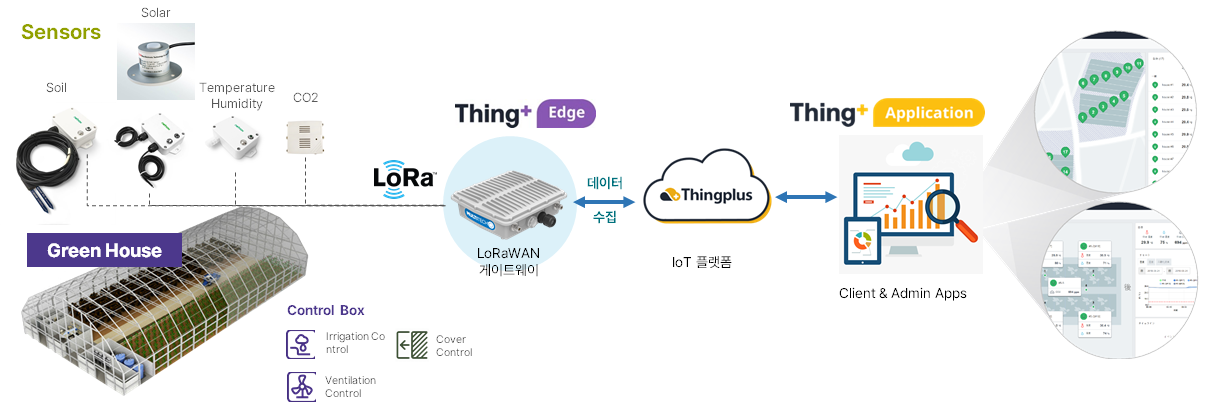
Thingplus applied to a watermelon farm in Kumamoto, Japan
Thingplus collects data in real time — temperature, humidity, soil moisture, solar radiation, CO₂ concentration, and more — from a range of sensors installed inside the greenhouse. The data goes beyond simple status checks: it is linked to key greenhouse equipment — covers, irrigation systems, ventilation fans, and the like — and designed for automated or remote control. The farm owner can grasp everything at a glance on the Thingplus platform or smartphone app and take control immediately when needed.
Using LoRaWAN-based wireless communication gateways, the farm achieved stable data collection and communication across the entire expansive greenhouse. Sensors can be placed freely, and operations stay stable even with many control points. For example, when strong sunlight suddenly streams in early in the morning, the system automatically closes the covers; when humidity drops, the irrigation system starts running. Beyond mere convenience, this automation plays a decisive role in optimizing the growing environment so crops are never stressed.
Since the smart farm system was introduced, the owner says the uniformity of watermelon growth and the stability of harvest timing are tangibly better. In the past, weather swings and human judgment errors easily caused growth variation; now, thanks to data-driven environmental control, the farm enjoys a dual effect: fruit quality stays consistently even while labor intensity falls and productivity rises.
This case shows that the smart farm is no longer a tool that merely displays information — it is evolving into a system that regulates and responds to the growing environment on its own. Thingplus keeps its UI and system simple so users never feel intimidated by the technology, while reliably implementing complex control logic to realize field-friendly automated agriculture.
Case ③ Shrimp Farm – Seeing Inside the Tanks in Real Time
At a shrimp farm in Gyeonggi Province, even the slightest change in tank water temperature or quality could have fatal consequences. Shrimp are highly sensitive to water temperature, pH, and oxygen levels, and a sudden change in water quality can lead to mass die-offs — which makes 24-hour real-time monitoring of the farming environment more important than anything else. To reduce this operational risk and raise productivity, the farm adopted a Thingplus-based smart aquaculture monitoring system.
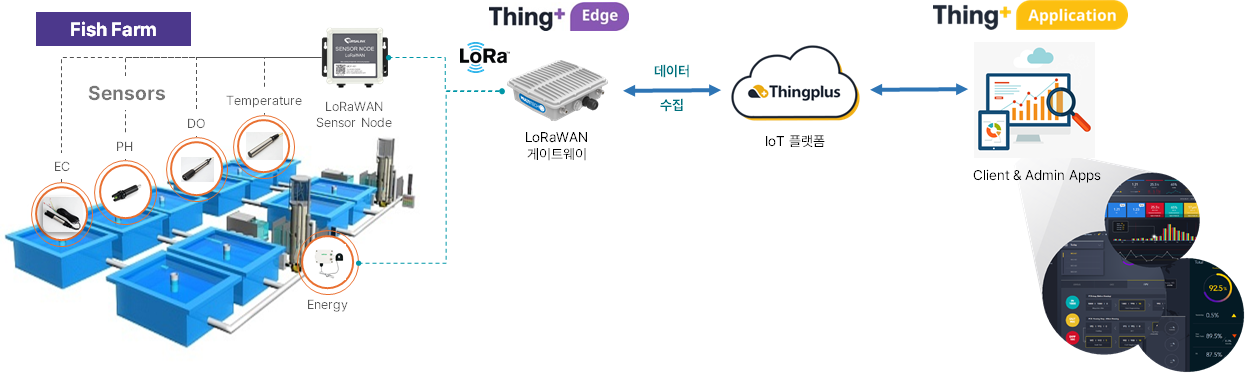
Thingplus applied to a shrimp farm
Over LoRaWAN communication, Thingplus collects real-time data — water temperature, DO (dissolved oxygen), pH, EC (electrical conductivity), and more — from sensors installed at multiple points in the tanks. The data is displayed in an intuitive UI on the web or mobile app used by managers and operators, providing an at-a-glance view of environmental conditions across the entire farm. Anomalies can be identified in real time, and action taken immediately when needed.
The system does not stop at collecting data. When a sensor value in any tank exceeds its threshold or changes abruptly, Thingplus automatically sends an alert to the operator based on preset warning thresholds. For example, if the DO level falls below the standard, an alarm sounds and the operator can immediately activate the oxygen supply. Unlike traditional operations that relied on experience and intuition, this response framework enables fast, accurate responses grounded in quantitative criteria.
Above all, since the system was introduced, the operator has maintained a far more stable rearing environment and experienced lower shrimp mortality along with higher survival rates and shipment quality. Staff once had to walk the tanks several times a day checking water quality by hand; now they can manage every tank remotely, in real time, from a single app, dramatically reducing the physical workload.
This aquaculture case shows that smart farm technology can precisely control not only land-based crop cultivation but underwater rearing environments as well. By analyzing water-quality and operational data in an integrated way, Thingplus presents an architecture that can later extend to AI-based survival-rate prediction and integration with automated feeding systems.
Case ④ Livestock Odor Monitoring – Predicting and Responding to Complaints
Livestock farming is a vital pillar of agriculture, yet resident complaints and conflicts over odor remain an unresolved challenge. In summer especially, odors spread into nearby villages depending on wind direction and weather, and recurring complaints place a heavy burden on livestock operations. To solve this problem, Thingplus developed and deployed a smart barn management system that combines odor monitoring with prediction.
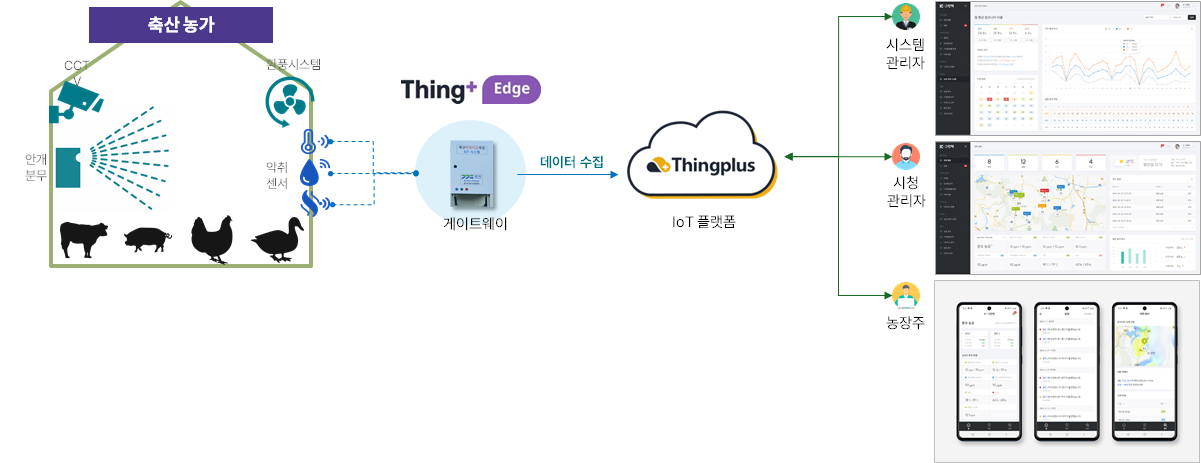
Thingplus applied to a livestock farm
The system installs sensors that detect odor-causing gases such as ammonia (NH₃), hydrogen sulfide (H₂S), and methane (CH₄) at key points inside the barn, collecting real-time odor data 24 hours a day. The data is visualized on the Thingplus platform and shared so that operators, managers, and even local government officials can see odor conditions at the same time. By checking data from surrounding outdoor points as well as inside the barn, the system also provides a framework for tracing how far odors spread and what causes them.
Above all, the system goes beyond monitoring to provide AI-based odor forecasting. Drawing on weather data and historical odor patterns, it predicts which farms are likely to see odor intensify at a given time, enabling preemptive measures (e.g., running misting systems or strengthening ventilation). Forecast accuracy improves as operational experience accumulates, allowing farms to shift from simple reaction to proactive management.
The alert system is another strength of this solution. When odor levels exceed the configured threshold, Thingplus immediately sends warning messages to the farm owner, system administrator, and local government officer. Farms can respond before complaints arise, and when problems do occur, they can quickly explain the situation and take action based on causal data. This goes beyond simple equipment operation to build trust-based administrative cooperation and a transparent farm management framework.
Livestock farms running the system report fewer complaints and shorter response times, along with genuine internal improvements in the quality of the rearing environment itself. Data-driven operations give workers clear standards and are becoming a new benchmark for balancing animal welfare with environmental responsibility.
This case shows that smart farming is evolving not just to raise productivity, but to reduce social conflict and secure the sustainability of agriculture. Through technology, Thingplus is helping build a structure in which farms and local communities can coexist.
The Shared Technology Foundation Behind Thingplus
The reason Thingplus works so effectively across such varied agricultural settings — from strawberry farms to livestock operations — is not simply that sensors were installed. Behind it lies the technical integration to collect field data, analyze it, and connect it all the way to control. Thingplus is the platform that made the core smart farm principle of ‘data-driven operations’ actually work in the field.
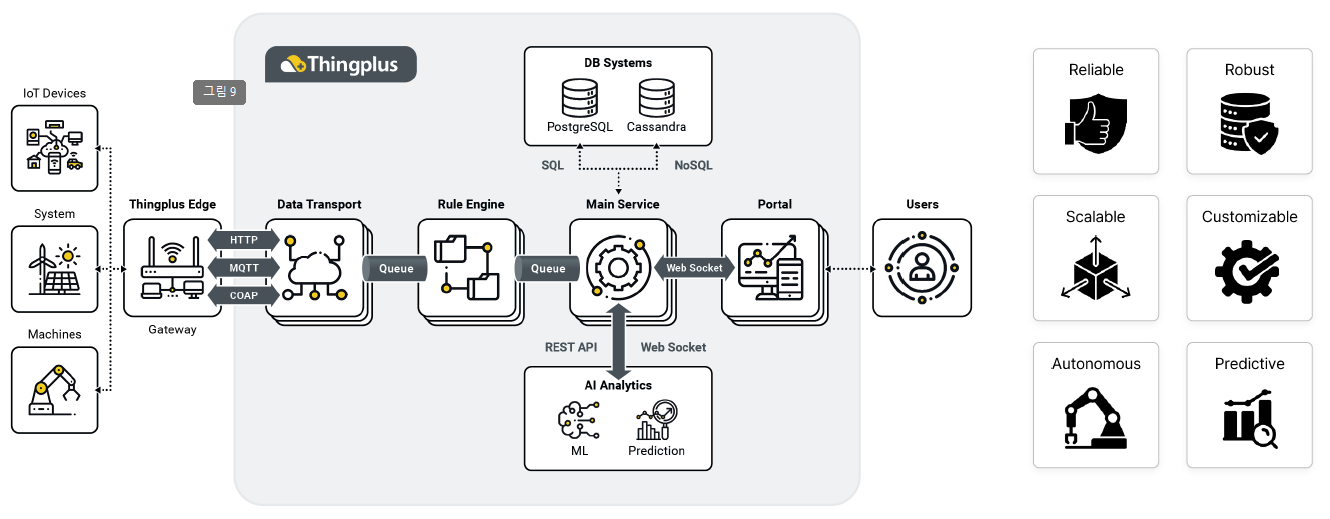
Thingplus architecture diagram
First, Thingplus provides an IoT-based data collection infrastructure. Sensors matched to each environmental factor — temperature, humidity, CO₂, pH, DO, odor gases, and more — can be deployed with long-range LoRaWAN gateways, providing stable connectivity even in rural areas with poor power and network infrastructure. This flexibility maintains the same level of data precision across environments with entirely different physical conditions: open fields, greenhouses, tanks, and barns.
Second, rather than listing raw numbers, the collected data is presented on a visual, intuitive dashboard. Growth-stage trends, odor-level changes, and water-quality graphs are laid out so anyone can understand them at a glance, and when needed the data can be downloaded as CSV for further analysis or reporting. This offers even farmers unfamiliar with IT a low-barrier user experience.
Third, Thingplus is equipped with real-time control and automated response capabilities. For example, when a reading rises above its threshold, the system sends a warning alert or automatically activates irrigation systems or ventilation fans. Remote control is also available through the app anytime, anywhere — the state of the farm can be adjusted in real time from a single smartphone — so efficiency and responsiveness are maximized.
Finally, Thingplus accumulates data collected across diverse sites and is structured to extend into predictive analytics (AI-based forecasting) and intelligent alerting systems. This helps operations move beyond simple monitoring to gain the ability to respond preemptively before problems occur.
In this way, from sensor → gateway → platform → user, Thingplus integrates the entire operational flow of the smart farm within a single system, flexibly adapting to the conditions and needs of each agricultural site. As a result, it has solved different problems for different farms while driving a shared operational transformation.
Smart Farm Benefits Proven in the Field
Smart farm technology draws attention not simply because it is “cutting-edge,” but because its results have been proven on real farms. Applied across entirely different environments — crop cultivation, aquaculture, and livestock — Thingplus has consistently produced visible change and measurable impact.
Higher Productivity and More Uniform Quality
The biggest change common to the strawberry and watermelon farm cases is higher productivity. Data-driven control of the growing environment reduced crop stress and optimized growth conditions, leading to larger harvests and smaller quality variation. At the strawberry farm in particular, analyzing per-bed growth with numbers and images made it possible to even out growth rates and detect potential disease outbreaks in advance.
Labor Savings and Improved Operational Efficiency
Farms that adopted Thingplus all say the same thing: the first change they felt was that “you no longer have to run around the site as much.” At the aquaculture farm, the chore of checking water quality tank by tank disappeared; at livestock farms, emergency call-outs to handle odor complaints declined. Opening greenhouse covers, adjusting irrigation, and saving data from a single smartphone is no longer anything out of the ordinary.
Thanks to automated control and real-time alerts, farms could reduce on-site staffing or deploy it more efficiently, and by shifting intuition-based decisions once dependent on veterans over to data, they also secured standardized work and greater predictability.
Environmental Response and Preventing Social Conflict
There are also cases where smart farm technology reaches beyond the farm and connects with society. The odor monitoring case at livestock farms is the prime example: based on data collected through Thingplus, it became a representative model for predicting odor and taking preemptive action, reducing complaints and strengthening administrative responsiveness.
Odor data became more than environmental information — it became the foundation for a farm’s operational credibility, its relationship with the local community, and its cooperative framework with government agencies, showing that technology itself can act as an asset that raises the ‘social sustainability’ of a farm.
Turning Data into Assets and Long-Term Scalability
Thingplus turns collected data from ‘information you glance at once and discard’ into an operational asset that accumulates over time. Comparing crop growth data year over year, cross-analyzing odor events against weather data, and visualizing survival-rate data as aquaculture conditions change — this structure provides analytical and predictive power beyond any operator’s experience.
Because this lays a foundation that can readily extend to AI-based automated control, per-crop modeling, and business analytics, the potential for further technical evolution is also very high.
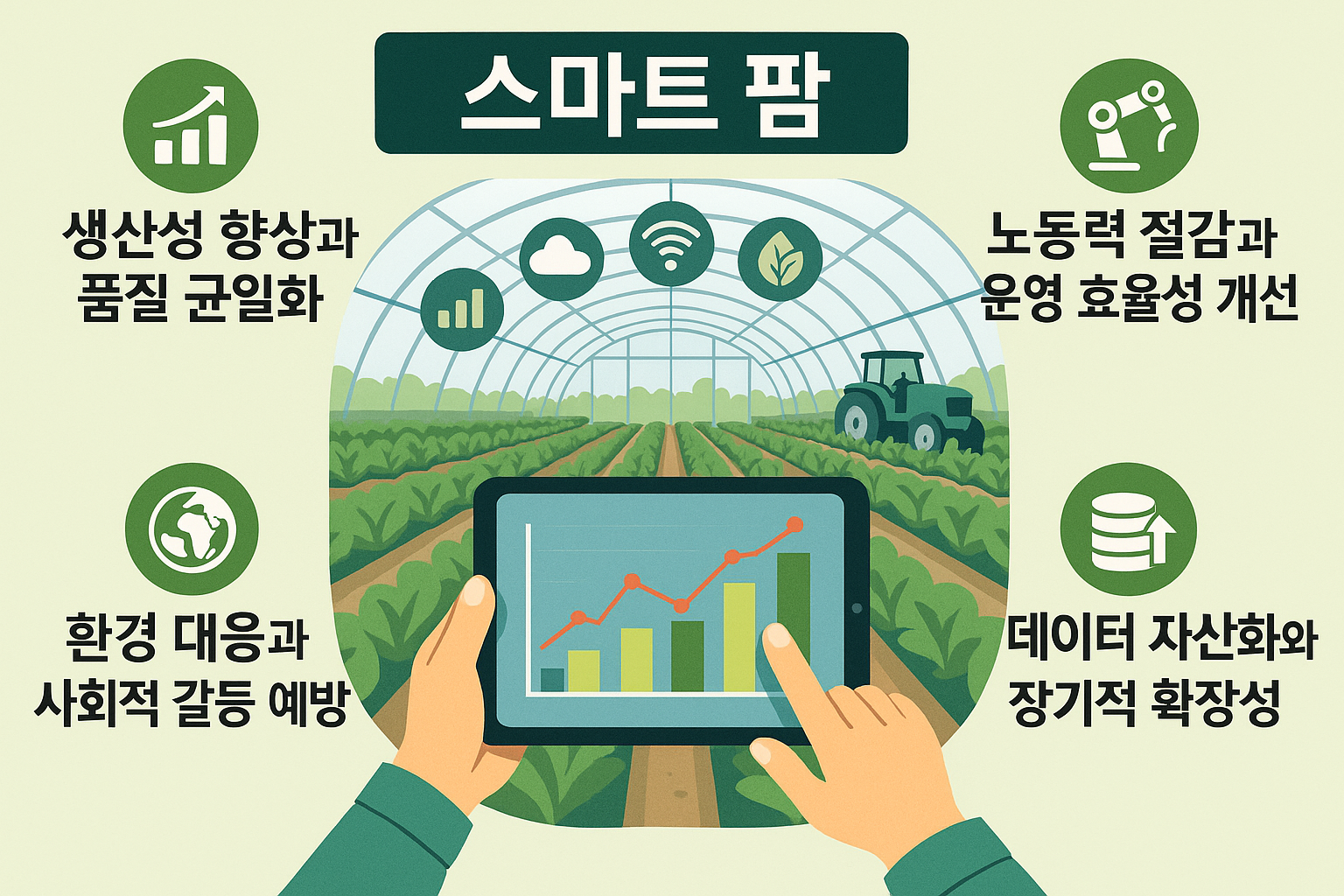
Benefits of adopting smart farming
Closing Thoughts
Smart farming is no longer a technology of the distant future. It is already being applied across diverse agricultural sites and is genuinely solving agriculture’s core challenges — from productivity and efficiency to environmental responsiveness. Thingplus is not a mere equipment supplier but a platform that diagnoses field problems around data and drives change through the right connectivity and control. From growth visualization at the strawberry farm and automated greenhouse control for watermelons to real-time water-quality monitoring at the shrimp farm and odor prediction in the barn—
Across agricultural environments with very different conditions, Thingplus has worked in a consistent way to identify problems, explain them with data, and solve them with technology.
These cases make one thing clear: the evolution of the smart farm is happening not in the laboratory, but in the field. And at the center of what makes that evolution possible is not a sensor or a piece of equipment, but data, connectivity, and a platform that drives continuous improvement.
Smart farming will face ever more diverse and complex demands. Yet through all of that change, Thingplus will hold fast to its principles — ‘technology that works in the field’ and ‘systems operators can understand and use’ — making the future of agriculture more practical and more solid.
A new agriculture built on data and connectivity — and at its center, Thingplus keeps evolving, day after day.