The IoT Ecosystem in the Age of Digital Transformation: Components and Value
The Internet of Things (IoT) is no longer an emerging technology or trend. It is well established and continues to grow. According to Gartner, 95% of new electronic devices incorporated IoT technology by 2020, and 21.5 billion devices are expected to be connected by 2025. Billions of devices, from advanced industrial equipment to children’s toys, are connected to the internet and sharing data.
IoT is steadily weaving itself into our daily lives, and consumer demand is shifting toward smart products. Look at smartwatches, robot vacuums, and home IoT devices: people now expect every device they own to be networked, to operate intelligently, and to be accessible remotely.
IoT operates across a vast network. It involves a variety of components working together to form a cohesive system, with equipment and devices performing autonomous tasks based on data collected from connected sensors. Many players take part in this entire process, forming a complex IoT ecosystem. Knowing what the IoT ecosystem is, along with its various components, gives you a much better understanding of how IoT works.
Understanding IoT
To understand how IoT affects your business, you first need to understand what IoT is. Put simply, IoT is the connection of sensors, devices, and software that communicate and share information, acting and interacting through automation and machine learning. It is a network of hardware, software, and applications that interact and connect with one another using the internet and cloud technology. At the heart of IoT is connectivity, and that is precisely why this technology offers companies opportunities for growth.
The use of IoT to remotely automate and control business processes and operations has grown dramatically. With IoT software, for example, an organization can connect all of its mobile devices to the network and manage them from one central location. That gives you more effective control over how devices interact with and make use of the network. The technology lets you implement security protocols and manage data in ways that affect efficiency and productivity, and it also lets you track and monitor company assets.
What Is an IoT Ecosystem?
An IoT ecosystem is a network of organizations that drive the creation and delivery of IoT products and services. As IoT systems grow more sophisticated and specialized, the interdependence among IoT ecosystem participants is becoming ever more important and more complex.
The IoT ecosystem is expanding rapidly. Every component involved in connecting providers and users through devices forms part of the ecosystem. These can be visible components such as user interfaces and hardware, or software and processing components such as networks and storage.
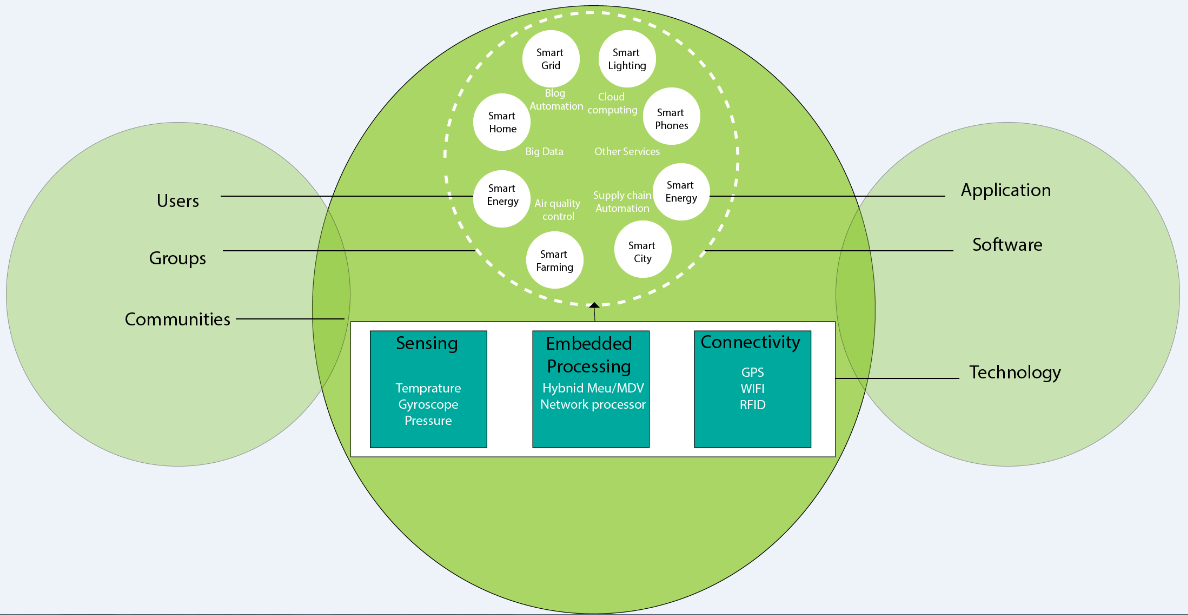
Components of the IoT Ecosystem
Sensing & Embedding
Sensing and embedding form the backbone of the IoT network. In any conversation about IoT, data is indispensable, and sensors are the critical element that guarantees data accuracy and reliability. Sensing and embedding are essential elements of IoT, responsible for collecting data or controlling mechanisms.
Sensors
Sensors operate to collect fine-grained data from the surrounding environment. This lets IoT devices capture relevant data for real-time or later processing. In addition, sensors are essential to achieving automation based on specific conditions.
Depending on the type of sensor, anything can be measured: smoke, motion, even blood pressure. Advanced sensors can measure many different things, and some IoT devices come bundled with multiple sensors so they can collect a variety of data or perform several functions. A smartphone, for example, packs GPS, fingerprint, camera, tilt, motion, and countless other sensors into one place. Different applications need different types of sensors depending on the device and use case.
Thanks to advances in technology, today’s sensors are smaller, smarter, and cheaper. The choice of sensor depends on the goal you are trying to achieve. It is also determined by the sensor’s accuracy, the reliability of its results, its operating range, its resolution, and its level of intelligence, which is to say its ability to handle interference.
Actuators
Actuators work in the opposite direction from sensors. While sensors sense, actuators act. They receive signals or commands and trigger actions based on them. They are just as important as sensors, because when a sensor detects a change in the environment, an actuator makes something happen based on the conditions.
Actuators come in many types depending on the purpose. They can switch things on or off, and they can also control valves and perform tasks such as rotating or gripping, making them enormously valuable in industrial applications
Connectivity
IoT is a network encompassing sensors, actuators, devices, and the cloud, and they must be connected to one another to analyze data and, ultimately, take action.
Protocols
Once sensors collect data, a transmission medium is needed; in other words, a communication channel between the sensors and the cloud. IoT protocols handle data transmission in the online world, and that transmission is possible only when two devices are securely connected. IoT standards and protocols encompass the invisible language that allows physical objects to communicate with one another.
The choice of network depends on factors such as power consumption, data transfer speed, range, bandwidth, and overall efficiency. The most popular IoT wireless protocols and standards include Bluetooth, Wi-Fi, ZigBee, LoRaWAN, DDS, MQTT, and cellular.
IoT Gateways
Raw data received from sensors must reach the cloud through a gateway. Gateways translate network protocols to ensure smooth communication among all the devices in the network. In essence, the gateway becomes a key communication point that makes data traffic easy to manage.
Gateways provide security by protecting the system from unauthorized access and malicious attacks. Because the data passing through this layer is protected with modern encryption, it can be regarded as a security layer.
Gateways can also pre-process data from sensors before sending it to the cloud, minimizing the large volumes of data sensed in the previous stage. Some, though not all, intelligent IoT gateways can even analyze and average the data so that only relevant data is sent to the cloud.
The IoT Cloud
The cloud is where the “intelligence” happens; it primarily connects components to the IoT ecosystem, and it processes, stores, and analyzes data. All of this involves staggering volumes of data, yet it happens fast.
The main purpose of an IoT solution is to deliver real-time information and remote control, so there must be a component that can process vast amounts of data in a short time to match that time-sensitive nature. This is where the cloud system comes in. The cloud system serves as the brain of the IoT ecosystem, since it is generally responsible for processing, commanding, or analyzing the collected data. It combines devices, protocols, gateways, and storage for efficient real-time data analysis.
The cloud effectively delivers information to consumers through massive computing power, storage capabilities, networking options, analytics, and other service components. IoT does not strictly require the cloud, since local processing with Edge or Fog computing is also an option, but the cloud can be the preferred choice as a high-performance facility offering large-scale scalability and lower operating costs.
Data Management and Analytics
Data may feel trivial, but it holds enormous power to shape a business. Data analytics is used to make sense of vast amounts of analog data. Put differently, data analytics converts raw data into useful insight and lays the groundwork for decision-making.
Data analytics helps determine critical business insights. Deep learning models in particular can be used for predictive analytics. By drawing a range of learned outcomes from the data, you can forecast trends, plan ahead, and make useful business decisions.
This kind of analysis requires storage capacity that can accommodate all of the data, along with intelligent computation. Depending on the IoT architecture, these workloads can be hosted in the cloud.
Interfaces
The user interface is the visible component that IoT users can easily access and control. This is where users control the system and set their preferences. The more user-friendly this component of the IoT ecosystem is, the easier it becomes to interact with users.
Users can interact with the system through the device itself or remotely via smartphones, tablets, and laptops. Smart home systems such as Amazon Alexa and Google Home also let users communicate with their devices.
In today’s fast-moving world, design is an important consideration, and some IoT devices set themselves apart from competitors on the strength of their design. Touch interfaces, the use of color, fonts, and voice are all contributing factors. An attractive design is necessary, but the interface must be user-friendly enough to give users no difficulty at all.
The Value of the IoT Ecosystem
IoT does not run on a single company; it takes a digital ecosystem of multiple companies and technologies to create, manage, and monetize an IoT platform. The relationship between the IoT ecosystem and platform companies is deeply symbiotic, and the collective results work in every participant’s favor, creating new opportunities. With the enormous volumes of data from connected devices driving demand for other digital platforms such as 5G ultra-fast mobile networks and real-time cloud data management and analytics, the IoT ecosystem has established a commanding presence.
Joining an IoT ecosystem brings the following benefits.
New revenue
As IoT technology captures consumer interest and the push toward smart buildings and industrial automation accelerates, opportunities have emerged to offer new products and services that were not needed before. These IoT offerings will hand entirely new revenue streams to many companies, including telecommunications providers.
Greater efficiency
Through the IoT ecosystem, companies can streamline and automate processes to raise efficiency and, in turn, employee productivity. As processes become more streamlined and automated, more work gets done faster with fewer resources and less chance of human error.
New business models
IoT is being used to create new business models through automation and new service offerings. Joining an IoT ecosystem can change how you operate your business for the better.
Better business insight and customer experience
The capabilities of the IoT ecosystem surface real-time data you can use to improve product and service offerings and operations, and analyzing that data yields business insight. That, in turn, translates into a better experience for customers.
A point of differentiation
By collaborating within the IoT ecosystem, a company can use its partners’ strengths and resources to stand apart from competitors, for example by selling into new categories it could not otherwise reach.
Greater business agility
Gaps in a company’s product portfolio can be filled by partners’ products, increasing the agility to bring IoT systems to market faster, offset risk, and reduce upfront capital expenditure by spreading investment across multiple industry participants.
Broader reach
Because each partner brings different customer relationships, partnerships often accelerate market reach and adoption. Building the right partnerships also frees up time and resources that can be devoted to IoT innovation and value creation.
Join the Thingplus IoT Ecosystem
Having led the IoT platform market for the past decade, Thingplus believes the key to success in the IoT business lies in partnerships among diverse IoT players. The heart of our approach is for the hardware, network, and platform companies that make up an IoT service to build high-potential partnerships together, develop new killer services, and scale the business. We aim to build this IoT ecosystem on Thingplus and create new business value.
Building an IoT ecosystem strategically makes it far easier to build and manage IoT services that give you a competitive edge. Centered on its IoT platform, Thingplus is working with a wide range of companies to create IoT ecosystems both in Korea and abroad and to keep growing them.
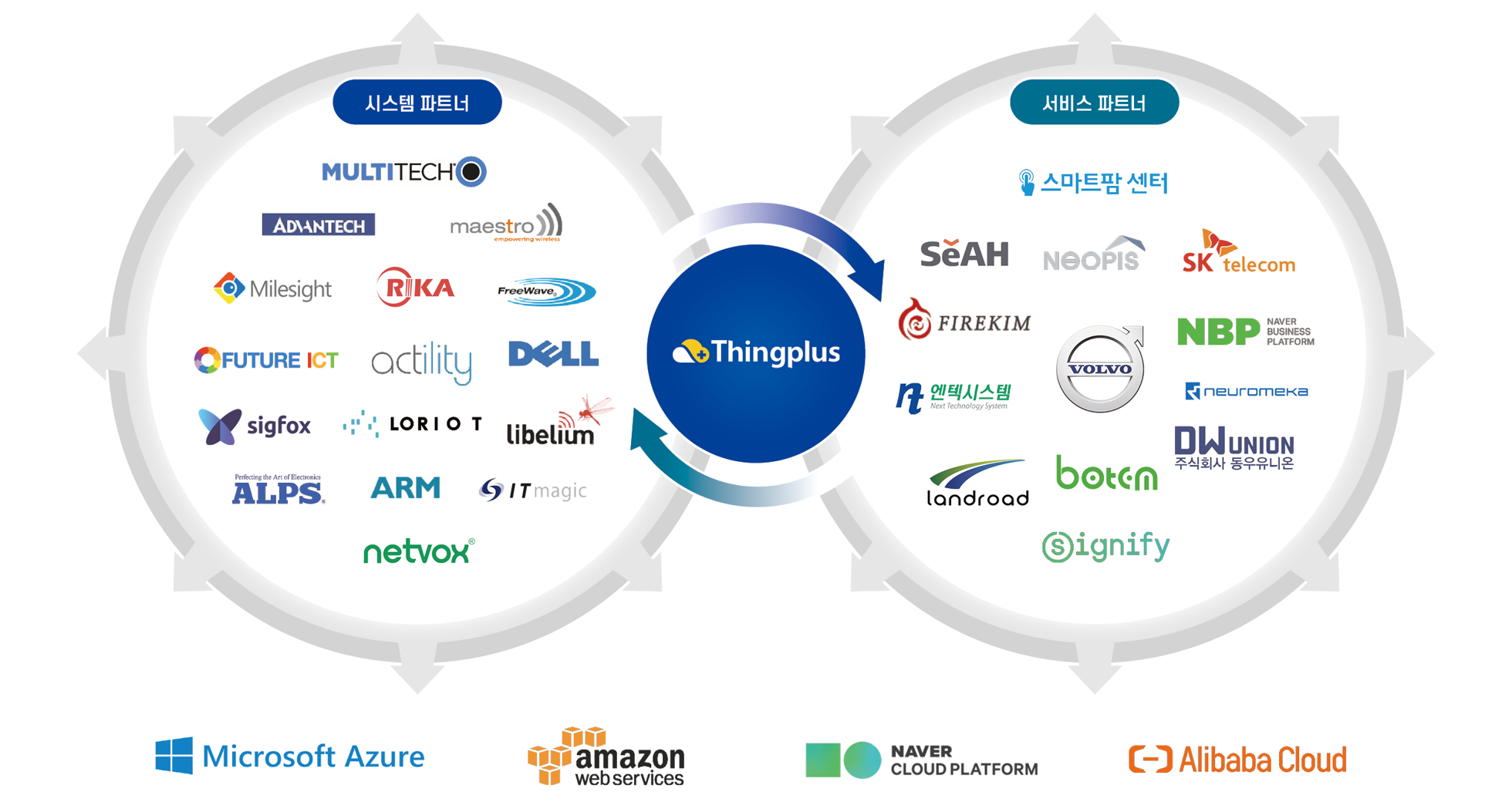
Thingplus Service Partners
Transform your customer experience. Thingplus helps service partners deliver IoT services to their customers. By providing the services customers expect as efficient, secure cloud-based SaaS, partners can secure business competitiveness. Service partners deliver integrated IoT services to customers in specific vertical domains and pay for the Thingplus platform through service revenue sharing or solution license purchases.
If you would like to know more about how to get started, contact Thingplus!