Industry Trends in the Artificial Intelligence of Things (AIoT)
As the adoption of artificial intelligence (AI) to commercialize the IoT field comes to be seen as a natural progression, AIoT is drawing attention as a new industry. IoT connects physical space to virtual space through the digital transformation of the physical world, and as digital twins that visualize the big data of the digitized virtual space are combined with AI that supports decision-making in physical space, IoT is advancing from connected IoT to intelligent IoT and evolving further into autonomous IoT. Building on connected IoT, data analysis based on machine learning algorithms is being used to optimize business processes and raise productivity.
The Concept of AIoT and Where It Is Headed
According to the definition in the ICT R&D Technology Roadmap 2023, the IoT technology of the future is “a convergence technology that analyzes, predicts, and judges situations to autonomously deliver intelligent services,” and as the three stages of AIoT evolution (connected, intelligent, autonomous) make clear, the importance of AI is predicted to become even more prominent.
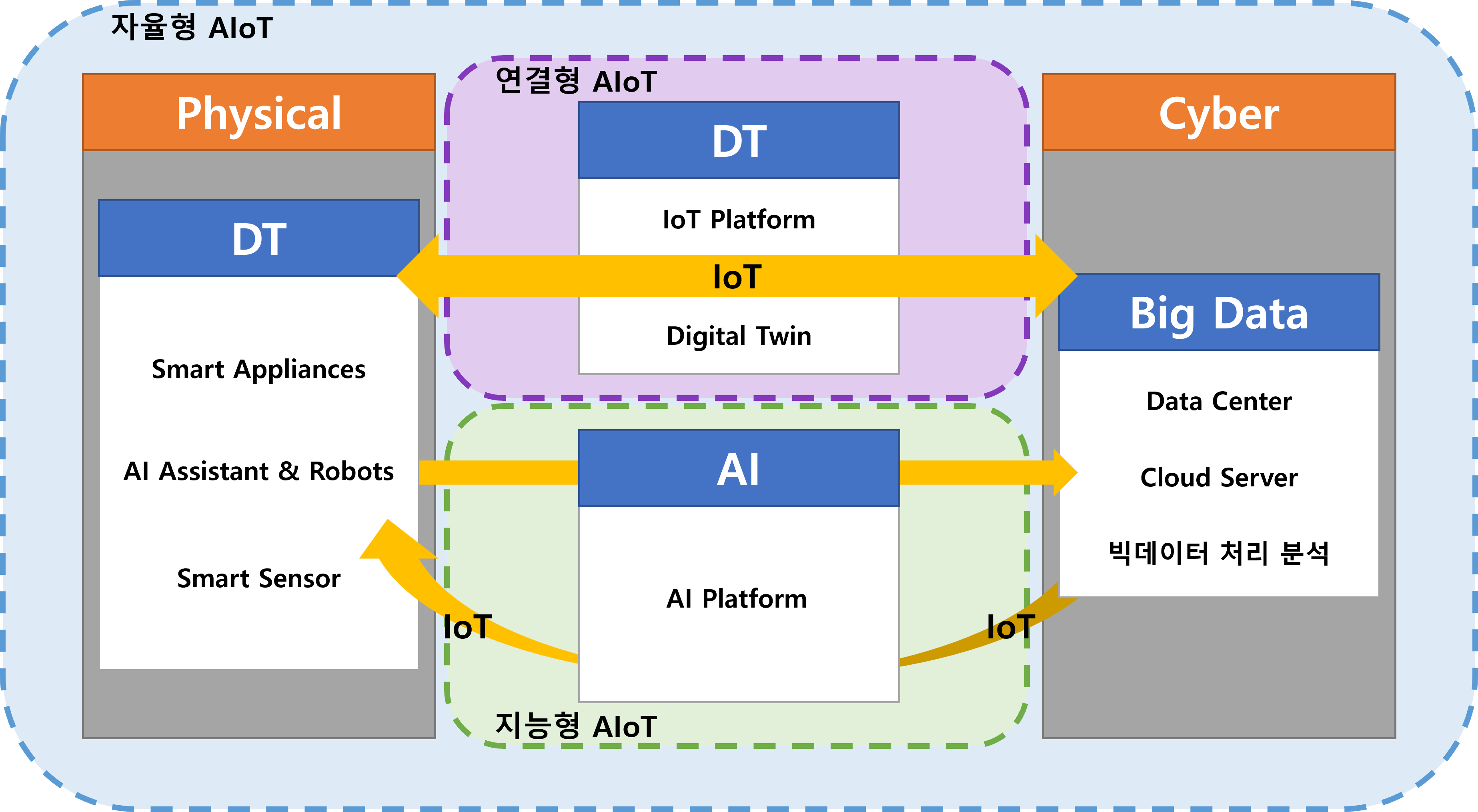
If we divide service spaces into physical space and cyber space, digitalization is needed to connect the real-world physical space with the virtual space, and the Internet of Things serves as that link, bringing about digital transformation (DX). In the virtual space, big data gathered through IoT is expected to be activated, through visualization, into digital twin or metaverse services that can be put to use in the real world. The big data gathered in virtual space is analyzed with AI algorithms against unstructured data from the real world, and as AI platforms move beyond analysis to optimization in the real world, AIoT will ultimately evolve into autonomous AIoT in which AI makes decisions before we even notice.
Why AIoT Is Needed
Gartner cites three reasons industrial companies should adopt IoT.
① To generate data from the systems the company already operates (for example, collecting data from manufacturing equipment to predict maintenance requirements)
② To provide real-time feedback on company performance (for example, collecting user-pattern data from smart trash bins at amusement parks)
③ To create new value propositions that sharpen the company’s competitive edge (for example, integrating data to improve product/service delivery, as with smart refrigerators)
Technical Requirements of AIoT
AIoT architecture can be broadly divided into a perception layer, a network layer, and an application layer. Middle layers may be needed to interconnect the perception and network layers, and the network and application layers, and what roles and functions those middle layers provide can become the differentiating point of a product or technology.
The limitations and requirements that can arise when adopting AIoT are as follows, and they must be addressed to deliver smooth intelligent IoT services.
Greater operational risk as IoT spreads
After adoption, the more complex system composition that IoT brings can actually slow responses to emergencies such as disasters, and these problems have become a major constraint on IoT’s development.
Data interruption and transmission delay
Contingency measures are needed so that IoT devices can keep operating on their own both when transmission delays occur as many devices send data simultaneously and when communications are cut off entirely.
Communication costs
Large volumes of data must be stored and analyzed, but direct communication between individual IoT devices and a central control center incurs ongoing communication costs. There have been moves to build private LPWA networks to avoid network fees, but with the recent shift to enterprise IoT rate plans, prices fall as device counts grow, so companies are increasingly choosing mobile carrier networks over building separate private networks.
Integrating diverse devices
IoT technologies vary by communication method and frequency, and each service carries its own set of requirements, so many technologies coexist but are hard to integrate. Gateway products that support every wireless interface are appearing as a result, but they can end up raising the cost of the overall system.
Security
In a smart city, IoT is highly exposed to attacks through potential flaws in the devices and networks of each layer, including the perception layer and the network layer. IoT devices are prime targets in particular because their computing power is markedly low. IoT cyberattacks do not end with simple data theft; they can escalate into weakened administrative capacity or citywide paralysis, so caution is essential. In common IoT communication protocols the payload is encrypted, but metadata containing information such as packet size and communication timing is not, so security demands attention. Recently, momentum has been building behind security reinforced by deep learning-based IoT threat detection and safe network technologies, which span network cloaking, high-assurance VPN tunneling, and intelligent networking.
AIoT in the Business Domain
Intelligent IoT, combined with convergence technologies for efficient IoT service operations, is accelerating digital transformation and will ultimately develop into autonomous IoT with minimal human intervention. In its IoT technology roadmap, the Institute of Information and Communications Technology Planning and Evaluation selected the key technologies expected to draw attention going forward, among them “lightweight/low-power AIoT on-device technology,” “AIoT platform technology,” “autonomous IoT networking technology,” and “digital twin platform technology.”
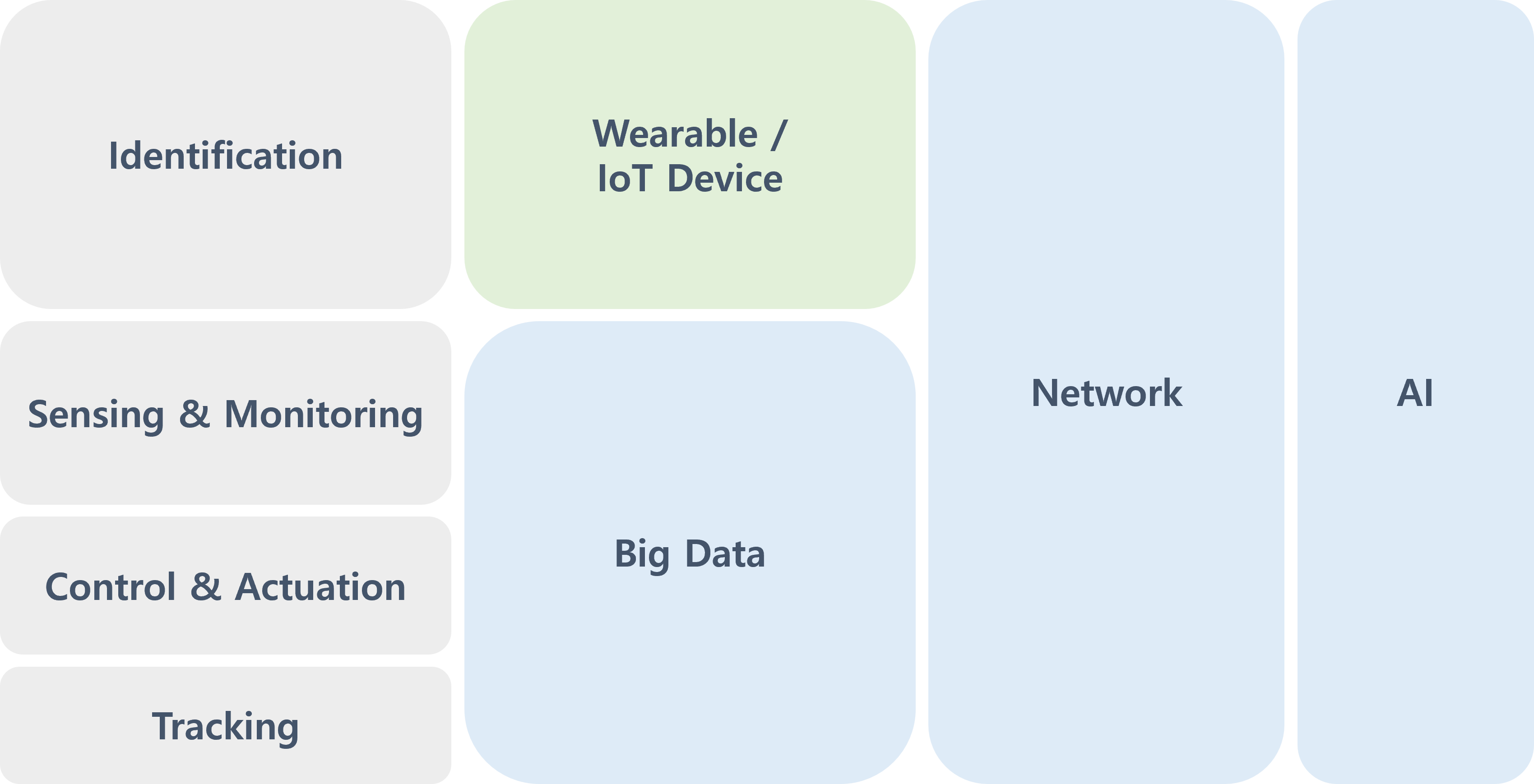
IoT services are applied on top of device and infrastructure component technologies such as ID recognition, sensing, monitoring, control, and tracking, and they break down into technologies that collect data from things and deliver it over networks to the systems that analyze or control it.
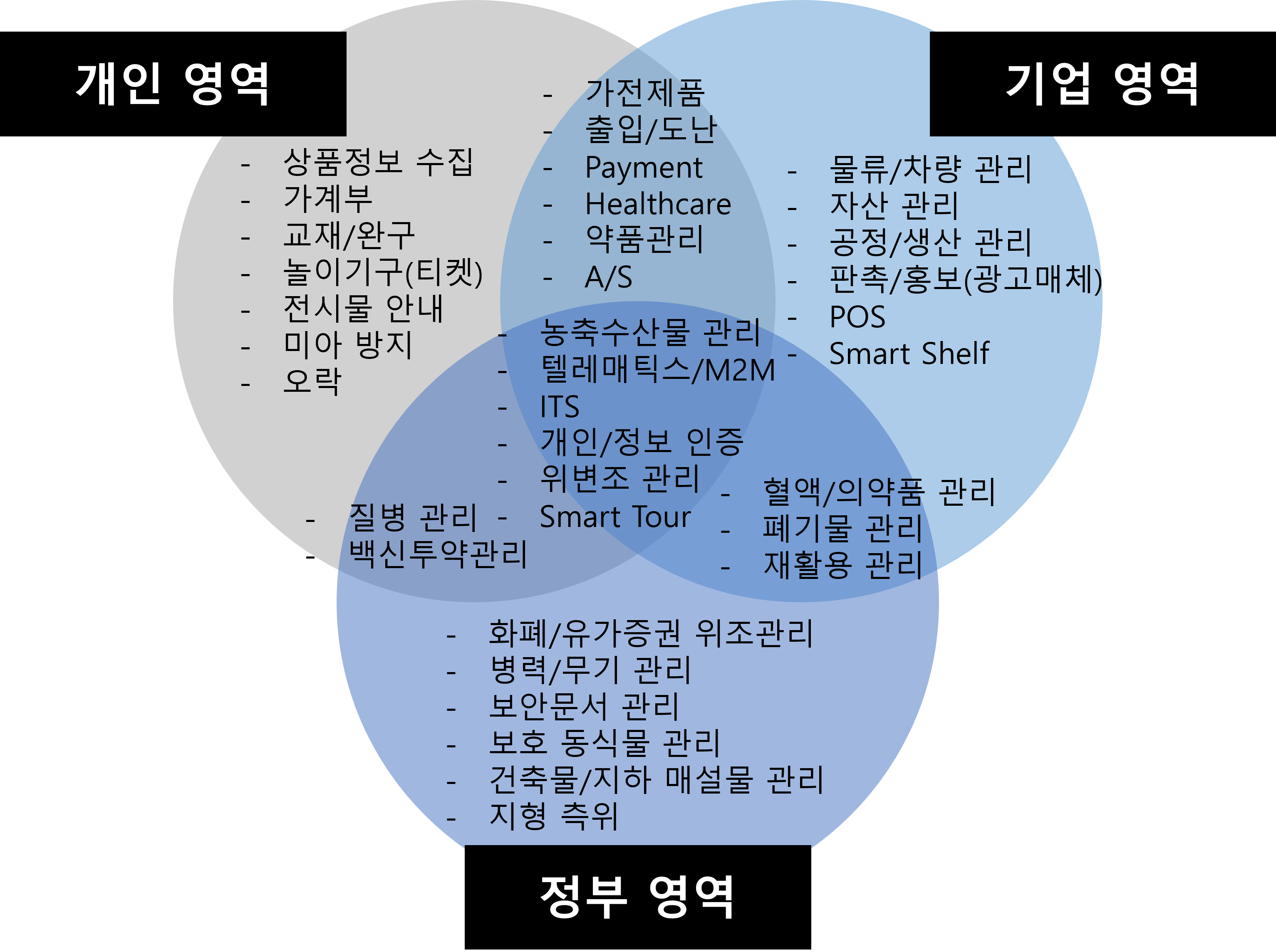
Use cases for IoT business can be organized, following design thinking methodology, into the personal, enterprise, and government domains. The overlapping areas between domains are where new converged services can emerge; each service name written in the figure refers to a representative service, but should be read expansively as covering related services rather than being limited to that term.
As an example of services overlapping the enterprise and personal domains, AIoT appliances are already part of everyday life in IoT-based home appliance services: air conditioners driven by human-presence sensors, robot vacuums that scan every corner of the house to build indoor maps for cleaning, washing machines that switch options depending on how soiled the laundry is, humid weather, or high fine-dust days, and refrigerators that order food online and track expiration dates. Looking more closely, IoT appliances can tie into the smart home, and in healthcare, viewed from the logistics side, the same IoT service becomes pharmaceutical supply chain management in the enterprise domain while becoming a personal medication management service in the personal domain, allowing IoT and healthcare services to be combined. Marrying appliances and healthcare can produce a home doctor service built on AI speakers, which can also play the role of an assistant that smooths communication between people.
In the government domain, building management and underground utility management can pair with digital twins to extract meaningful information from thing-generated data and 3D-digitized spatial information, delivering services for urban control and construction. Typhoons and floods in city centers, rivers, and bridges can be simulated in advance so local governments can prepare urban safety and disaster measures ahead of time, and cities and buildings can be designed from the outset as smart cities that prevent natural disasters while a digital city is built in parallel, serving as a new metaverse city.
Where the enterprise and government domains overlap, supply chain management or cold chain services for vaccines, blood, and pharmaceuticals are representative examples. This space is generally backed by legal regulation, and companies typically bid on government public projects. Laws and regulations related to IoT include the Personal Information Protection Act, the Location Information Act, the Information and Communications Network Act, the Special Act on Promoting Information and Communications, the Medical Service Act and Medical Devices Act, and the Motor Vehicle Management Act, with the IoT Security Guidelines serving as security management guidance.
Where the enterprise, government, and personal domains all overlap, telematics and ITS are the flagship examples. With control functions built into personally driven vehicles, businesses are already under way around AI-infused autonomous vehicles, C-ITS, and the c-V2x technology essential to connected cars.
AIoT Adoption Trends by Industry
Manufacturing
In traditional manufacturing, the shift no longer stops at adopting control systems for simple automation; the transition to smart factories is taking visible shape. Through intelligent IoT, robots are deployed across production facilities, and the data generated by each piece of process equipment is created, collected, and analyzed, with AI learning used to optimize processes and predict outcomes. Digital twin technology links the physical and virtual worlds, enabling AR and VR, and parts of production lines are being combined with 3D printing lines so that production can run anywhere in the world IoT reaches.
On production lines, image sensors and AI catch product defects in items moving along conveyor belts; for sensing components, analyzing measured performance values automatically detects defective units, and AI algorithms calibrate components to raise production yield. Meanwhile, communication links between equipment and workers make control-room monitoring possible on the production floor. For worker safety, site management and monitoring enable indoor and outdoor positioning, and wearable devices fitted with motion sensors and AI video cameras capable of object recognition are used to analyze worker behavior and detect workers without helmets or safety vests, while work equipment such as forklifts and cranes fitted with LiDAR sensors helps prevent accidents involving people or other machinery.
More recently, IoT infrastructure built on 5G, with its ultra-high speed, ultra-low latency, and hyperconnectivity, is overcoming the limits of WiFi and wired Ethernet inside factories, providing mobility and wireless coverage for more cost-effective smart factories. 5G services applicable in smart factories include intelligent video surveillance, predictive maintenance for equipment, production quality management solutions, collaborative robots, remote control and automation solutions, AR-based remote expert support, and autonomous guided vehicles (AGV, AMR), with AI and 5G IoT technology at the foundation.
Logistics
Logistics systems generally use IoT to secure visibility and traceability of cargo. To deliver fresh products such as fruit, vegetables, and dairy safely, research on IoT food supply chains monitors environmental data from production sites through warehouses, delivery vehicles, and stores, tackling traceability, food safety, and spoilage risk. Food waste from spoilage is a critical problem in today’s food supply chains, and tracking systems across the chain provide visibility into food safety information. When a food problem does occur, however, tracing past information backward consumes substantial resources, so research is also under way on designing FCM (Fuzzy Cognitive Maps)-based autonomous IoT tracking systems that can trace products across their entire life cycle.
Automated handling equipment such as AGVs and AMRs is spreading inside warehouses, and with AI algorithms plotting optimal delivery routes to make last-mile parcel delivery more efficient, expectations are also rising for autonomous vehicles and unmanned delivery drones. Using LiDAR and cameras, SLAM (Simultaneous Localization and Mapping) technology and deep learning algorithms for object recognition control moving vehicles so they can avoid people and obstacles while in motion, and video recognition of cargo storage locations improves delivery management and productivity.
Public Sector
A growing number of local governments and public institutions are adopting IoT networks to monitor water supply facilities or deploying smart flood control systems. Jeju Island, in a first for Korea, equipped some 1,000 city buses with a high-precision satellite navigation system (RTK-GNSS) offering centimeter (㎝)-level positioning accuracy; GPS errors are corrected with signals from ground reference stations, and each bus’s current location is sent periodically over the IoT network to the BIS (Bus Information System) server and displayed on map apps. RTK-GNSS is also being built out not only as an ultra-precise positioning sensor for lane changes in future autonomous vehicles but also as a system to minimize accidents caused by drowsy truck drivers.
Meanwhile, the Ministry of Science and ICT decided to concentrate support on seven flagship projects in five strategic areas starting in 2021, with a range of AIoT projects planned: △for individuals and small businesses, an “intelligent indoor air quality management system”; △for digital healthcare, an “intelligent IoT-based virtual and augmented reality rehabilitation therapy system”; △for logistics and transportation, an “intelligent IoT integrated cold chain system”; and △for manufacturing, a “predictive maintenance service for small and midsize equipment.”
Construction/Housing/Energy
In construction and civil engineering, moves are under way to bring IoT, AI, and digital transformation into every element of the business, from surveying, design, and procurement to construction, operations and maintenance, and demolition and repair. From measuring terrain to producing drawings, minimizing trial and error in construction and reducing on-site accidents has become critically important, driving the industry’s shift toward Smart Construction. The IoT market in construction is forecast to grow from 7.8 billion dollars in 2019 to 16.8 billion dollars in 2024.
By adopting BIM (Building information modeling), a 3D design technology, and drones fitted with laser scanners, design errors that used to arise when designing from human-surveyed 2D topographic maps can be examined through 3D design, and unforeseen circulation problems can be reviewed in VR. Once construction begins, systems are being introduced that use AI, sensors, and IoT to reflect real-time site information and to monitor and operate construction machinery in an integrated way, raising on-site efficiency. Work status across the construction site can be tracked, drones enable rapid response when accidents occur, and to prevent safety accidents, smart helmets and smart safety vests provide real-time monitoring of site conditions and workers’ real-time locations, preparing for any contingency. Attaching an RTK-GPS sensor unit to a tower crane senses the crane’s actual movements[46], enabling VR operation on a digital twin with visibility into blind spots, and AI can predict and warn of collisions between tower cranes or tipping accidents, preventing construction site accidents. Beyond tower cranes, when IoT and digital transformation are grafted onto excavators, trucks, and other construction machinery that only skilled operators could previously handle, novice operators can work at the level of experts, or the machines can go further into autonomous control, contributing to cost savings, accident prevention, and better working conditions.
After completion, AIoT technology for the smart home links everything that goes into interior work, including heat recovery ventilators, gas valves, lighting, switches, power outlets, and wall pads, as well as AI speakers and white and black goods, all connected through IoT; this is already happening in the real world. AI adoption is also expanding in HEMS (Home Energy Management System), which intelligently measures and adjusts all the energy consumed in a home to create a passive house, in BEMS (Building Energy Management System) for managing building energy efficiency, and in factory-scale FEMS (Factory Energy Management System).
Reference: Intelligent IoT Industry Trends (Institute of Information and Communications Technology Planning and Evaluation)