Digital Transformation Trends by Keyword
In this post, we look at digital transformation trends by keyword, focusing on real-world cases.
Using the Metaverse for Digital Transformation
Across industries, more and more companies are putting the metaverse to work in their digital transformation. The companies pursuing it are striving to deliver differentiated experiences through a range of content and services in the metaverse—a three-dimensional virtual world where activities mirror those of the real world.
Financial Institutions Are Serious About the Metaverse
Shinhan Bank to Build a Metaverse Platform Within the Year

Metaverse service built by Shinhan Bank / Source: Shinhan Bank
Shinhan Bank is expected to open the banking sector’s first metaverse branch. Among banks, it is moving fastest on building a metaverse financial platform. A Shinhan Bank official said, “Our goal is to build a metaverse-based digital platform that can give customers new experiences and intuitive financial services by expanding financial and non-financial content, with the financial business at its center.”
For now, major banks’ metaverse initiatives remain at the level of holding some meetings and events on external metaverse platforms, but the ultimate goal behind the interest of Shinhan and other commercial banks is operating virtual branches where banking transactions are possible. To that end, Shinhan Bank is building an online-offline linkage system through consultations tied to physical branches and creating virtual spaces for delivering information such as customer lectures and product guidance. It also plans to add an element of fun to finance by building a metaverse environment that borrows from gaming—avatars, virtual spaces, and communication features.
Construction Companies Are Using the Metaverse Across Many Areas
As contactless services expand across industries, construction companies are racing to introduce online tours using virtual reality (VR) and 3D imagery.
The biggest difference between conventional cyber model homes and metaverse-enabled ones is that users can walk through the virtual space themselves. Just as in a physical model home, they can move between different spaces and examine them closely. This opens visits to prospective buyers who find it physically difficult to reach exhibition halls. There are no limits on visitor numbers or hours, and no hassles such as demolition after the sales period ends. For builders, it is highly efficient in terms of cost and time.
Lotte E&C Partners with Zigbang to Boost Real Estate Proptech

Lotte E&C metaverse model house / Source: Lotte E&C
Lotte E&C has joined hands with real estate information company Zigbang to promote real estate proptech using the metaverse. Proptech is a term combining ‘property’ and ‘technology,’ referring to real estate services infused with technologies such as mobile and big data. Through the partnership, Lotte E&C plans to lead residential culture in the contactless era through proptech.
POSCO E&C Opens ‘Metaspace,’ a Virtual Headquarters
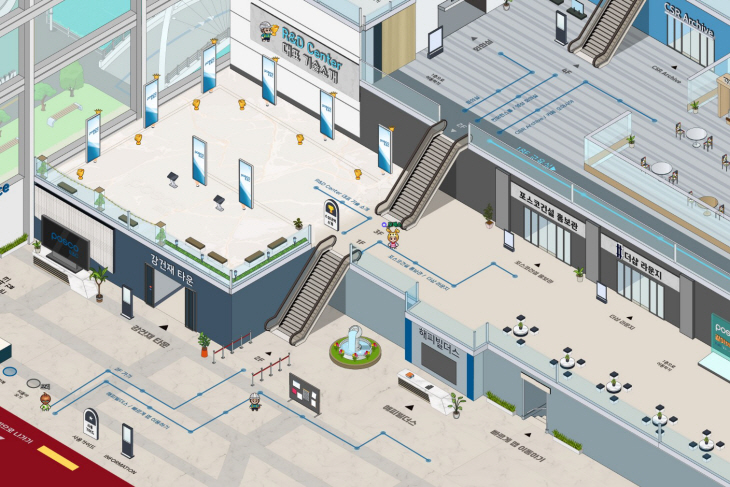
Inside POSCO E&C’s Metaspace / Source: POSCO E&C
POSCO E&C’s Metaspace was developed to support meetings among job sites, headquarters, and stakeholders anytime, anywhere, as flexible work and hub offices become the norm. Immersion is heightened by letting employees communicate through their own avatars in spaces modeled on real buildings, such as the POSCO E&C Songdo headquarters and Incheon Songdo Central Park. Employees send their avatars into virtual meeting rooms and conference rooms to hold meetings, and outside visitors can enter areas other than the workspaces.
Strengthening the Digital Footprint by Linking Online and Offline
Some industries are deeply committed to online-offline integration. After riding a ‘roller coaster’ of results during COVID-19, the furniture industry slid into weaker earnings and is now specializing its stores and reinforcing online business as a strategy to find new paths forward. Vertical commerce companies—which, by the nature of their platforms, need ever more customers to keep growing—are using online-offline integration to widen their points of contact with consumers. Finally, the education industry is also showing strong interest in hybrid education for reasons of educational quality and safety.
Furniture Makers Are Finding a Way Forward in Digital
Hanssem Combines Online and Offline for Millennial Customers
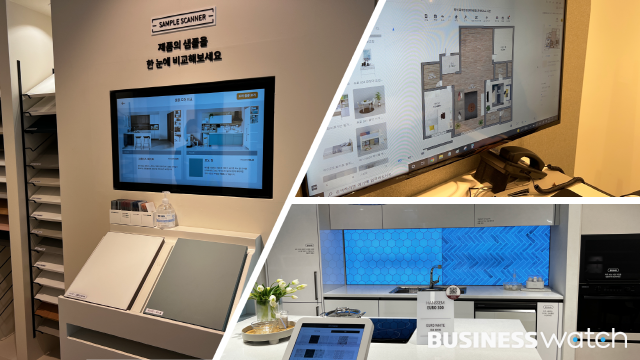
Hanssem’s online-offline integration / Source: Businesswatch
Hanssem is pursuing an ‘online-offline combination’ strategy aimed at millennial customers. First, it is redesigning stores around design, with themes divided by customer taste. It is also adding digital technologies such as 3D design programs to run them as ‘real-time experience spaces.’ The plan is to tie them organically into the integrated Hanssem Mall and Hanssem.com platform slated to launch next year.
IKEA Korea Reinforces Its Omnichannel Strategy
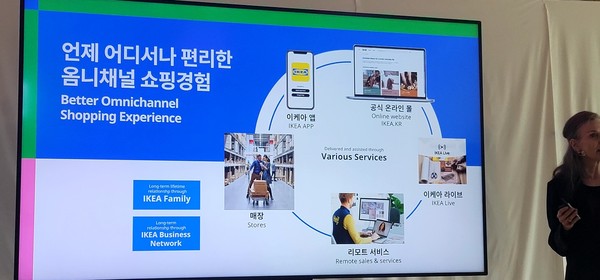
IKEA Korea omnichannel / Source: IKEA Korea
IKEA Korea has unveiled an ‘omnichannel strategy.’ It plans to expand its sales channels beyond physical stores to include the IKEA app, its online mall, and live-stream shopping. An IKEA official said, “Online sales have grown 12% over the past year,” adding, “We also plan to expand remote channels such as phone, chat, and online video services that cover everything from consultation to payment.”
Lotte Mart’s Integrated Online-Offline ‘Digital Fulfillment Store’
Lotte Mart announced it will unveil a digital fulfillment store that integrates online and offline under the banner of turning stores into B2C logistics hubs. The store incorporates a concept of active shopping in which customers receive the products they want, at the time and in the way they want. Online customers can book a delivery window or experience a range of services including immediate delivery, in-store pickup, and drive-through pickup, while offline shoppers can even shop basket-free through QR code shopping.
The fulfillment store is both a warehouse concept for responding to online orders effectively and on time, and an expression of Lotte Mart’s ambition to serve as the customer’s refrigerator.
Strengthening the Digital Footprint by Linking Online and Offline
The logistics industry—where items once had to be sorted, loaded, and unloaded entirely by hand—is being transformed 180 degrees by cutting-edge technology. As logistics shifts rapidly from a ‘labor- and experience-intensive’ structure to a ‘digitally intensive’ one, the latest technologies are being adopted. Artificial intelligence (AI) and big data classify products while robots carry boxes, pushing work efficiency higher through automation. This is expected to strengthen operational safety, ease the physical strain on employees, and raise productivity.
Coupang Streamlines Workflows with AI and Deploys Auto-Baggers and Coupang Cars

Coupang’s latest logistics technology / Source: Coupang
When a customer order comes in, the system weighs millions of options—inventory locations, delivery routes, and more—and tells workers the fastest, most efficient process. Using personally issued PDAs, workers can find the products to ship along optimal routes. ‘Picking robots’ (AGVs) that navigate by reading barcodes on the floor quickly bring hundreds of items to workers. They carry entire shelves of goods to the workstation and even indicate with a blue light which slot to pick from.
The automatic packaging machine, the ‘auto-bagger,’ attaches the waybill and seals the package on its own—workers simply drop the item in, with no need to open and close plastic bags by hand. When workers place packed products on the ‘sorting robots,’ the robots scan the address on the waybill and sort them by region within seconds. Coupang’s delivery vehicle, the ‘Coupang Car,’ has sliding doors and shelves, so goods can be loaded efficiently and found quickly.
Automated systems now handle the item sorting people once did by hand, so all volumes are already sorted before Coupang’s delivery workers, the ‘Coupang Friends,’ arrive for work. Coupang Friends can plan efficient delivery routes through AI-powered PDAs.
CJ Logistics Moves Aggressively to Secure Advanced Technology and Infrastructure
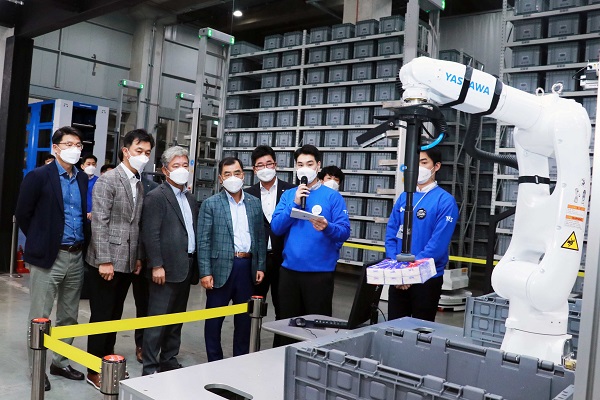
CJ Logistics TES Logistics Technology Institute / Source: CJ Logistics
The CJ Logistics TES Logistics Technology Institute is actively commercializing core technologies such as robot-based site automation, AI and big data-driven operational optimization, and digital transformation-based systems.
The center is supervised with digital twin technology, and 101 picking AGVs (Automated Guided Vehicles) and 25 transport AGVs stand in for human hands. An AGV is a ‘fixed-route transport robot’ that moves by following QR codes attached to the floor.
The steps after workers place the boxes AGVs bring from the picking zone onto the conveyor are automated as well. With these robots and advanced systems, the number of boxes that can be shipped rose 35%. Productivity per person, measured by hourly output per worker, proved 55% higher. Tasks like taping and affixing waybills are also done entirely without people, making packaging productivity up to 40% higher.
Strengthening the Digital Footprint by Linking Online and Offline
AI is delivering efficiency gains on many fronts. With AI, ML, and real-time analytics, companies can minimize business disruption, streamline operations, and improve production environments.
France Uses AI to Detect Violations and Levy Taxes
French tax authorities used AI software to find tens of thousands of unregistered private swimming pools and levied a total of 10 million euros in taxes. The system recognizes pools in aerial photographs and compares them with the property registration database. Piloted in nine regions in 2021, it is now expanding across all of France. Authorities also plan to broaden its use beyond pools to detecting vacant land, unregistered additional structures and extensions, porches, and more.
Hansalim Adopts AI-Based Product Demand Forecasting and Digital Ordering
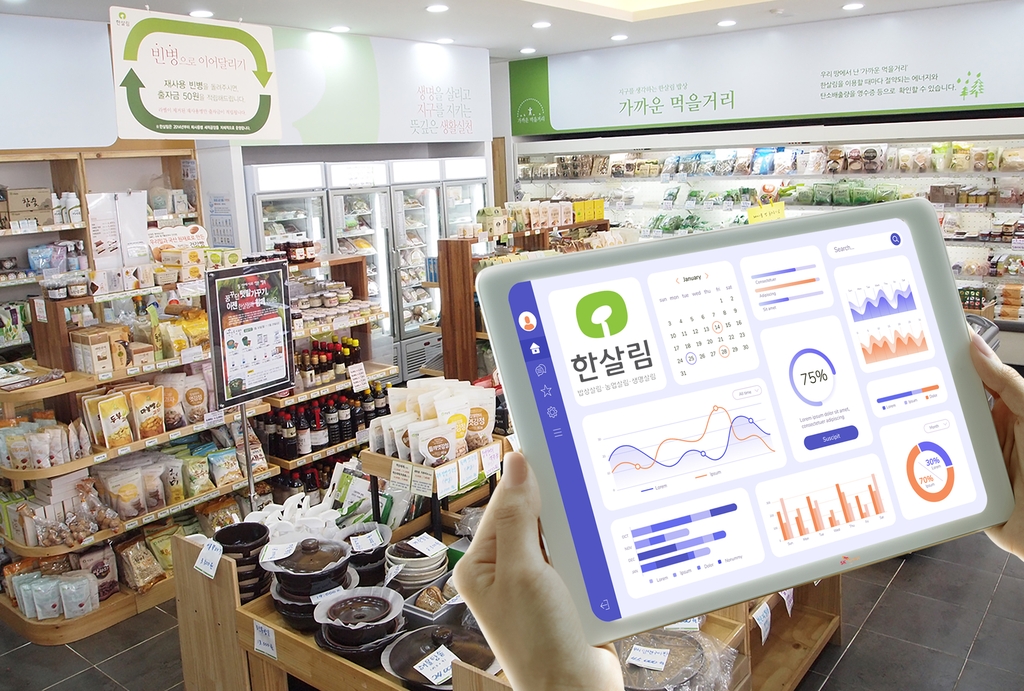
Hansalim adopts AI-based product demand forecasting and digital ordering
Hansalim, an eco-friendly direct-trade cooperative, plans to introduce AI-based product demand forecasting and a digital ordering service. It expects this will allow each of its stores to offer products that match customer demand.