Why Vertical SaaS Is on the Rise | Definition, Differentiators, and Business Strategy
The SaaS market is growing fast within the cloud industry. The global SaaS market is projected to reach $60.36 billion in 2023 and record a CAGR (compound annual growth rate) of 9% over the next four years.
When the SaaS market first emerged, vendors focused on delivering solutions that spanned a wide range of industries (also known as horizontal SaaS). Representative examples include Microsoft 365, Quickbooks, Slack, Salesforce, and ServiceNow. Over the past few years, however, there has been a surge in vertical SaaS companies building solutions tailored to niche industries.
In this post, we take a closer look at vertical SaaS. We will first define what vertical SaaS—often called the next big trend—is and what sets it apart, then consider the business strategies behind building a successful vertical SaaS.
What Is ‘Vertical SaaS’?
As the stakes in the SaaS market have grown, companies competing with SaaS optimized for specific industries have gained a much stronger presence, in contrast to the mainstream players that built products meant to work for all kinds of companies regardless of sector. These so-called vertical SaaS companies are being credited with ever-greater potential. Mainstream enterprise SaaS companies like Salesforce and ServiceNow rose to the ranks of tech giants with horizontal SaaS products that work across finance, retail, manufacturing, services, and more.

SaaS / Source: freepik
SaaS (Software as a Service) delivers software installed in the cloud over the internet. SaaS has the advantage of saving on update and maintenance costs. Because the software is already installed in the cloud, it also spares users the time spent on installation and configuration. SaaS is attractive to cloud companies as well, helping them build cloud infrastructure use cases by serving a wide range of fields.
One reason SaaS is singled out as a promising field for the future is that it has been one of the most heavily invested sectors over the past four years. Going forward, as the time people spend working directly decreases, demand for SaaS that takes over tedious tasks is expected to keep growing.
Vertical SaaS is a concept that spans IaaS (Infrastructure as a Service), PaaS (Platform as a Service), and SaaS, referring to a cloud service that delivers offerings optimized for a specific industry. Vertical SaaS companies focus on a strategy of choosing the narrowest possible market and then drilling into it as deeply as they can. Industries where automation is expected to raise production efficiency—manufacturing, lodging and food service, retail, mining and oil, distribution, and utilities—are cited as fields where vertical SaaS can take root.
The strength of vertical SaaS is that it can be tailored to a specific industry as closely as possible. Realistically, a single SaaS cannot cover all the special circumstances that arise across many different industries—all the more so in sectors made up of small businesses. Exploding Topics, which surfaces promising technology trends for investors and founders, reports that more companies are adopting vertical SaaS specialized for particular industries and uses instead of general-purpose SaaS—and that founders building software for specialized niche markets accordingly have strong growth potential.
The true value of vertical SaaS stood out even when cloud-based SaaS stocks recently declined. Unlike mainstream SaaS companies such as Salesforce and Adobe, companies specializing in vertical SaaS took a comparatively smaller hit.
Experts point to Amazon and Toss as examples, stressing that the companies that built each market’s flagship services share one thing in common: they started by focusing on a small market. Their advice for startups is to concentrate on a small market, become the king of that domain, and grow the company by stacking up these small wins.
What Sets Vertical SaaS Apart
So how does vertical SaaS differ from horizontal SaaS? Let’s find out by comparing it with traditional SaaS.
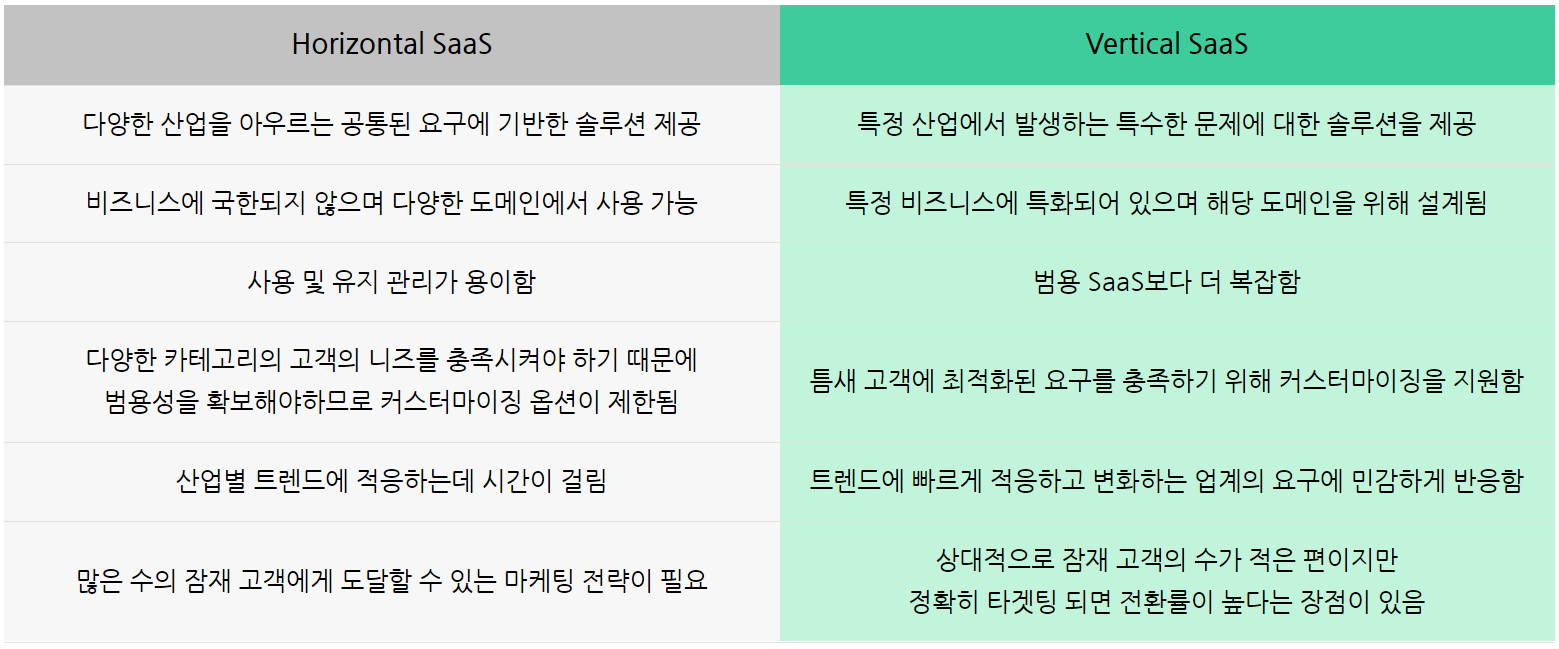
Horizontal SaaS and vertical SaaS each enjoy different advantages.
Horizontal SaaS
– Because it covers a broad market, the revenue it generates is larger in scale
– Companies have a better chance of capturing higher market share in the SaaS industry
Vertical SaaS
– Serves niche markets where leads are more likely to convert
– Customer acquisition and marketing costs are relatively low
– Must comply with industry-specific standards and requirements
– Customer retention depends on the vendor’s level of industry domain knowledge
The challenges they face also differ.
Horizontal SaaS
– Customer retention is lower because it does not always meet industry-specific requirements
– It is hard to stand out in any particular industry
– Marketing costs are enormous, so customer acquisition costs tend to be high
Vertical SaaS
– Marketing revolves around a handful of niche markets, and securing leads is itself difficult
– If prospects already use general-purpose SaaS, persuading them to migrate to a vertical SaaS is not easy
Business Strategies for Building a Successful Vertical SaaS
1. Choose a Promising Vertical
Vertical SaaS is not a one-size-fits-all approach. Instead, it excels at solving industry-specific problems. That makes choosing the right vertical essential. ‘Promising’ means an industry with growth potential that has not yet reached saturation. According to research by Bowery Capital, manufacturing, transportation, drones, and energy are counted among the promising industries of the future.
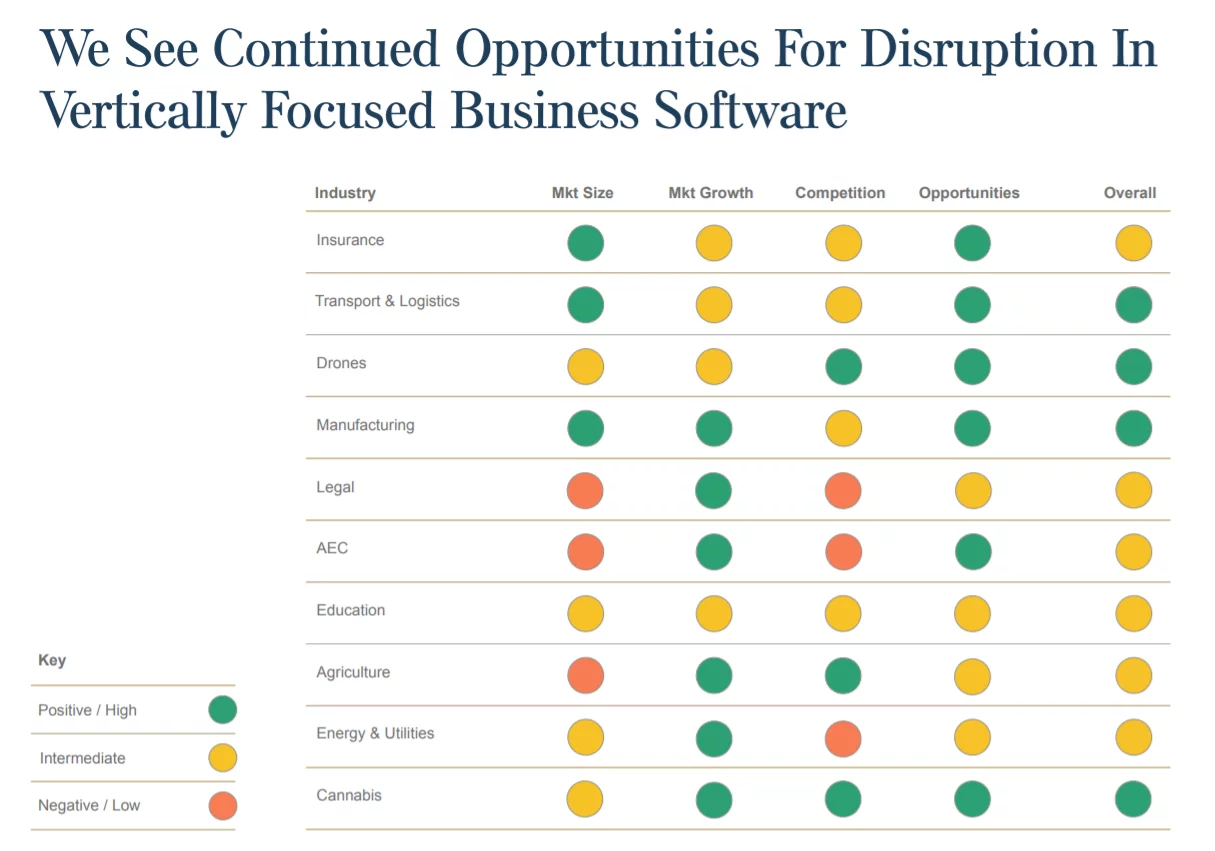
Promising fields for vertical SaaS / Source: https://www.singlegrain.com/
Careful market research matters here. Once you have chosen your field, identify the top SaaS companies and review their pricing and features. Then think about how you will differentiate. Without a differentiator that can outdo the competition, you will likely struggle to win market share.
2. Stick to One Vertical
Moving into other categories can be tempting—because the problems look similar, or because you want to grow your customer base. But it should be avoided. Each vertical requires the service to be customized to that field, so you can only solve the problems of one specific vertical.
Innovaccer, for example, started out serving diverse domains—healthcare alongside finance, retail, and entertainment. In 2016, however, Innovaccer’s founders decided to narrow their focus to healthcare. They dropped their non-healthcare customers and lost nearly 60% of their revenue, but before long the company gained momentum and has since generated more than $120 million in revenue.
Another benefit of staying true to one category is the ability to collect, aggregate, and store industry-specific metrics. You can then monetize this data through value-added solutions such as benchmarking or marketing reports.
3. Comply with Industry Regulations
Targeting a single market lets you design your service to comply with industry-specific regulations. That, in turn, lets you penetrate the market quickly.
4. Involve Industry Insiders
A vertical SaaS must speak the language of its prospects and offer a solution that fully resolves the industry’s pain points. Only then can it win and retain customers.
Insiders with long experience in the industry contribute deep insight through their domain knowledge, helping you improve the service. Another benefit of engaging with industry insiders is being able to quickly understand and adapt to market changes.
Join the Vertical SaaS Trend!
The number of vertical SaaS companies in the Fractal Vertical SaaS Index has grown 28% since early 2020 alone, and many vertical SaaS companies reportedly went public in 2021. The median market capitalization of the companies in the index reaches $11 billion (KRW 14 trillion), showing how sharply vertical SaaS companies have grown, especially since the COVID-19 pandemic.
The reason cloud and SaaS are drawing even more attention lately is that more and more companies are pushing ahead rapidly with digital transformation. Even traditionally offline industries are all moving to digital. That is why ‘vertical’ appears without fail whenever cloud and SaaS trends are summarized—and indeed, you can see many cloud companies launching vertical products. Whether your company is adopting SaaS or building it, that is why the vertical SaaS trend deserves your attention.
If you are interested in adopting or building vertical SaaS, contact Daliworks!