2024 DX Market Trends ┃ Digital Twin, Manufacturing AI, Smart Factory
Digital transformation (DX), which has advanced steadily over the years, has established itself as a core element of the Fourth Industrial Revolution, and in 2024 its importance and influence continue to grow. Companies are constantly adopting new technologies and innovative strategies to secure competitiveness and adapt to a changing market environment.
In 2024, the DX market is experiencing the introduction of new trends and technologies, along with the need to reconcile the changes brought on by the COVID-19 pandemic. As boundaries between industries blur and the convergence of fields such as artificial intelligence (AI), the Internet of Things (IoT), blockchain, and robotics accelerates, companies are entering a new phase of digital transformation. To prepare for these changes, companies need proactive responses and innovative ideas. The importance of cross-industry collaboration and partnerships will also continue to grow, opening the way to new business opportunities.
In this blog, we survey the DX market trends of 2024 and take a close look at technological innovation and how companies are responding strategically. Let’s share the insights needed to build smart strategies in step with new opportunities, challenges, and the waves of change.
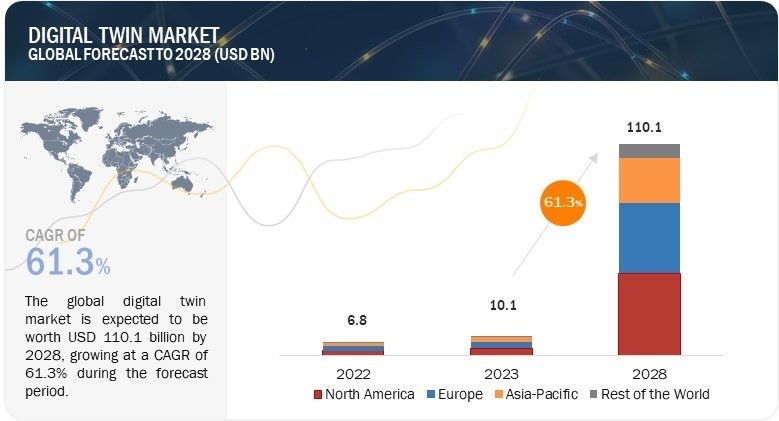
Digital Twin Market to Grow 61.3% Annually Through 2028
Digital twin technology continues its rapid growth, projected to expand from 10.1 billion dollars in 2023 to 110.1 billion dollars in 2028. This growth is driven by rising demand for cost savings through predictive maintenance and improved supply chain operations in the manufacturing and healthcare sectors.
Source: MarketsandMarkets
MarketsandMarkets released its ‘Digital Twin Market – Global Forecast to 2028’ report, analyzing the digital twin market by company size, application area, and industry. According to the report, the digital twin market is expected to sustain ultra-fast annual growth of 61.3%, with the automotive and transportation sector projected to hold a large share of the market among major industries.
A digital twin implements a physical object as a virtual model, collecting diverse data and analyzing it in real time for use in predictive maintenance. The report expects digital twins centered on maintenance applications to show the greatest growth, explaining that predictive maintenance capabilities will improve through the combination of artificial intelligence and machine learning technologies.
North America is also projected to remain the largest market for digital twin technology, thanks to its mature ecosystem of advanced infrastructure, data analytics capabilities, and a skilled workforce.
These advances in digital twin technology are expected to minimize downtime, reduce costs, and enable more efficient operations across a wide range of industries.
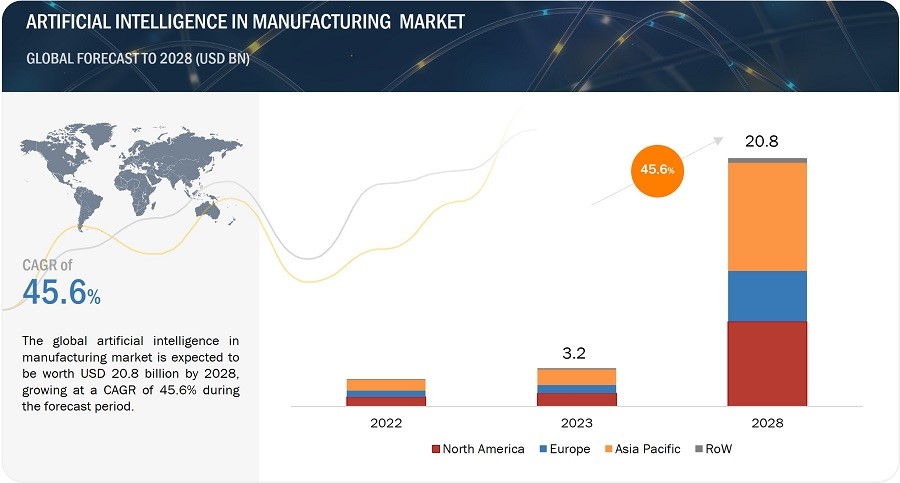
Manufacturing AI to Grow at a Rapid 45.6% Annually Through 2028
The artificial intelligence market in manufacturing, projected to grow from 3.2 billion dollars in 2023 to 20.8 billion dollars by 2028, is expected to record an annual growth rate of 45.6%. This reflects growing demand for AI driven by the rapid spread of digital technologies and the accelerating automation built on industrial robots and the Internet of Things (IoT).
Source: MarketsandMarkets
According to the ‘Artificial Intelligence in Manufacturing Market – Forecast to 2028’ report published by MarketsandMarkets, the application of AI is expected to spread rapidly in manufacturing as well. The report analyzed AI in manufacturing by offering (hardware, software, services), technology (machine learning, natural language processing, cognitive computing, computer vision), industry (automotive, energy, metals and heavy machinery, semiconductor, food and beverage, pharmaceuticals, and more), and application (predictive maintenance, production planning, quality control, industrial robots, and more).
According to the report, hardware is projected to record the highest growth rate due to rising demand for AI, while software is also expected to achieve substantial growth in manufacturing. Computer vision technology is analyzed to show higher growth than other technologies, and among related applications, predictive maintenance and machine inspection are projected to form the main market.
The industries with the largest share of AI in manufacturing are projected to be automotive and metals and heavy machinery, with the Asia-Pacific region expected to show the highest growth rate. This is because factors such as the growth of e-commerce in China, Japan, and India, along with Industry 4.0 and advances in warehouse technology, are accelerating AI adoption.
Amid these trends, AI in manufacturing is expected to contribute significantly to greater efficiency and productivity in production processes, helping cut costs and optimize production lines.
Smart Factory Market to Grow at a CAGR of 9.52% Through 2032
According to global market research firm Precedence Research, the smart factory market was valued at 129.7 billion dollars in 2022 and is projected to grow at a compound annual growth rate of 9.52% through 2032, reaching 321.9 billion dollars.
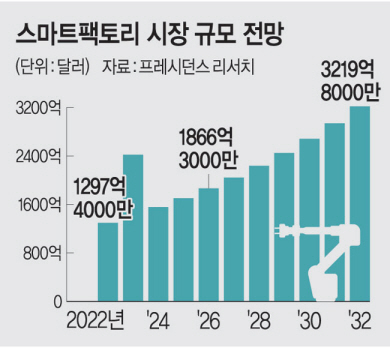
A smart factory is a system that uses core Fourth Industrial Revolution technologies such as the Internet of Things (IoT) and artificial intelligence (AI) to perform real-time monitoring and data analysis within the plant, improving the production environment, boosting productivity, and enhancing worker safety. North America currently leads this market, but the Asia-Pacific region is also projected to show substantial growth. Key drivers cited include increased adoption of industrial robots enabled by sensor miniaturization and the entry of 5G technology into smart factories — factors analyzed as fueling the growth of the smart factory market.
Companies that have adopted smart factories are achieving strong results in productivity, quality, and cost, with corporate revenue and employment rising while industrial accidents decline. Smart factories use IoT solutions such as various sensors and cameras to check process conditions and product quality in the plant in real time. This plays an important role in improving plant safety by quickly detecting unexpected events such as leaks or fires, reporting them to managers, or activating automated response equipment. Through the adoption of these technologies and systems, smart factories are driving innovation and productivity gains in manufacturing.
Korean companies POSCO and Hyundai Motor have built smart factories using AI and IoT technologies to automatically control their production processes, maintaining high productivity and product quality. Small and medium-sized enterprises, however, face relative difficulties in building smart factories; to address this, the Ministry of SMEs and Startups and private companies are running a variety of support programs. The results they are demonstrating are expected to be a significant help in securing future competitiveness.