FEMS Latest Trends and Market Analysis
FEMS (Factory Energy Management System) is a system that efficiently manages and optimizes energy use within a plant. As interest in energy efficiency and sustainability has grown in recent years, the importance of FEMS has come sharply into focus. In this blog post, we examine the future outlook for FEMS through the latest trends and market analysis.
FEMS Market Size
FEMS (Factory Energy Management System) is a system that efficiently manages the energy consumed in a plant. It monitors and controls a variety of energy-consuming equipment — production machinery, HVAC systems, lighting systems, and more — helping reduce energy consumption and improve productivity.
👉 For more details, see our introduction to FEMS.
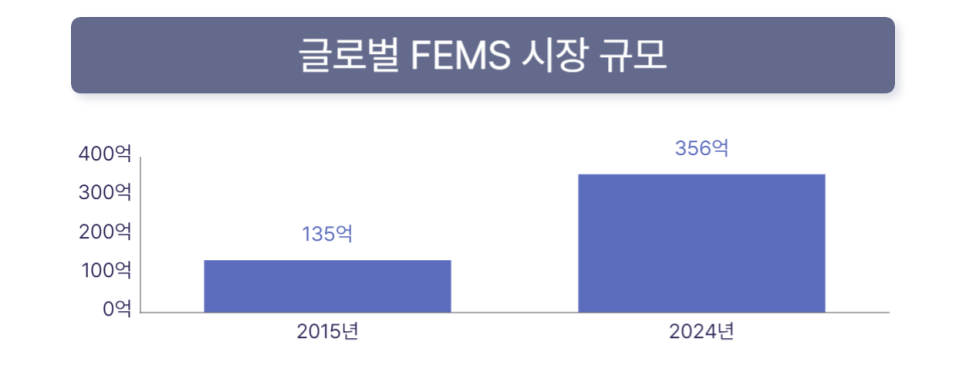
The FEMS market is growing rapidly worldwide, with the market expected to reach 35.6 billion dollars in 2024. That is roughly 2.6 times the 2015 market size of 13.5 billion dollars. Growth in the FEMS market is being driven by the following factors.
FEMS Market Trends

Growing Adoption of Smart Factories
– As smart factories spread under the influence of the Fourth Industrial Revolution, FEMS adoption is increasing along with them. Smart factories powered by IoT (Internet of Things) and AI (artificial intelligence) optimize energy use based on real-time data, achieving cost savings and productivity gains at the same time.
The Importance of Energy Cost Reduction
– With rising global energy prices and tightening environmental regulations, companies are focusing more than ever on reducing energy costs. FEMS is a powerful tool for analyzing and optimizing energy usage patterns, making a major contribution to lowering energy costs.
Environmental Protection and Sustainability
– As ESG (environmental, social, and governance) management gains emphasis, environmental protection and sustainability have become key corporate priorities. FEMS reduces energy consumption to cut carbon emissions, establishing itself as an essential system for realizing eco-friendly management.
Recent Developments in FEMS
Enhanced Big Data Analytics
– The scope of data collection has expanded: in addition to traditional power usage data, systems now also collect data on production output, weather conditions, equipment status, and more. Real-time analysis capabilities have also improved — with stream processing technology, data can now be analyzed the moment it is generated.
Use of AI and Machine Learning
– Recent FEMS systems integrate AI and machine learning to increase the efficiency of energy management. This enables real-time data collection, analysis, and forecasting, helping predict and optimize energy use — ultimately making energy management more accurate and efficient.
Cloud-Based Solutions
– With advances in cloud technology, FEMS solutions are shifting to the cloud. Cloud-based FEMS offers low initial adoption costs, excellent scalability, and easy real-time data access. This is proving a major advantage, especially for small and medium-sized enterprises.
Integration with Predictive Maintenance
– As FEMS integrates with equipment management systems, it has become possible to detect early signs of equipment anomalies through energy consumption patterns. For example, anomalies can be detected in advance to plan maintenance, or energy usage patterns can be analyzed to suggest optimal operating strategies. This contributes not only to improved energy efficiency but also to higher productivity.
User-Friendly Interfaces
– The latest FEMS solutions offer user-friendly interfaces that make energy management easy even for non-experts. With intuitive dashboards and real-time alerts, managers can see the plant’s energy usage at a glance and respond quickly.
Improved Mobile Accessibility
– Cross-platform apps supporting iOS and Android have been developed, and real-time push notifications enable rapid response. Remote control has made equipment management easier, and optimized mobile dashboards make key information easy to grasp. Data access security in mobile environments has also been strengthened through biometric authentication and other measures.
Renewable Energy Integration
– Hybrid systems have been developed to manage existing power grids and renewable energy sources in an integrated way, and linkage with ESS (energy storage systems) now compensates for the variability of renewable generation. Optimal operating algorithms that account for multiple factors have increased the efficiency of renewable energy use. Microgrid support has improved energy independence, and real-time monitoring of carbon emission reductions has been added, enabling environmental impact assessment.
FEMS Future Outlook
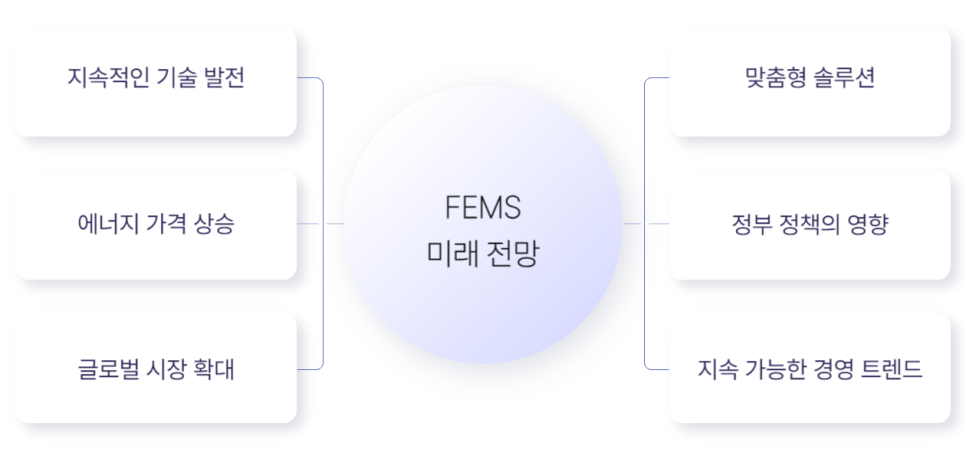
Continuous Technological Advancement
– Advances in AI, IoT, big data, and related technologies continue to improve the performance of FEMS. As these technologies develop further, FEMS will evolve into an even more sophisticated and efficient energy management solution.
Rising Energy Prices
– As energy prices rise worldwide, plants are looking for ways to cut energy costs. FEMS is emerging as an effective means of reducing energy consumption and lowering energy bills.
Expansion of the Global Market
– As the importance of energy cost reduction and environmental protection is emphasized globally, demand for FEMS is growing worldwide. Adoption is expected to accelerate especially in energy-intensive manufacturing sectors.
Customized Solutions
– Customized FEMS solutions tailored to the characteristics of each industry and plant are emerging. These help companies manage energy more effectively and will contribute to improving energy efficiency across industries.
The Impact of Government Policy
– Carbon neutrality policies and tightening environmental and energy-efficiency regulations in countries around the world are accelerating FEMS adoption. In Korea in particular, the goal of improving manufacturing energy efficiency by 20% by 2030 is expected to drive FEMS market growth. Because FEMS helps cut greenhouse gas emissions by reducing energy consumption, it stands to benefit from stricter environmental regulations.
The Sustainable Management Trend
– As companies emphasize sustainable management, FEMS is rising as an important tool. FEMS contributes to higher energy efficiency and lower carbon emissions, playing a key role in achieving corporate sustainability goals. As the sustainable management trend strengthens, the importance of FEMS will only grow.
Conclusion
FEMS is more than a simple energy management tool — it is a critical system that maximizes plant operational efficiency and drives sustainable growth. With the commercialization of 5G technology in particular, even more precise, real-time energy management will become possible.
Through the latest trends and market analysis, we have confirmed the importance of FEMS and its future outlook. If your company aims to reduce energy costs and protect the environment at the same time, FEMS adoption is well worth serious consideration.