The State of Digital Transformation in Japan
One keyword dominated a 2018 report by Japan’s Ministry of Internal Affairs and Communications: the ‘2025 Digital Cliff.’ It refers to the possibility that if digital transformation fails to advance across Japanese society, the country could suffer economic losses of up to 12 trillion yen per year from 2025 onward. With the ‘2025 cliff’ drawing ever closer, digital transformation has already moved beyond the level of individual companies to become a national priority for Japan.
The Japanese Government’s Digital Transformation Policy
The Digital Agency, a central government body created to lead digital reform, officially launched on September 1, 2021. Placed directly under the Prime Minister, it is effectively a declaration of intent to drive Japan’s digital transformation at the national level. Starting with the expansion of the My Number card, which is similar to Korea’s resident registration number, Japan is pushing to overhaul its government-wide data platforms. Japanese local governments are also expanding DX proof-of-concept (PoC) projects that apply advanced technologies such as AI, IoT, and big data.
Accordingly, six digital reform bills centered on the creation of the Digital Agency passed in June 2021. They include the Digital Agency Establishment Act; the Basic Act on the Formation of a Digital Society, which sets out the principles of a digital society; and the Digital Society Formation Improvement Act, whose core provision abolishes personal seals in administrative procedures. The Digital Agency holds strong authority to review the digital operations of other government ministries and recommend improvements. It places the unification and digitization of administrative systems at the heart of its digitalization drive. Along with more efficient digital administration, the agency’s creation is expected to accelerate digital policy overall.
Digital Reform Legislation

The State of Major Japanese Companies
In internet services, online shopping surged as stay-at-home consumption grew during the pandemic, social networks absorbed the demand for communication, and news apps thrived as people sought information such as COVID-19 case updates. Against this backdrop, the handling of personal data has become a problem. In March 2021, it emerged that a Chinese company entrusted with system management for LINE, Japan’s leading messenger, had accessed the personal data of LINE’s Japanese users, causing a public stir. For internet services that handle a wide range of personal data—email, home addresses, phone numbers, purchase histories, payment information—not only user convenience but also rigorous data management and stronger security awareness are now required.
Software is considered a relatively weak area for Japan. Business software is completely dominated by foreign players—Microsoft’s operating systems and Office, Oracle’s database software—while Japanese companies mainly handle the distribution and sale of foreign software or maintain a presence only in a few niches such as accounting solutions. In terms of industry trends, the shift from traditional packaged license sales to the SaaS (Software as a Service) model is progressing rapidly.
In the cloud industry, the number of companies adopting cloud has grown sharply as remote work became the norm during the pandemic. Japan’s major SI providers, which once insisted on responding with their own technology alone, are now actively partnering with the cloud giants (AWS, Azure). Fujitsu’s partnership with Azure and NEC’s with AWS are highly symbolic moves.
In the information processing services (SI) industry, the recognition that widespread remote work and cloud adoption are not temporary, pandemic-driven phenomena but essential to corporate competitiveness even after COVID-19 is spreading from large enterprises to midsize companies, so mid- to long-term growth is expected to continue.
Meanwhile, in February 2021, the Act on Improving Transparency and Fairness of Specified Digital Platforms, which regulates big tech companies, took effect. To address opacity in digital business, it requires designated operators to improve transparency, including explanations of their business practices and their dealings with trading partners. Each company is obligated to report to the Minister of Economy, Trade and Industry once a year on matters such as complaint handling and information disclosure. On that basis, where there are concerns about unfair trade, the ministry can ask the Fair Trade Commission to respond under the Antimonopoly Act.
The operators subject to regulation announced by the Ministry of Economy, Trade and Industry are six companies: Yahoo Japan, Rakuten Group, Amazon Japan, Google (US), Apple (US), and iTunes, which operates the relevant sites in Japan. The EU, which has moved ahead on regulating big tech, demands strict measures such as banning companies from favoring their own services on their own platforms. Japan’s new law, by contrast, takes the view that excessive regulation can stifle innovation; rather than prohibiting problematic behavior, it urges operators to correct issues voluntarily.
Japan’s Digital Transformation Is in Full Swing
According to the Japanese consulting firm Fuji Chimera Research Institute, investment in Japan’s digital transformation market is expected to grow from 790 billion yen ($5.57 billion) in 2019 to 3.4 trillion yen ($24 billion) by 2030. By sector, the largest market is transport and logistics, projected to expand roughly 4.1-fold from 219 billion yen in 2019 to 905.5 billion yen in 2030. Beyond improving safety, a key social priority, active investment in new areas adopting advanced technologies such as ICT is expected to drive demand. Other sectors expected to stand out in both scale and growth include finance (from 151 billion yen in 2019 to 584.5 billion yen in 2030, a 3.9-fold increase), manufacturing (from 97.1 billion yen in 2019 to 450 billion yen in 2030, a 4.6-fold increase), and distribution (from 36.7 billion yen in 2019 to 237.5 billion yen in 2030, a 6.5-fold increase).
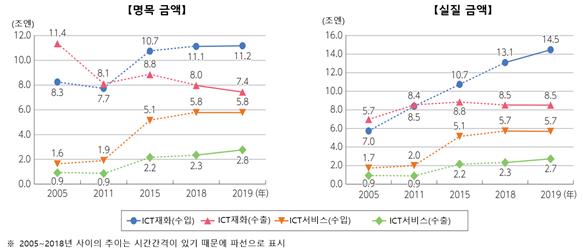
Since COVID-19, Japan has been hurrying to digitally transform every sector of society. The 2021 edition of the Information and Communications White Paper published by the Ministry of Internal Affairs and Communications shows that imports and exports of ICT goods and services continue to grow. Notably, ICT services have consistently run an import surplus since 2005, and ICT goods have also shown a sustained import surplus in recent years.
The operators subject to regulation announced by the Ministry of Economy, Trade and Industry are six companies: Yahoo Japan, Rakuten Group, Amazon Japan, Google (US), Apple (US), and iTunes, which operates the relevant sites in Japan. The EU, which has moved ahead on regulating big tech, demands strict measures such as banning companies from favoring their own services on their own platforms. Japan’s new law, by contrast, takes the view that excessive regulation can stifle innovation; rather than prohibiting problematic behavior, it urges operators to correct issues voluntarily.
Strategies for Entering Japan’s Digital Transformation Market
Demand for digital transformation in Japan is widely expected to keep expanding. Japan has digitalized relatively slowly compared with other major advanced economies, which gives its digital transformation market all the more growth potential. The digital transformation fields in question are the so-called ‘X-Tech’ domains. Among them, areas such as AgriTech, AutoTech (mobility), FinTech, EdTech, HealthTech, HRTech, InsurTech, MedTech, PropTech, and SportTech are projected to have high growth potential.
Accordingly, Korean ICT service companies with strong technology and service competitiveness in digital transformation are also expected to find a wide range of DX-driven business opportunities in Japan over the next several years.