How FEMS Technology Works: Principles and Architecture
In modern manufacturing, energy efficiency is a critical factor that determines a company’s competitiveness. The system that emerged to maximize this efficiency is FEMS (Factory Energy Management System). FEMS monitors and manages a plant’s energy consumption and power quality in real time. Built on artificial intelligence technology, it maximizes energy efficiency and optimizes power quality, reducing energy costs and improving plant safety. In this article, we analyze the principles and architecture of FEMS technology in depth to understand how a FEMS system operates.
Core Components of FEMS Technology
A FEMS system consists of a variety of hardware and software components.

– Data collection devices: A variety of sensors collect real-time data on the facility’s energy consumption, power quality, environmental conditions, and more.
– Data communication network: Transmits the collected data to a central server and supports data exchange between servers.
– Data analysis server: Analyzes the collected data using artificial intelligence technology and establishes optimal control strategies to improve energy efficiency.
– Control devices: Deliver the control commands generated by the data analysis server and control the plant’s energy-related systems.
– Interface: Provides users with a visual view of the plant’s energy usage, power quality status, and control strategies, and allows them to adjust control settings.
How FEMS Technology Operates
FEMS is a system that monitors and manages energy consumption in manufacturing processes in real time. Its core principles are as follows.
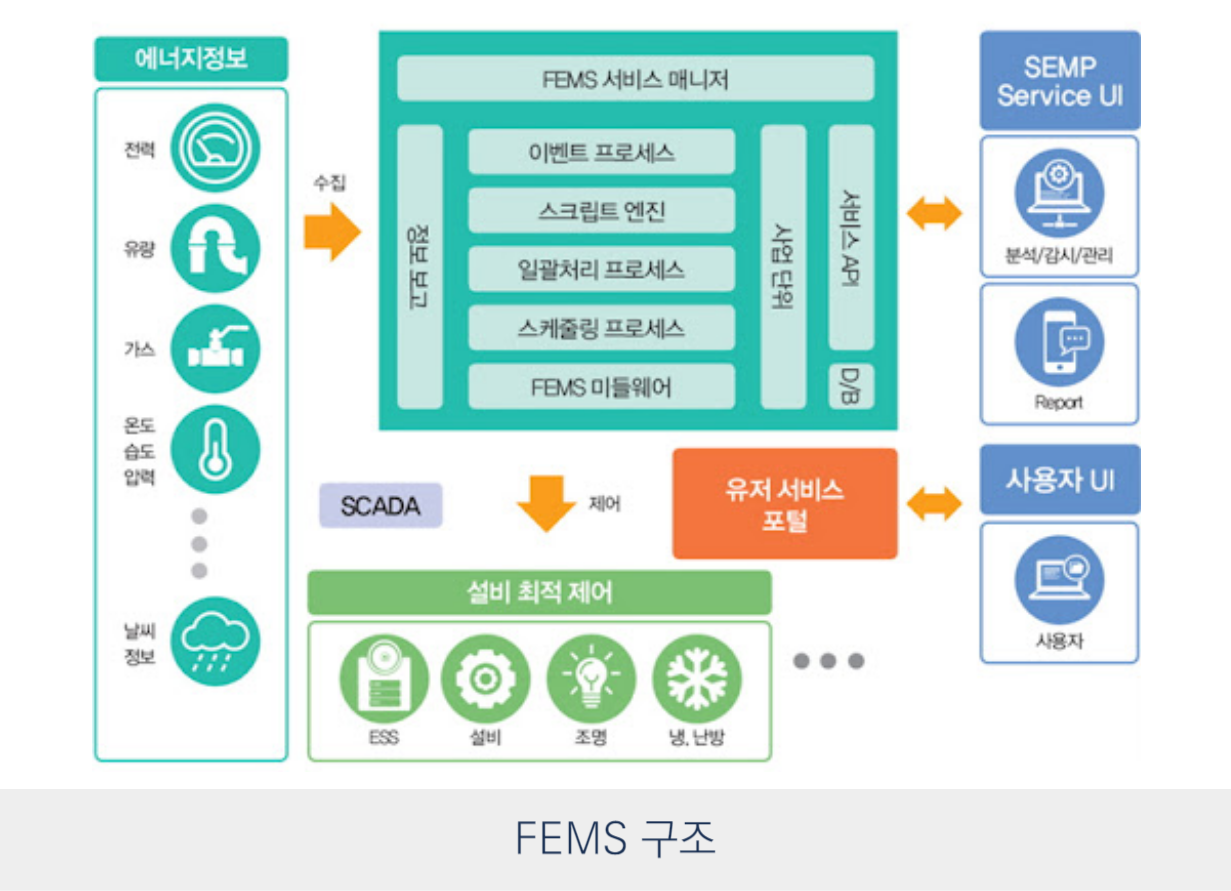
– Data collection: Data collection devices gather real-time data on the plant’s energy consumption, power quality, environmental conditions, and more. They also collect energy usage data from each process. This is done through smart meters, sensors, IoT devices, and similar equipment.
– Data transmission and storage: The collected data is transmitted to the data analysis server over the data communication network and stored in a database.
– Data analysis: The collected data is sent to the central management system for analysis. There, it is processed using a range of algorithms and AI technologies to explore energy usage patterns, anomalies, and optimization opportunities. This provides insight into energy usage patterns, power quality status, operational efficiency, and more.
– Control strategy development: Based on the analysis results, the data analysis server establishes optimal control strategies to improve energy efficiency.
– Real-time feedback and control: Real-time feedback is provided based on the analysis results. This helps each department in the plant take action to optimize energy consumption and reduce unnecessary waste.
– Monitoring and visualization: Through the interface, users can visually check the facility’s energy usage, power quality status, and control strategies, and adjust control settings
– Reporting and optimization: Regular reports evaluate energy efficiency and inform strategies for continuous optimization.
Conclusion
FEMS is an essential system for manufacturers looking to maximize energy efficiency and reduce costs. From data collection to real-time control, its various modules work together organically to fundamentally improve a plant’s energy management capabilities. This enables a sustainable manufacturing environment and strengthens corporate competitiveness.
✅ Recommended Reading