What Is a Smart Factory? Concept and Benefits
The smart factory — an intelligent factory — is a core technology driving the future of manufacturing. It goes beyond simple automation: it is an intelligent system that fuses advanced technologies such as data-driven decision-making, artificial intelligence, and the Internet of Things to maximize production efficiency and improve quality. In this article, we take a close look at the technologies that play a central role in building a smart factory and how each contributes to it.
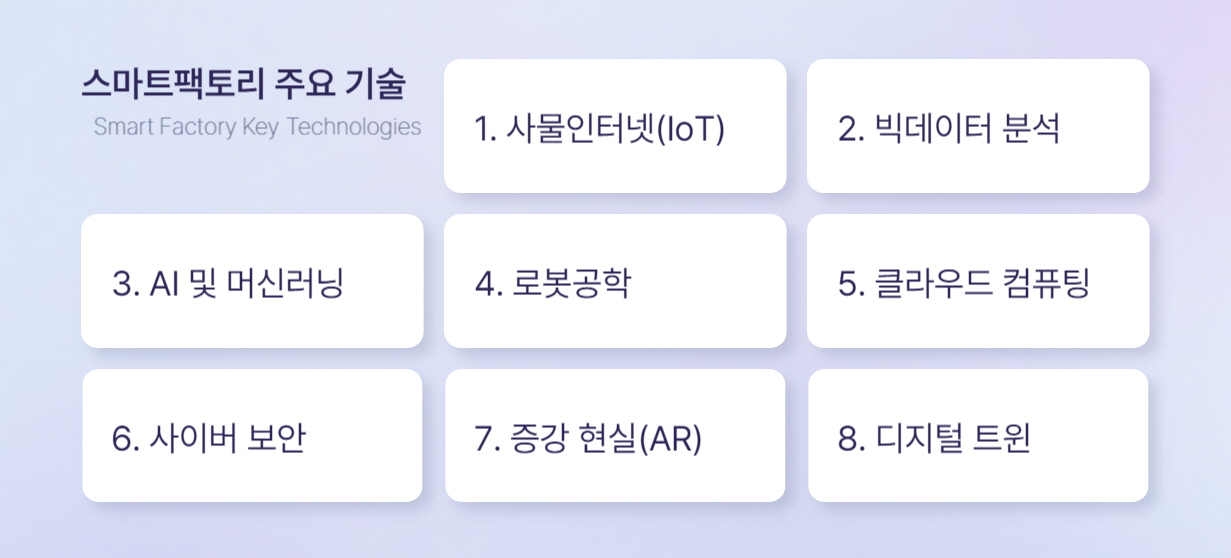
1. Internet of Things (IoT)
– The Internet of Things (IoT) is one of the foundational technologies of the smart factory, connecting every device and sensor in the plant to the internet to collect and analyze data in real time.
– Role in the smart factory : IoT technology is applied to production equipment, products, and sensors to collect and analyze data in real time. This makes it possible to monitor production status, improve process efficiency, and detect anomalies early to prevent problems before they occur.
2. Big Data Analytics
– A smart factory generates a wide variety of data. Big data analytics processes this data and extracts meaningful insights to improve productivity. Through data analysis, you can identify process bottlenecks and improve quality control.
– Role in the smart factory : The massive volumes of data collected through IoT sensors are analyzed to increase production efficiency and improve quality. Process bottlenecks can be identified and quality control improved. Predictive analytics can forecast equipment failures and optimize production planning.
3. Artificial Intelligence (AI) and Machine Learning

– Artificial intelligence (AI) and machine learning enable automated decision-making in the smart factory.
– Role in the smart factory :
1. Machine learning : Production data is analyzed to build predictive models used for quality prediction, demand forecasting, and more.
2. Deep learning : Image recognition and natural language processing are applied to product inspection, robot control, and more.
3. Reinforcement learning : Models learn in simulation environments to establish optimal production plans and optimize robot motion.
4. Robotics
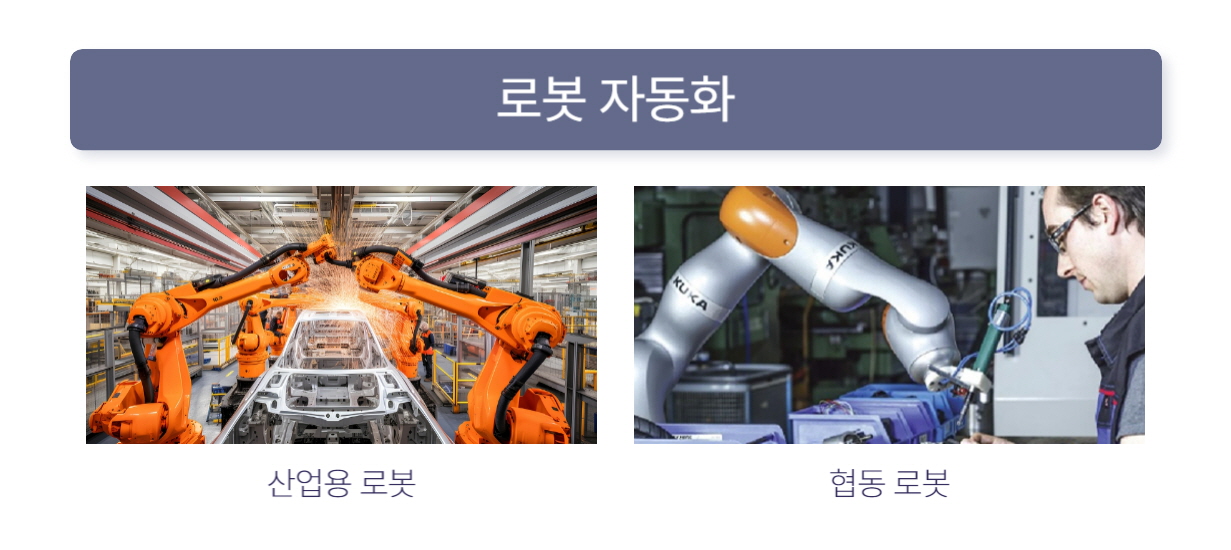
– Robotics plays a critical role in smart factory automation. Robots perform repetitive and hazardous tasks and reduce human error. They can also collaborate with human workers to increase productivity.
– Role in the smart factory :
1. Industrial robots : Used across a wide range of production processes such as welding, assembly, and logistics to improve productivity.
2. Collaborative robots : Work alongside people to create a flexible and safe production environment.
5. Cloud Computing
– Cloud computing is essential for storing and managing data in the smart factory.
– Role in the smart factory : Cloud-based platforms allow all plant data to be managed and analyzed centrally, enabling rapid decision-making.
6. Cybersecurity
– In a smart factory, the security of data and systems is critically important.
– Role in the smart factory : Cybersecurity technology protects the plant from external attacks, prevents data breaches, and provides a secure network environment.
7. Augmented Reality (AR)
AR is a technology that overlays virtual information onto the real world.
– Role in the smart factory :
1. Remote support : Experts can give on-site workers real-time work instructions through AR devices.
2. Equipment maintenance : AR devices visualize the internal structure of equipment, enabling rapid resolution when problems occur.
8. Digital Twin
– A digital twin is a virtual model that replicates a real-world system or process in a virtual space.
– Role in the smart factory :
1. Simulation : Before building a new production system, it can be simulated in a virtual environment to validate its efficiency.
2. Optimization : Various scenarios can be simulated to establish the optimal production plan.
Conclusion
The smart factory is an innovative manufacturing environment that combines advanced technologies such as the Internet of Things, big data analytics, artificial intelligence, robotics, cloud computing, and cybersecurity. These technologies improve process efficiency and maximize productivity. By adopting a smart factory, companies can strengthen their competitiveness and lead the transformation of future manufacturing.
✅ Recommended Reading