Have you ever imagined a future where streams of data replace the smell of soil, and precisely controlled light replaces sunshine in growing crops? Remarkably, that vision is no longer a distant story. An innovative agricultural technology called the smart farm is becoming reality before our eyes.
In recent years, cutting-edge technologies such as artificial intelligence (AI), the Internet of Things (IoT), and big data have been converging with agriculture, producing changes once unimaginable. Smart farms are expected to play a central role in securing stable productivity despite limited resources and unpredictable environments, easing the labor shortage of aging rural communities, and building a sustainable agricultural ecosystem.
In this post, we take a deep look at the 4 core technologies essential to realizing the smart farm — from precision environmental control and data-driven, intelligent growth management to automation and robotics that maximize efficiency, and the intelligent platform that integrates and manages it all. We invite you on a fascinating journey into the present and future of smart farming. Let’s explore the innovative transformation of future agriculture together!
The Smart Farm: The Heart of Future Agriculture
A smart farm can be defined, in a word, as an intelligent farm that applies information and communication technology (ICT) to agriculture to keep and manage crops’ growing environment in an optimal state. Moving beyond farming that relied on experience and intuition, it uses sensors, communication equipment, and software to collect and analyze diverse environmental data — temperature, humidity, light levels, CO2 concentration, soil condition, and more — in real time.
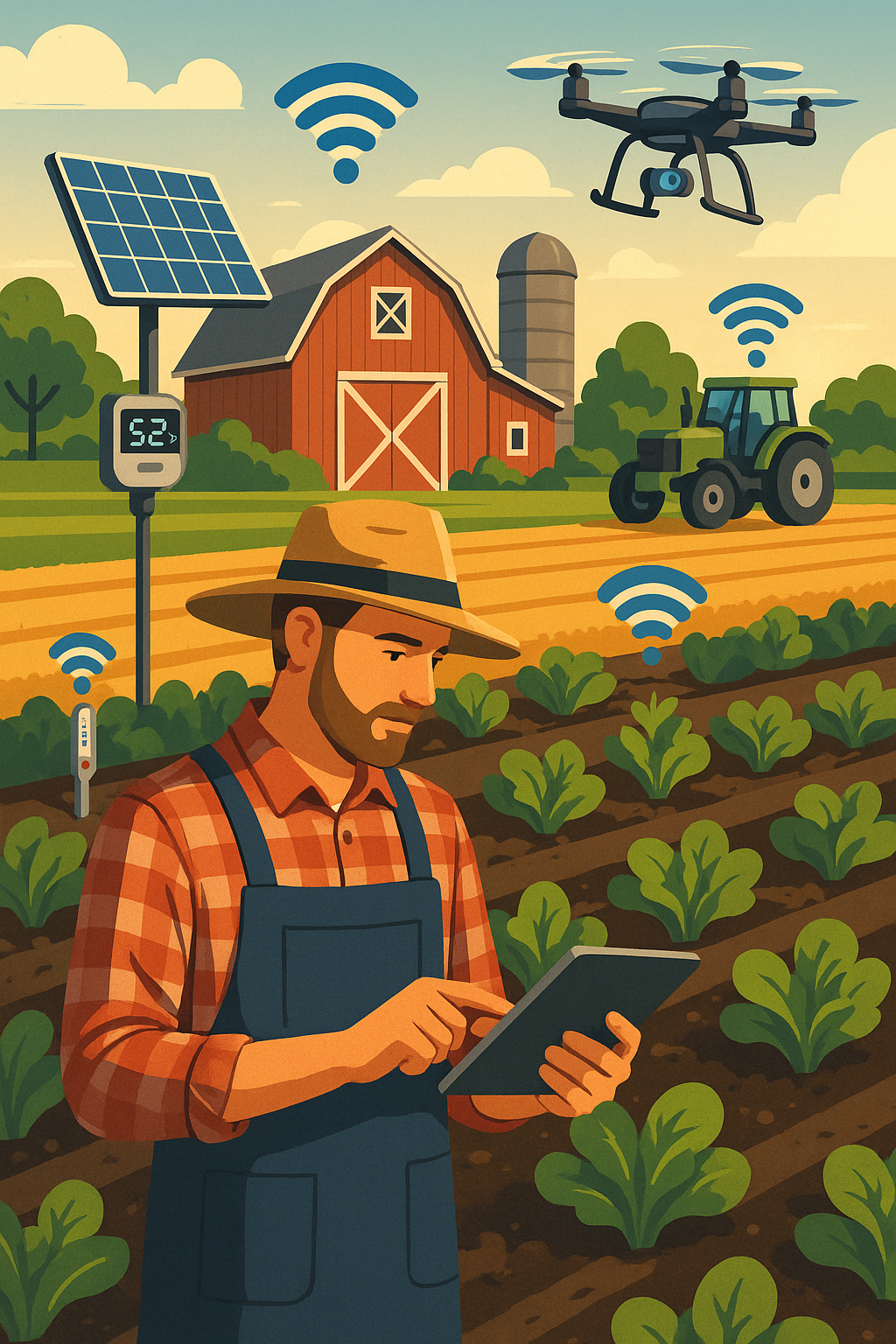
A smart farm leveraging diverse technologies
Based on this collected data, automated control systems actively adjust the environment to the crop’s growing requirements and supply optimal nutrients and water. This goes beyond simply raising output — it saves labor, improves energy efficiency, and ultimately makes sustainable agriculture possible.
Whereas conventional farming is heavily exposed to the natural environment, the smart farm is revolutionary in that precision data analysis and automatic control reduce dependence on external conditions, and crop growth can be monitored and managed remotely anytime, anywhere. Smart farm adoption maximizes agricultural productivity and efficiency and is drawing attention as a vital answer for future food security.
A smart farm is a composite system in which many advanced technologies operate in concert. Let’s first look at the core component technologies that form its foundation, then see how they integrate into the composite technologies that deliver the smart farm’s main capabilities.
1. Internet of Things (IoT) Technology
The Internet of Things (IoT) gives objects sensors, software, and communication capabilities, connects them to the internet, and lets them exchange information and interact with each other and with users. In a smart farm, IoT acts like the nervous system. Sensors, control devices, cameras, robots, and other equipment installed across the farm connect over the internet, exchange data in real time, and communicate with the central management system to enable automated operations.
Core functions:
– Data collection: Collects diverse data related to the crop’s growing environment — temperature, humidity, light, soil moisture, pH, EC, CO2 concentration — in real time.
– Device control: Based on collected data, controls devices such as HVAC units, ventilation fans, shade screens, irrigation valves, and robots remotely or automatically.
– Monitoring: Monitors farm conditions and equipment status in real time and sends alerts when anomalies occur.
– Communication and connectivity: Links many kinds of sensors and devices into a single network and supports stable data communication.
Thanks to IoT, farmers can accurately understand and efficiently manage the farm environment free of time and place constraints. Just as you switch your home lights on and off from a smartphone, you can control farm equipment remotely and check crop status in real time.
2. Sensor Network Technology
A sensor network consists of the various sensors that detect farm environment information and the communication network that efficiently relays the collected data. Just as our sense organs deliver information to the brain, the sensor network serves as the smart farm’s ‘eyes’ and ‘ears,’ and the data it gathers becomes the most fundamental basis of smart farm operations.
Key characteristics:
– Diverse sensors: Sensors measuring temperature, humidity, light, soil, weather, and more are deployed as needed.
– Wireless communication: Technologies such as Zigbee, Bluetooth, Wi-Fi, and LoRa efficiently transmit sensor data to the central system. Wired communication can also be used for stable data transmission.
– Low-power design: With many sensors installed across a large farm, low-power communication and sensor design are important for extending battery life.
– Self-configuration and management: Sensor networks can configure and manage themselves as conditions change, improving efficiency and reliability.
Data gathered through a precise sensor network becomes critical input for the smart farm’s decision systems. Soil moisture sensor data, for example, determines when the automatic irrigation system runs.
3. Big Data Technology
The vast volumes of data collected through IoT and sensor networks are analyzed and turned into meaningful information by big data technology. Much as a veteran farmer’s long experience accumulates as data, big data analysis identifies past patterns and predicts the future, enabling more scientific farm management.
Key functions:
– Data collection and storage: Efficiently collects and stores agricultural data of many forms and attributes.
– Data analysis and mining: Analyzes stored data to extract useful insights such as crop growth patterns, pest and disease trends, and the correlation between environmental changes and yield.
– Data visualization: Presents analysis results in graphs, charts, and other easy-to-understand formats.
Big data analysis helps farmers decide optimal sowing times, fertilizer and water amounts, and harvest timing, and lets them predict and prepare for potential risks in advance.
4. Artificial Intelligence (AI) Technology:
Artificial intelligence (AI) is the core technology that learns and judges on its own from big data analysis to support optimal decision-making. Like embedding the intelligence of a seasoned agricultural expert into the system, AI raises the smart farm’s automation to the next level and makes predictive agriculture a reality.
Key functions:
– Crop growth prediction: Learns from historical and current environmental data to predict future crop growth and yield.
– Pest and disease diagnosis and prediction: Uses image analysis and AI algorithms to diagnose crop diseases and pests early and predict their likelihood.
– Optimal control strategy: Analyzes crop growth models and environmental data to automatically formulate control strategies that raise energy efficiency and maximize productivity.
– Robot control: Intelligently directs automated equipment such as harvesting and crop-protection robots to boost efficiency.
AI is the driving force that evolves the smart farm beyond simple automation into an intelligent farm that thinks and acts on its own.
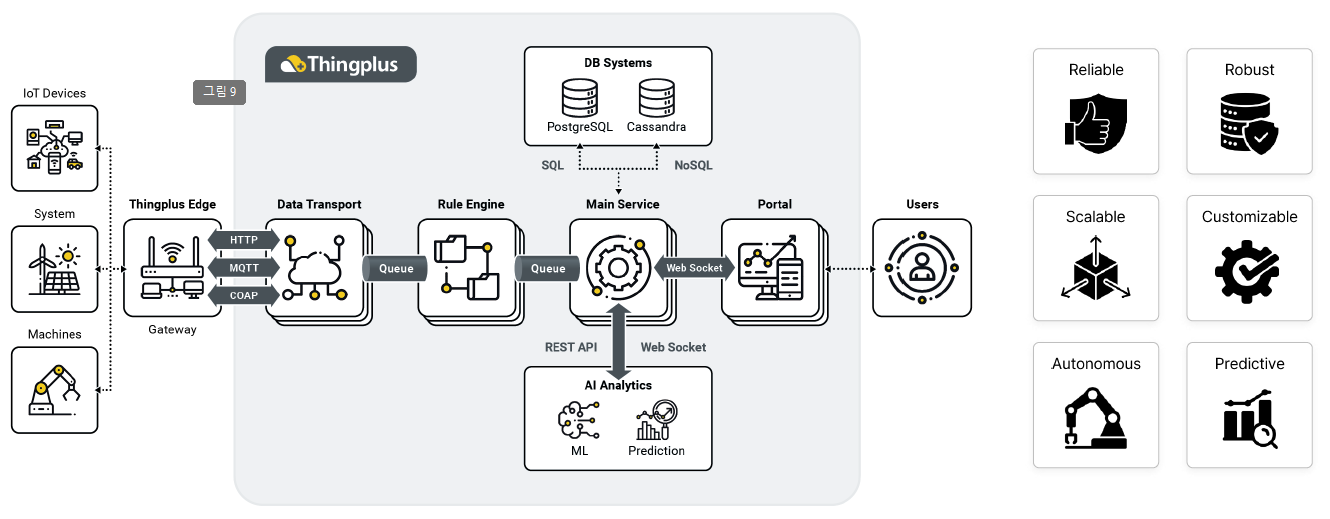
Daliworks’ Thingplus with the four core technologies applied
The Fusion of Component Technologies
What lets the smart farm evolve beyond an automated farm into an intelligent production system is precisely these four core technologies. Each connects organically with the others, creating synergy and maximizing the smart farm’s efficiency and sustainability.
1. Precision Environmental Control: Creating the Optimal Growing Environment
Like a master farmer’s know-how, precision environmental control automatically creates and maintains the optimal conditions for crops to grow at their healthiest. It collects environmental data inside and outside the farm in real time through various sensors, and control devices act on the analyzed information to finely adjust temperature, humidity, light, CO2 concentration, and more.
Key technology elements:
– Sensors: Sensors measuring temperature, humidity, illuminance, pH, EC (electrical conductivity), and CO2 concentration collect data in real time. Like the body’s sense organs, they detect everything related to the crop’s growing environment.
– Control devices: Analyze sensor data to automatically operate HVAC units, ventilation fans, shade screens, irrigation valves, and CO2 supply units — like a skilled pilot flying an aircraft to conditions.
– Communication technology: Stable data communication among sensors, control devices, and the central management system is essential, with real-time information exchanged over wired or wireless networks.
– Software: Visualizes collected data and provides the interface for monitoring and controlling environmental conditions. It also sets optimal conditions based on per-crop growth models and performs automatic control.
How it is used on real smart farms:
– Temperature and humidity management: Maintains each crop’s optimal temperature and humidity to accelerate growth and reduce pest and disease risk. For tomatoes, for instance, keeping slightly lower nighttime temperatures helps improve sweetness.
– Light control: Measures sunlight to open and close shade screens automatically, or supplements insufficient light with LED grow lights. For strawberries, consistent light levels are important for quality.
– CO2 management: Keeps CO2 at optimal levels to boost photosynthesis efficiency, adjusting concentration via CO2 supply units in enclosed environments.
– Nutrient solution control: Automatically supplies the exact ratio of nutrients and water needed at each growth stage, reducing fertilizer use and improving productivity.
By scientifically analyzing and delivering the conditions crops need, precision environmental control overcomes the limits of open-field cultivation exposed to external swings and enables stable production.
2. Data-Driven Growth Management: Intelligent Decision Support
A smart farm goes beyond controlling the environment — it analyzes and applies accumulated data to support more intelligent decisions. Data-driven growth management plays the central role in collecting, analyzing, and predicting the many kinds of data generated as crops grow, and in formulating optimal cultivation strategies.
Key technology elements:
– Big data technology: Efficiently stores, manages, and analyzes the massive data collected from sensors, image analysis devices, and growth records.
– AI and machine learning: Learns from the collected big data to provide insights such as growth patterns, pest and disease forecasts, and harvest timing — like learning a master’s experience from data.
– Cloud computing: Provides the infrastructure essential for storing and analyzing huge datasets and delivering results in real time.
– Image analysis: Uses cameras and video analysis algorithms to non-destructively assess crop condition and detect pests and disease.
How it is used on real smart farms:
– Growth prediction: Analyzes historical growth data and current conditions to forecast growth rates and final yield, and to optimize harvest timing.
– Early pest and disease detection and prediction: Uses image analysis and AI to catch early signs, predict outbreaks, and set proactive control strategies.
– Optimal nutrition and watering: Analyzes nutrient and water requirements by growth stage and automatically sets the optimal feeding schedule.
– Quality prediction and management: Analyzes growth data to predict final product quality and manage the growing environment for uniform output.
Data-driven growth management shifts agricultural decisions from experience to scientific data analysis, maximizing production efficiency, improving predictability, and reducing farmers’ risk.
3. Automation and Robotics: Building an Efficient Working Environment
To solve the labor shortage of aging rural communities and maximize work efficiency, automation and robotics form a key pillar of the smart farm. By automating repetitive, labor-intensive farm work, they lighten farmers’ burden and raise productivity.
Key technology elements:
– Automatic irrigation robots: Robots that supply water and nutrients to the farm on set schedules.
– Mobile work robots: Robots that perform sowing, transplanting, crop protection, harvesting, and more, using sensors and AI to recognize crop conditions and carry out the work.
– Drones: Used for pesticide spraying, growth monitoring, and environmental data collection over large areas, enabling fast, efficient operations.
– Automated conveyor systems: Systems that automatically sort and package harvested crops.
How it is used on real smart farms:
– Precision irrigation and fertilization: Robots deliver water and fertilizer precisely to each crop’s needs, cutting waste and raising efficiency.
– Automatic sowing and transplanting: Robots plant seeds or transplant seedlings at uniform spacing and depth, saving labor and reducing early growth failures.
– Intelligent harvesting: Robots are being developed that judge ripeness like a skilled worker and harvest automatically — optimizing harvest timing and easing labor shortages.
– Pest and disease control: Drones or mobile robots spray large areas efficiently or apply eco-friendly control methods.
Automation and robotics are expected to dramatically improve the efficiency of farm work, lower its physical demands, and help draw younger workers into agriculture.
4. The Intelligent Integrated Management Platform: The Brain of Smart Farm Operations
Precision environmental control, data-driven growth management, and automation robotics each play important roles, but without an intelligent integrated management platform that unifies and efficiently manages them all, it is hard to realize a smart farm’s full potential.
Key features:
– Real-time monitoring: Visualizes environmental data inside and outside the farm, crop growth information, and equipment status in real time. Users can check farm conditions anytime, anywhere from a smart device.
– Remote control: Enables remote operation of environmental control devices, irrigation systems, and robots based on collected data.
– Data analysis and predictive insights: Analyzes accumulated big data to provide useful information such as crop growth forecasts, pest and disease risk levels, and optimal work timing, supporting farm decisions.
– Automatic report generation: Automatically records farm operations, output, and energy use and generates reports to support efficient management.
– Multi-device and system integration: Provides integration features so sensors, control devices, and robot systems from different manufacturers can be managed together on one platform.
What to consider when choosing a platform:
– Ease of use: It should offer an intuitive interface that ordinary users, not just agricultural experts, can easily understand and operate.
– Data compatibility and scalability: It should integrate data smoothly from many kinds of sensors and equipment and allow for expansion as new technologies arrive.
– Security: It must have robust security to protect critical agricultural data.
– Customer support: Verify that fast, professional technical support is available when system errors occur.
The intelligent integrated management platform organically connects the smart farm’s many technologies and presents all the information users need at a glance, maximizing the efficiency and convenience of smart farm operations. Like a smartphone operating system, it integrates and controls every function of the smart farm.
Each of these four core technologies is advancing rapidly in its own domain, and together, in fusion, they are drawing a new picture of future agriculture.
Closing Thoughts
The smart farm is more than a change in farming methods — it is the core engine of future agriculture, pursuing food production efficiency and sustainability at once. The fusion of advanced technology and agriculture will bring changes more innovative than we can imagine: more precise and efficient crop production, labor savings, environmental protection, and a supply of high-quality produce. We are confident it will become a vital source of food for future society.
Of course, smart farm technology is still developing, and technical, economic, and social challenges remain. But through relentless R&D and field deployment, we believe these difficulties will be overcome and ever more advanced smart farm technology will spread across agriculture.