Why Adopt a Smart Farm? – Set Your Goals First
When you first get interested in smart farming, your first thought may be, “What equipment should I install?” But the more important question is “Why do I want a smart farm?” — in other words, defining your purpose. A smart farm is not a system that ends with bringing in machines. Your purpose completely changes the technology choices, investment scope, and operating approach.
For example,
– If the goal is relieving a labor shortage, automation systems like automatic irrigation, ventilation, and lighting control come first,
– If the aim is uniform quality, you need a monitoring-centered system where precision sensors and growth data analysis matter most.
– If you want better profitability, you need to quantify the impact of each technology and build a strategy around ROI (Return on Investment).
In short, a smart farm is a ‘purpose-built solution.’ This is also why a large enterprise’s smart farm and a small family farm’s smart farm should differ. So before thinking about technology, clearly define: “What problem do I want to solve on my farm?” The answer becomes the starting point and compass for selecting and applying technologies afterward.
The Stages of Building a Smart Farm: Diagnose → Design → Deploy → Operate
To build a smart farm properly, it is important to proceed step by step through a defined sequence. This process is not mere equipment installation — it is a strategic exercise that reviews and optimizes how the whole farm operates.
Smart farm construction typically goes through the following 4 stages.
2-1. Diagnose: Understand Your Farm’s Current State
The first task is to analyze what state your farm is in and what problems it has.
– What is the current growing environment for my crops?
– Which tasks are managed by hand?
– What recurring difficulties arise season by season?
These questions reveal where smart technology is needed and what to prioritize for investment. You should also review the physical conditions for adopting technology — communications environment, power infrastructure, greenhouse structure, and so on.
2-2. Design: Plan the Technologies and Equipment You Need
Once the diagnosis is done, design the system to match your goals and budget.
For example,
– If you need environmental control → temperature/humidity sensors and automatic ventilation
– If you need early pest and disease detection → AI cameras and real-time alert systems
– If quality history management is the goal → a growth data storage and analytics platform
At this stage, rather than adopting too many technologies at once, a select-and-focus strategy aimed at solving the core problem is what matters.
2-3. Deploy: Install Equipment and Integrate Systems
With the design complete, install the equipment and put the system in place. Install sensors, connect them to the cloud platform, and tune the automatic control devices to the conditions on site.
What matters here is ‘on-site optimization.’ Carefully check for early-stage variables such as unexpected communication failures, power problems, and sensor malfunctions. After installation, a trial run period is essential to verify the system works properly and the settings are appropriate.
2-4. Operate: Monitor and Improve
Once the system is running normally, the phase of continuous operation and improvement begins. It is important to build management habits — reviewing data daily and adjusting settings for weather changes and crop conditions.
The system may feel burdensome at first while it is unfamiliar, but once your ability to interpret data and an operating rhythm take hold, the smart farm evolves into a system increasingly tailored to your farm.
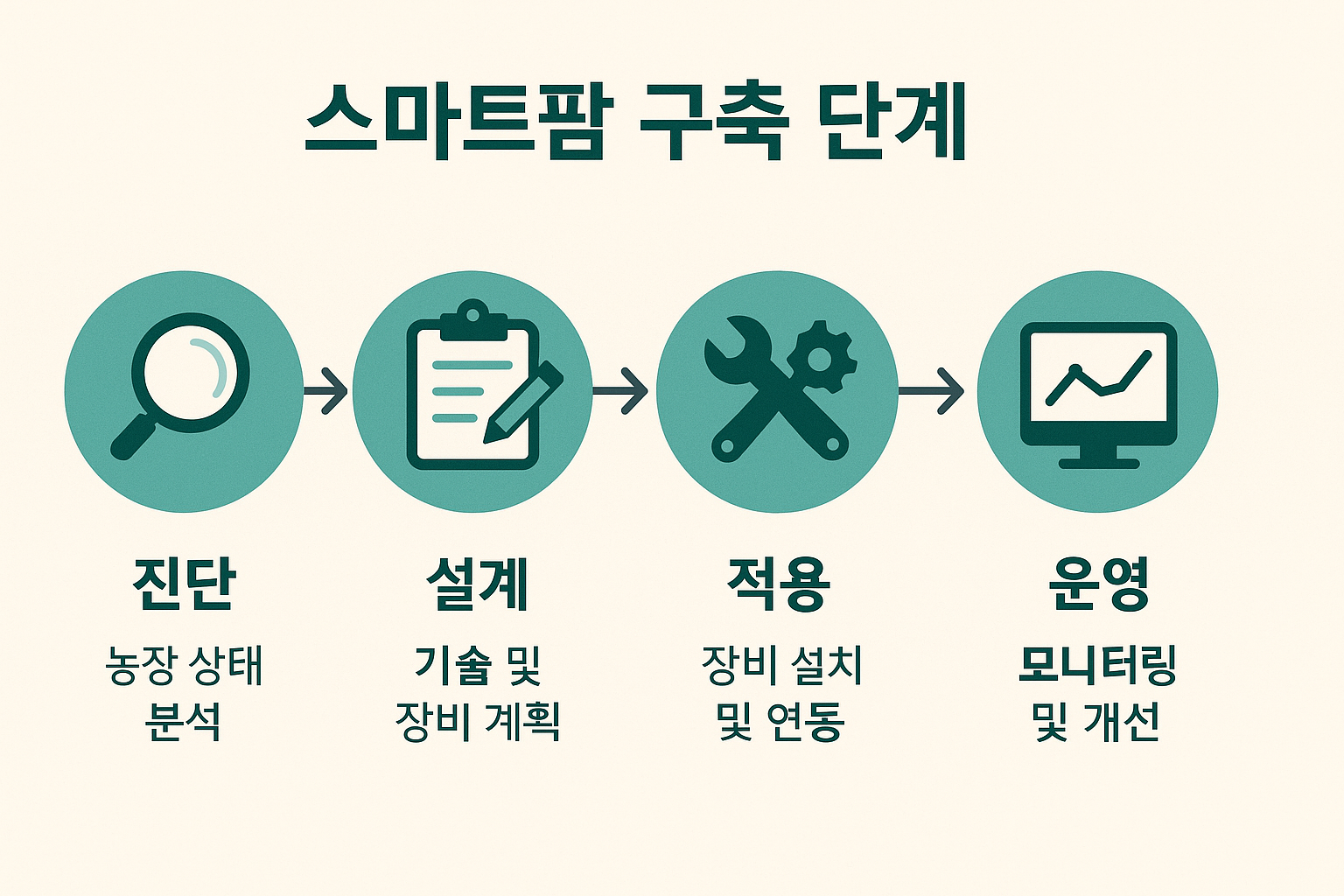
The stages of building a smart farm
A Smart Farm Starting Strategy for Small Farms
When people hear ‘smart farm,’ they picture the giant glass greenhouses, automated harvesting robots, and complex control systems they have seen on TV or in articles. But real small farms work in far simpler, humbler environments. It is natural that telling such farms to “adopt a smart farm” feels daunting.
But you do not need a grand system to have a smart farm. In fact, smaller farms have more room to start small and reap outsized benefits. The key is ‘approaching it realistically.’
Start Small and Expand Gradually
The first strategy for smart farm adoption is a phased approach. Rather than bringing in every device at once, start by solving “the most inconvenient task, the recurring problem.”
For example,
– If daily watering is exhausting → an automatic irrigation system
– If you grow weather-sensitive crops → temperature/humidity sensors
Adopting one item at a time and confirming the results is the safest and most sustainable path.
‘A few simple sensors first, then automatic control devices, and finally platform integration’ — expanding gradually like this reduces the technology burden and speeds up adaptation.
3 Core Technologies Worth Adopting First
You do not need every smart farm technology. Early on, it is important to start with the equipment that delivers the most practical value. Here is the recommended starter trio for small farms.
1. Environmental sensors
– Measure temperature, humidity, and soil moisture
– See crop growing conditions as ‘numbers’
– Recognize warning signs early
2. Automatic irrigation system
– Waters automatically based on soil condition
– Saves labor and stabilizes growth
– Prevents water waste
3. Monitoring app or platform
– Check real-time status on your smartphone
– Control operation remotely
– Data storage and analysis features
With just these three, you can lay the cornerstone of the smart farm’s essence: ‘data-driven management + automation.’
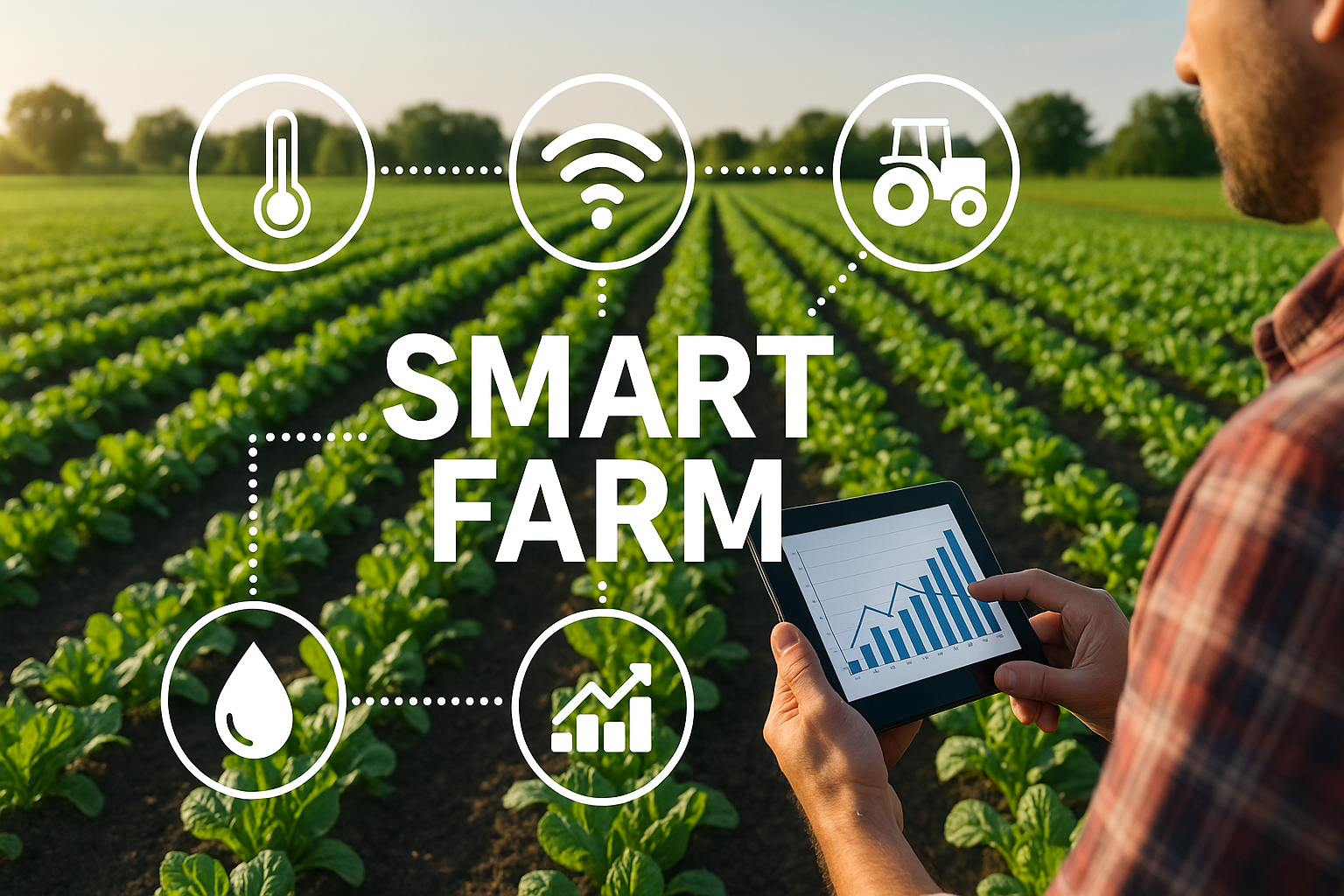
Adopt the right smart farm technology.
Be Sure to Check Government Support Programs
More small farms than you might expect say “smart farming is too expensive for us,” but in fact there are plenty of support programs available.
Representative examples include
– the Smart Farm ICT Convergence Expansion Program
– the Young Farmer Startup Smart Farm Package
– the Smart Agriculture Testbed Support Program
and more.
These programs subsidize part of the equipment cost or provide expert consulting, system installation, and training, greatly easing the initial burden. Application notices are posted every year through local governments, the Ministry of Agriculture, Food and Rural Affairs, and the Foundation of Agricultural Technology Commercialization and Transfer, so timing your application well matters.
A Smart Farm Is a Change in ‘How You Operate’ More Than in ‘Technology’
Most important of all is the shift in perspective: a smart farm is not simply a matter of machines or software but a ‘change in how you operate.’ Even with devices installed, if you do not review the data or make proper use of the control settings, the smart farm is effectively useless.
The heart of smart farming is building the ability to recognize problems early from data and respond quickly. More than the technology, the operator’s habits and attitude
are the key to running a smart farm successfully.
Small Farms Can Absolutely Get Started
Smart farms are not the preserve of large operations. Small farms too can realistically adopt them — with clear results — by sticking to the principle of problem recognition → small-scale technology application → gradual expansion.
Technology is ultimately a means of solving problems. The door to smart farming is already open; what matters now is deciding “where to take the first step that fits my farm.”
Practical Conditions to Consider Before Adopting
Smart farm adoption is becoming more common, but when you actually try to act, you run into a range of practical barriers. That is why the question “Will it really work on my farm?” arises.
A smart farm is clearly beneficial over the long term, but there are practical factors you must weigh at the start. Rather than diving in blindly, it is wise to check the items below first.
1. Upfront Investment and Payback Period
A smart farm requires a certain level of upfront investment. The line items vary — sensors, control devices, gateways, platform fees — and the amounts differ widely by farm size and desired features.
When budgeting, consider not just equipment costs but installation, maintenance, and network costs, and evaluate ROI (Return on Investment) over the mid-to-long term. Farm income typically rises noticeably within 1~3 years of adoption, so a long-term perspective is important.
2. Power and Communications Infrastructure
A smart farm is a digital system, so stable power and communications are required for normal operation. But in some rural areas, power to field huts or open fields is limited and internet connections are unstable. In such cases, consider solar panels, backup batteries, or LPWAN (low-power wide-area network) based equipment.
Before adopting, always verify power availability and communication quality, and confirm that the equipment’s power draw and communication method fit your environment.
3. Ease of Use and Training
A smart farm system can look technically complex, but what matters most in real operation is the user’s understanding and engagement. Installing machines may be easy, while interpreting and adjusting the data can feel difficult.
Elderly farmers unfamiliar with IT especially need continued training and support after installation. Be sure to check whether the manufacturer or supplier provides an intuitive UI and has a customer center or after-sales support system.
If possible, taking advantage of programs or consulting packages that include smart farm training is a good approach.
4. Maintenance and Technical Support
Smart farm equipment needs regular inspections and after-sales service even after installation. Since a range of issues can occur — sensor malfunctions, communication errors, power failures —
how fast and systematic the technical support is determines operational stability.
When choosing a supplier, make sure they are a partner who keeps managing the system after installation, not just a vendor who delivers it.
4. The Intelligent Integrated Management Platform: The Brain of Smart Farm Operations
Precision environmental control, data-driven growth management, and automation robotics each play important roles, but without an intelligent integrated management platform that unifies and efficiently manages them all, it is hard to realize a smart farm’s full potential.
Key features:
– Real-time monitoring: Visualizes environmental data inside and outside the farm, crop growth information, and equipment status in real time. Users can check farm conditions anytime, anywhere from a smart device.
– Remote control: Enables remote operation of environmental control devices, irrigation systems, and robots based on collected data.
– Data analysis and predictive insights: Analyzes accumulated big data to provide useful information such as crop growth forecasts, pest and disease risk levels, and optimal work timing, supporting farm decisions.
– Automatic report generation: Automatically records farm operations, output, and energy use and generates reports to support efficient management.
– Multi-device and system integration: Provides integration features so sensors, control devices, and robot systems from different manufacturers can be managed together on one platform.
What to consider when choosing a platform:
– Ease of use: It should offer an intuitive interface that ordinary users, not just agricultural experts, can easily understand and operate.
– Data compatibility and scalability: It should integrate data smoothly from many kinds of sensors and equipment and allow for expansion as new technologies arrive.
– Security: It must have robust security to protect critical agricultural data.
– Customer support: Verify that fast, professional technical support is available when system errors occur.
3 Practical Tips for a Successful Rollout
Running a smart farm successfully often depends more on ‘attitude and approach’ than on technology. More than installing the equipment itself, how you start, what criteria you judge by, and how you use it determine long-term success.
1. Look for a ‘Partner,’ Not Just a Supplier
With smart farm equipment, how well it runs after installation matters more than the purchase itself. So the key is finding a ‘technology partner’ who will handle installation, training, and after-sales service together — not just a ‘seller.’
When selecting one, check the following:
– Whether post-installation training programs are provided
– After-sales response times and coverage by device
– Whether a user-friendly management app or platform exists
– Whether there are existing farm deployments
Even at a somewhat higher price, working with a company that thinks through operations with you delivers better value for money.
2. Create a ‘Small Win’ First
Many farms try to deploy every feature from the start and burn out on operational complexity and trial and error. It is more effective to focus on solving one smallest problem.
For example, if your worry is “I do not know when or how much to water,” start with just a ‘moisture sensor + automatic irrigation system.’
Once you feel the impact in a small area, expanding to the next stage becomes much easier, and trust in the technology and the operator’s confidence grow together.
3. Build the Habit of Collecting and Reviewing Data
A smart farm is a system that runs on data. But if you do not use the data you collect, it is just numbers. Even if it feels unfamiliar at first, check the sensor data once a day, note abnormal readings, and relate them to your crops’ condition — and a ‘feel for data’ gradually develops.
Once this habit takes root, you can understand and predict crop growth more scientifically, and when problems occur you can trace the cause quickly.
Operating habits come before technology
A smart farm does not succeed on good equipment alone — the user’s attitude and sustained attention are the core.
– Choose a good partner
– Build up small wins
– Keep the habit of reviewing your data
Follow just these three, and a smart farm becomes an investment far more likely to succeed than fail.
Closing Thoughts
Adopting a smart farm never has to start with a grand, sprawling system. What matters is recognizing your farm’s problems precisely and realistically adopting the small technologies that can solve them.
In this article, we showed how farms starting their smart farm journey can
– clarify their purpose,
– apply technology in stages,
– check the practical conditions,
– and raise their odds of success with an execution-first strategy.
In the next article, we will show how these strategies are actually implemented in the field, centered on real deployments of the Thingplus smart farm solution. We hope these real-world success stories help you feel the possibilities of smart farming more concretely.