Motor Diagnostics Market Analysis
Motors are the heart of the industrial workplace. They account for more than 50% of total power consumption, and more than 70% of industrial power consumption. Keeping production lines running smoothly requires an accurate picture of motor condition and the ability to head off unpredictable failures in advance. In the past, the dominant approach was reactive: periodic inspections, or repairs only after a breakdown. But as industrial environments grow more sophisticated and productivity demands rise, motor diagnostics — monitoring and predicting motor condition in real time to guide maintenance — is drawing attention. Advances in the Internet of Things (IoT) and artificial intelligence (AI) in particular are bringing transformative change to the field.
In this post, we examine the outlook and analysis for the global motor monitoring market based on two reports. Each report analyzes market size and growth forecasts, the contribution of wireless technology and IoT advances, and market segmentation by technology and sensor type, presenting the current state and outlook for on-premise and cloud-based deployment models. They also note the potential for better predictive accuracy through the integration of AI and machine learning. The report sources are as follows.
– Motor Monitoring Market Research Report
– Global Motor Monitoring Market
Market Size and Growth Outlook
– Market size as of 2022: USD 1.6 billion
– Market size in 2023: USD 1.71 billion
– Projected market size in 2032: USD 3.2 billion
– Compound annual growth rate (CAGR) over the forecast period (2024-2032): about 7.17%
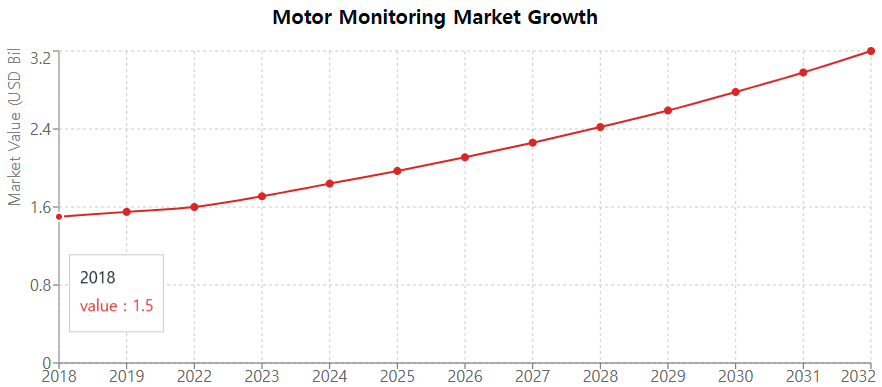
These figures suggest that the motor monitoring market is growing steadily and will expand further over the next decade.
Key Market Trends and Drivers
– Increasing digitalization and automation across industry: As motors play a bigger role in automated processes, monitoring and managing motor condition in real time is becoming ever more important.
– Rising demand for predictive maintenance: Companies’ drive to minimize downtime and maximize operational efficiency is fueling demand for predictive maintenance solutions.
– Growing focus on energy consumption and sustainability: Motor monitoring systems provide real-time insight into energy use, revealing savings opportunities and enabling sustainable operations.
– Wireless connectivity and cloud-based monitoring solutions: Wireless motor monitoring systems enable remote monitoring, while cloud platforms provide centralized data analysis and reporting.
– Integration of AI and ML: AI and machine learning improve the predictive power of motor monitoring systems, enabling proactive maintenance and failure prevention.
– Industry-specific requirements: The emergence of new industries and applications such as electric vehicles (EVs) and smart cities is creating demand for tailored motor monitoring solutions.
– Government regulation and industry standards: Government regulations on energy efficiency and carbon reduction, along with industry standards such as ISO 50001 and IEC 60034-17, are driving adoption of motor monitoring systems.
– Advances in wireless technology and IoT: Progress in wireless sensors and IoT platforms enables remote monitoring and better data accessibility, making motor maintenance more efficient.
In Korea, the government’s smart factory deployment policies, corporate energy-saving efforts, and the expectation of less downtime and lower costs through predictive motor maintenance are driving the motor diagnostics market.
Deployment Models
– Cloud-based: Expected to lead the market thanks to scalability, flexibility, and cost efficiency.
– On-premise: Still important for critical applications that require high levels of security and control.
In Korea, cloud-based motor monitoring is gaining share because it reduces the effort of on-site inspections and maintenance and keeps initial adoption costs low. On-premise deployments, meanwhile, remain the preference of large enterprises that prioritize security and integration with in-house infrastructure.
Sensor Types
– Vibration sensors: Hold the largest market share and are used extensively for motor fault detection.
– Acoustic sensors: Detect high-frequency sound to identify motor problems.
– Temperature sensors: Monitor motor temperature and prevent overheating.
– Electrical sensors: Detect electrical faults.
– Oil sensors: Monitor oil condition and prevent contamination.
Each sensor can be used on its own or in combination with one or more others, chosen according to the industry and the motor’s application.
Closing Thoughts
The motor monitoring market is expected to keep growing on the strength of industrial automation, rising demand for predictive maintenance, government regulation, and technological progress. Cloud-based solutions, the integration of AI and ML, and advances in wireless connectivity in particular look set to accelerate that growth. By tracking these trends and actively adopting motor monitoring systems, companies can raise operational efficiency, cut costs, and pursue sustainable growth.
✅ Related Content Worth Reading