1. MES: The First Step in Manufacturing Innovation
Manufacturing is now expected to move beyond simple automation to data-driven, intelligent operations. Producing a diverse mix of products quickly and accurately requires a framework that can see and control the factory’s state in real time.
Against this backdrop, the MES (Manufacturing Execution System) is drawing attention as the core foundation of the smart factory. An MES converts production plans into executable work units and collects everything happening on the floor in real time, providing operational visibility and control.
An MES is no longer optional — it has become a prerequisite for staying competitive.
2. MES: The Real-Time Operations Platform That Connects the Production Floor
MES stands for ‘Manufacturing Execution System.’ True to its name, it is the system that actually executes planned production and manages the results in real time. If ERP is the system that plans ‘what to produce and when,’ the MES directly controls and feeds back ‘how it is being made’ on the floor.
The MES as the Factory’s Control Tower
An MES collects and analyzes all the information generated by shop-floor work, from the start of the production process to the end. On this data, it performs the following core functions.
Production instruction and execution management
– Breaks the production plan handed down from ERP into instructions for each operator.
– Clearly communicates which operator should perform which process, on which equipment, with which materials.
Performance collection and history management
– Automatically collects production quantities, defect counts, and equipment runtime for each process.
– A manufacturing history (Traceability) is stored per product, enabling immediate root-cause tracing when problems occur.
Equipment status monitoring
– Uses sensor data to track equipment utilization, failure frequency, and warning signals in real time.
– When warning signs are detected, it can send alerts or trigger automatic stops.
Quality management
– Collects quality data mid-process or at completion.
– Deviations from standards are reported automatically and can be used immediately in quality improvement work.
Material and inventory flow management
– Tracks and records the flow of materials from input through movement, consumption, and removal.
– This reduces unnecessary inventory and enables a JIT (Just-In-Time) production system.
A Real Factory Example: Before and After MES
In a conventional factory, operators typically worked from whiteboards or paper work orders, wrote up production results by hand, and a manager re-entered them into a system. This process inevitably suffers frequent omissions, reporting delays, and errors.
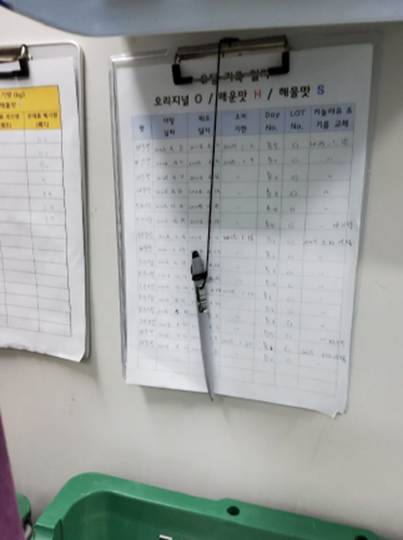
Manual management leads to missed entries and record errors
With an MES in place, by contrast,
– Operators receive instructions in real time via tablets or operator terminals,
– Work results are collected automatically through barcodes, sensors, and RFID,
– Managers and executives can watch the entire factory’s flow in real time on dashboards.
In short, an MES does not merely ‘digitize the factory’ — it is the system that connects the floor in real time and makes it controllable.
The Components of an MES
An MES is less a single system than a platform composed of multiple sub-modules. The following modules are typically integrated.
|
Module |
Description |
|
Work order management |
Assigns the production plan down to individual operators |
|
Production performance management |
Real-time production history collection and analysis |
|
Quality management |
Inspection standards management, defect analysis |
|
Equipment management |
TPM, utilization, and maintenance schedule management |
|
Material management |
Tracking material input/consumption/movement |
|
Traceability management |
Lot-based history and defect root-cause tracing |
|
Dashboards/reports |
Real-time visualization of KPIs and floor status |
Depending on company size, industry, and digital maturity, these modules can be selected or adopted in stages.
3. How Does MES Differ from ERP and SCADA?
One of the most common questions about MES is “How is it different from ERP?” Others say, “We already use SCADA.” On the surface they all look like ‘production management systems,’ but these three differ completely in role, position, users, and time horizon.
ERP vs. MES vs. SCADA: A Division of Functions and Roles
|
Category |
ERP |
MES |
SCADA |
|
Main function |
Enterprise-wide management of resources, finance, production planning |
Floor control of production execution, performance, quality, equipment |
Equipment data collection, status monitoring and control |
|
Scope |
Entire company (planning-centered) |
Production floor (execution-centered) |
Equipment and machinery (control-centered) |
|
Data flow |
Daily batch processing |
Real-time work data processing |
Equipment signal processing in seconds and milliseconds |
|
Users |
Executives, planners |
Production managers, operators |
Engineers, equipment managers |
|
System character |
Plan-based, analysis-centered |
Execution-based, control-centered |
Control-based, monitoring-centered |
ERP is the ‘headquarters of planning’
ERP is the back-office system that plans enterprise-wide resources (inventory, purchasing, people, assets) and runs them in concert with accounting, logistics, and sales. Production schedules are drawn up there too, but ERP does not know how each product is actually being made.
MES is the ‘control tower of the floor’
The production plan created by ERP flows down to the MES and is broken into work units. The MES converts the plan into executable work orders, collects work results in real time, and monitors productivity and quality. It also sends the collected data back to ERP, forming a feedback loop that analyzes the gap between plan and actuals.
SCADA is the ‘eyes and ears of the equipment’
SCADA is the automation system that monitors production equipment and lines in real time and performs remote control when needed. It specializes in collecting and visualizing detailed sensor data — equipment temperature, pressure, speed, current, alarms. But SCADA does not handle product-level history, operator information, or quality results, and its scope is too narrow to manage the process as a whole.
How Do the Three Systems Connect?
Each of these systems has independent functions, but in a smart factory they must be organically connected.
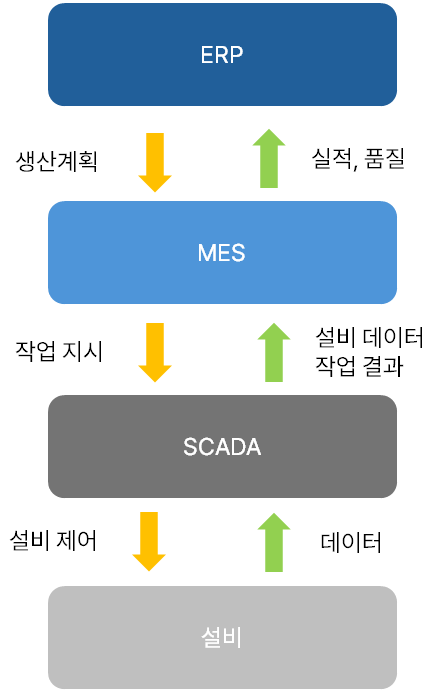
– The production plan established in ERP is sent to the MES,
– The MES breaks it into work units and executes it,
– Data from each machine is collected via SCADA to monitor status,
– Performance and quality data feed back into ERP to adjust the plan.
Through this structure, a company can operate planning and execution, equipment and processes, data and people as one integrated system.
4. Why You Need an MES: Giving the Factory Floor a ‘Brain’
Today, manufacturing competitiveness no longer comes from making ‘more, faster.’
What matters is whether you can make things accurately, flexibly, and without waste. Delivery windows keep shrinking, orders keep diversifying, and quality standards keep tightening. Yet many factories still write reports by hand and have to work the phones or radios to learn each process’s production status.
The root cause of this inefficiency is ‘the absence of real-time data.’
When equipment stops, it takes time to find out why; when a defect appears, it takes days to trace which process caused it. It is hard to see where bottlenecks occur across the whole process, and the gap between the production plan and actual output cannot be measured accurately.
The 5 Core Benefits of an MES
An MES transforms these shop-floor problems into a real-time, data-driven, execution-centered structure. You can expect the following benefits.
1. Real-time monitoring and anomaly detection
– See production volume, equipment status, and work progress in real time.
– Recognize and respond to problems early through data-driven alerting.
2. Lower defect rates and better quality
– Collects quality data by process and alerts instantly on deviations.
– Traces defect causes and lays the groundwork for reducing repeat errors.
3. Improved equipment efficiency
– Analyzes utilization, stoppage reasons, and failure history to optimize maintenance strategy.
– Enables integration with Predictive Maintenance as well.
4. Fewer operator errors and secured traceability
– Delivers standard work instructions on terminals or screens to prevent confusion.
– Automatically records operator-equipment-product histories, easing quality certification responses.
5. On-time delivery and stronger customer responsiveness
– Real-time delivery forecasting becomes possible based on production status and inventory flow,
– and you can build a flexible production system tuned to diverse customer demands.
An MES is less an IT system than a tool that enables a change in production philosophy and operating practice. Like the brain and nervous system of the factory, the MES connects real-time floor data and strengthens execution.
Global manufacturers are now actively using MES as the foundation for building a ‘digital twin of production,’ and for small and mid-sized companies too, MES is increasingly seen not as an option but as a key consideration for floor competitiveness.
5. Closing Thoughts
We have covered what an MES is, what it does, how it differs from other systems, and why it is needed. The heart of it is not simple automation but real-time visibility and execution. MES is the technology that enables not better planning, but smarter execution.
As the factory’s brain, the MES goes beyond issuing production plans — it monitors and analyzes execution on the floor and becomes the foundation on which a company’s competitiveness is built in real time. Discussing the smart factory without an MES is like building muscle without a brain.
In the next installment, we will look concretely at the actual benefits of adopting an MES, and at what must be prepared in advance to achieve them — target KPIs, organizational training, data standardization, and more.