As digital innovation in manufacturing accelerates, the Smart Facility Management System is emerging as a core source of corporate competitiveness. Today we look at the present and future of these systems, and at their impact on industry.
What a Smart Facility Management System Is, and Why It Matters
A smart facility management system goes beyond simple equipment monitoring: it is a total solution that manages the entire lifecycle of equipment, from installation to disposal. In the era of the Fourth Industrial Revolution, it is evolving into ever more advanced forms through convergence with cutting-edge ICT such as IoT, AI, and big data. As a core element of smart factory construction in particular, it plays a central role in driving the digital transformation of the manufacturing floor.
The points most worth noting are these:
– Real-time equipment condition monitoring and predictive analytics
– Systematic maintenance and asset management
– Data-driven decision support
– Cost savings and productivity gains
Market Trends and the Direction of Technology
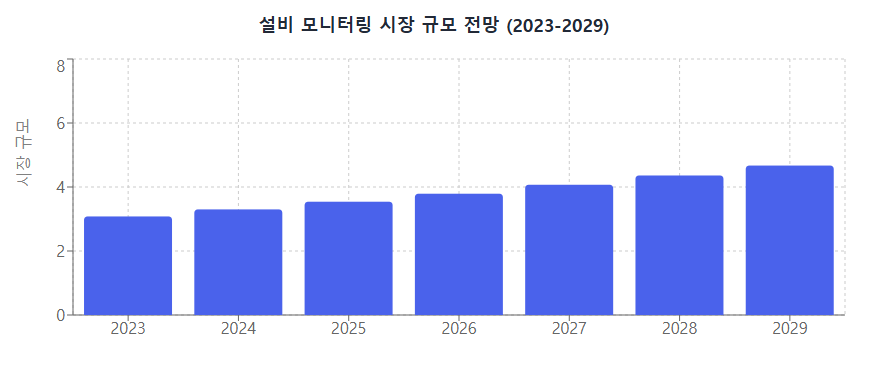
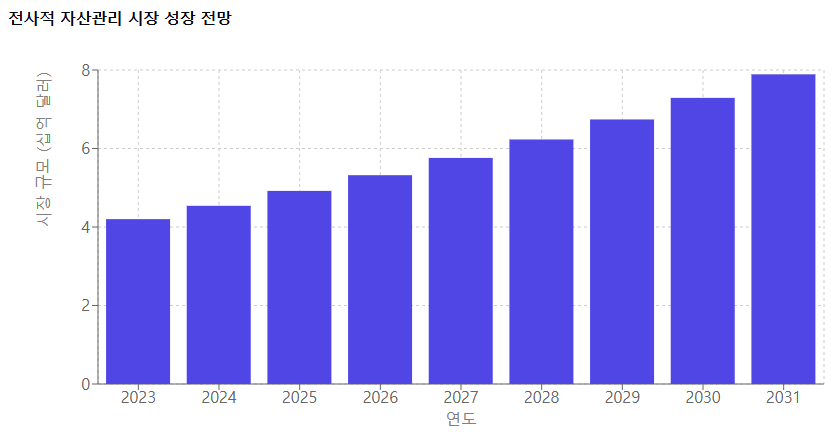
Among market-size analyses, we found one report focused on the machine condition monitoring segment and another on Enterprise Asset Management (EAM). Both segments are showing strong growth.
The Machine Condition Monitoring Market
The machine condition monitoring market, worth USD 3.08 billion as of 2023, is projected to grow at a compound annual rate of 7.19% through 2029. This reflects rising demand for real-time monitoring and predictive maintenance. The source is Global Information’s ‘Machine Condition Monitoring Market‘ report.
The EAM (Enterprise Asset Management) Market
The enterprise asset management market is forecast to grow from USD 4.2 billion in 2023 to USD 7.7 billion by 2031, a strong compound annual growth rate of 8.2%. The ALM (Asset Lifecycle Management) segment in particular is expected to lead the market. The source is ‘Enterprise Asset Management (EAM) Market Size, Share, and Growth Analysis‘.
Three core trends are driving this market growth.
1. The Spread of Big Data and AI-Based Preventive Maintenance
– Evolution from time-based maintenance (TBM) to condition-based maintenance (CBM)
– Use of real-time big data analytics platforms
– Adoption of AI-based predictive maintenance systems
2. The Growth of Cloud-Based EAM Solutions
– Scalability and flexibility
– Centralized management structures
– Greater cost efficiency
3. The Evolution from CMMS (Computerized Maintenance Management System) to EAM
– Expansion to an enterprise-wide asset management perspective
– Business process integration
– Incorporation of IoT and RFID technology
Outlook and Implications
Smart facility management systems are expected to keep evolving. Development is anticipated especially in the following directions:
1. More Advanced Sensor Technology
– Higher performance and miniaturization
– Incorporation of MEMS (Micro Electro Mechanical Systems) technology
– Development of composite sensors
2. More Advanced Data Integration and Analytics
– Real-time quality prediction
– Prediction of optimal maintenance timing
– Expansion of big data platforms
3. System Integration and Standardization
– Integration with ERP and PLM
– Expansion of cloud-based solutions
– Establishment of industry standards
Closing Thoughts
The smart facility management system is no longer optional; it is essential. To stay competitive in manufacturing especially, building a data-driven, intelligent asset management framework is a must. Now is the time for our companies to join this wave of change and prepare for the future of smart manufacturing.
✅ Related Content Worth Reading
Factory Energy Management System (FEMS) Market Size Analysis