1. The Changes an MES Brings
As the shift toward smart factories accelerates, many manufacturers are adopting automated equipment and ERP systems. But equipment alone cannot control the flow of the entire process, and ERP alone struggles to capture real-time data from the production floor.
Many small and mid-sized manufacturers still tally production results by hand and have to phone someone directly to learn the status of a process. In a structure where planning and execution, data and decision-making are separated, neither productivity gains nor quality improvement can be expected.
This is exactly what the MES (Manufacturing Execution System) solves.
An MES receives the production plan from ERP, breaks it down into work units, and tracks and records in real time which tasks are performed on which equipment in each process. By building a system where operator, equipment, material, and quality data flow as one, the factory can operate like a single organic system.
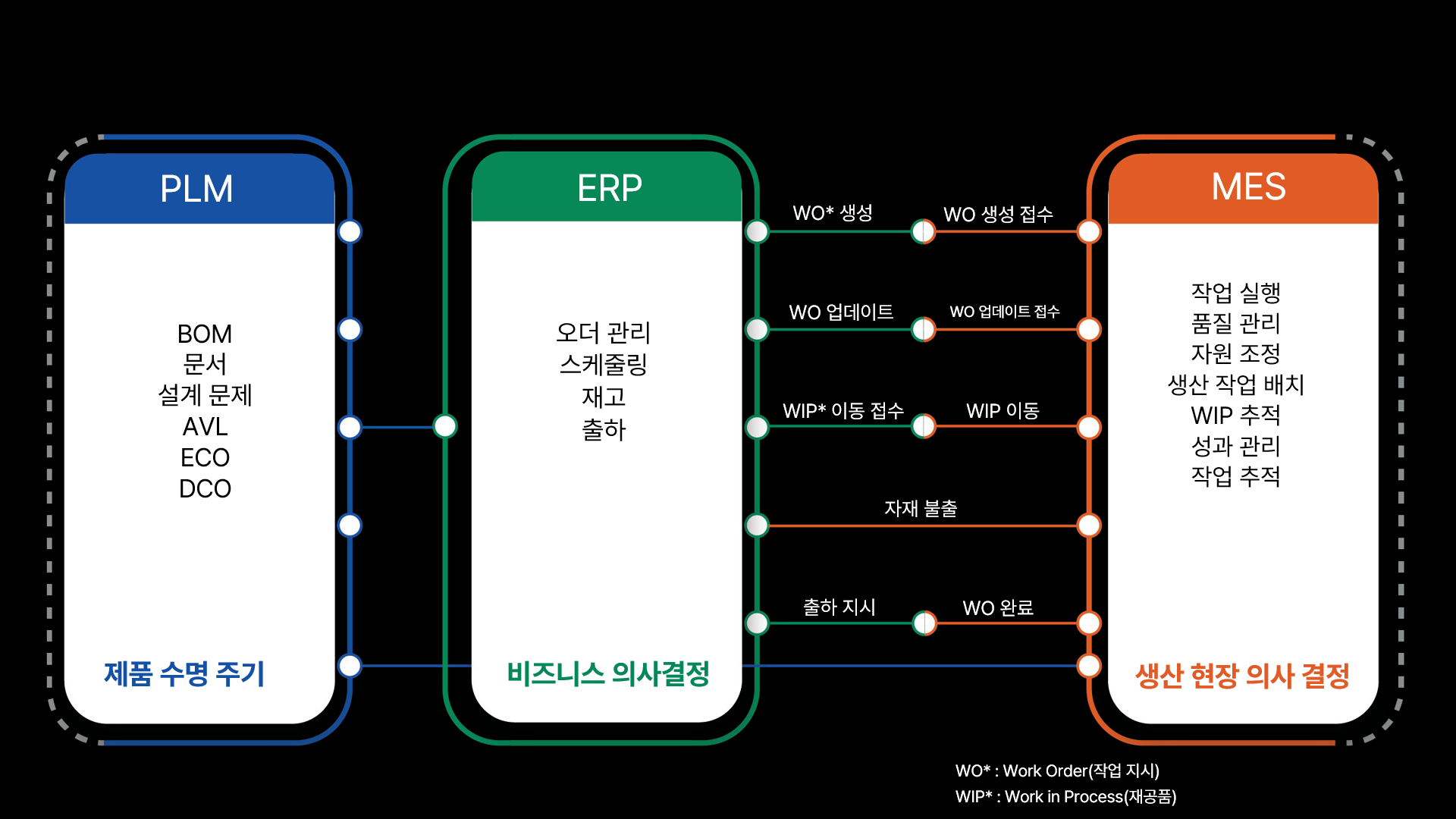
The relationship between ERP and MES (courtesy of 42Q)
Beyond quantitative results such as shorter lead times, lower defect rates, and better on-time delivery, MES adoption brings fundamental changes like these.
– Operators can view job information on tablets and log results automatically, with no paper work orders.
– Floor managers monitor equipment status and process bottlenecks in real time and respond immediately to warning signs.
– Quality data is recorded automatically, speeding up defect root-cause tracing and certification responses.
For small manufacturers in particular, an MES acts as the tool that realizes ‘standardized operations and data-driven decision-making.’
When manually run processes are digitalized, floor staff become part of the system too — and that leads to a transformation of the production culture and operating practices across the organization.
Ultimately, an MES is not just “a system for making things better” but “a system that lets you judge how you are making them and whether things are going well right now” —
the starting point of essential change in a manufacturer’s operating strategy.
2. The Impact of MES Adoption: Improvement Points in Numbers and Cases
Adopting an MES produces results you can prove with numbers, along with positive changes in how the shop floor itself operates. Here are concrete examples centered on key KPI improvements.
The MES as the Factory’s Control Tower
An MES collects and analyzes all the information generated by shop-floor work, from the start of the production process to the end. On this data, it performs the following core functions.
2-1. Minimizing production delays with real-time monitoring
– Johnson Controls built a real-time production monitoring system through MES adoption and cut production delays by 37% within 6 months. This shows how an MES reduces unnecessary downtime by surfacing floor problems immediately.
– According to MESA International, typical MES adoption yields productivity gains averaging around 25%.
2-2. Reducing defects with automated quality management
– An Aberdeen Group report found that MES-based automated quality monitoring cut defect rates by an average of 18% and quality costs by 23%.
– A pharmaceutical manufacturer reported a 22% improvement in batch record completeness, a 68% reduction in quality investigation time, and a 17% shorter production lead time after adopting an MES.
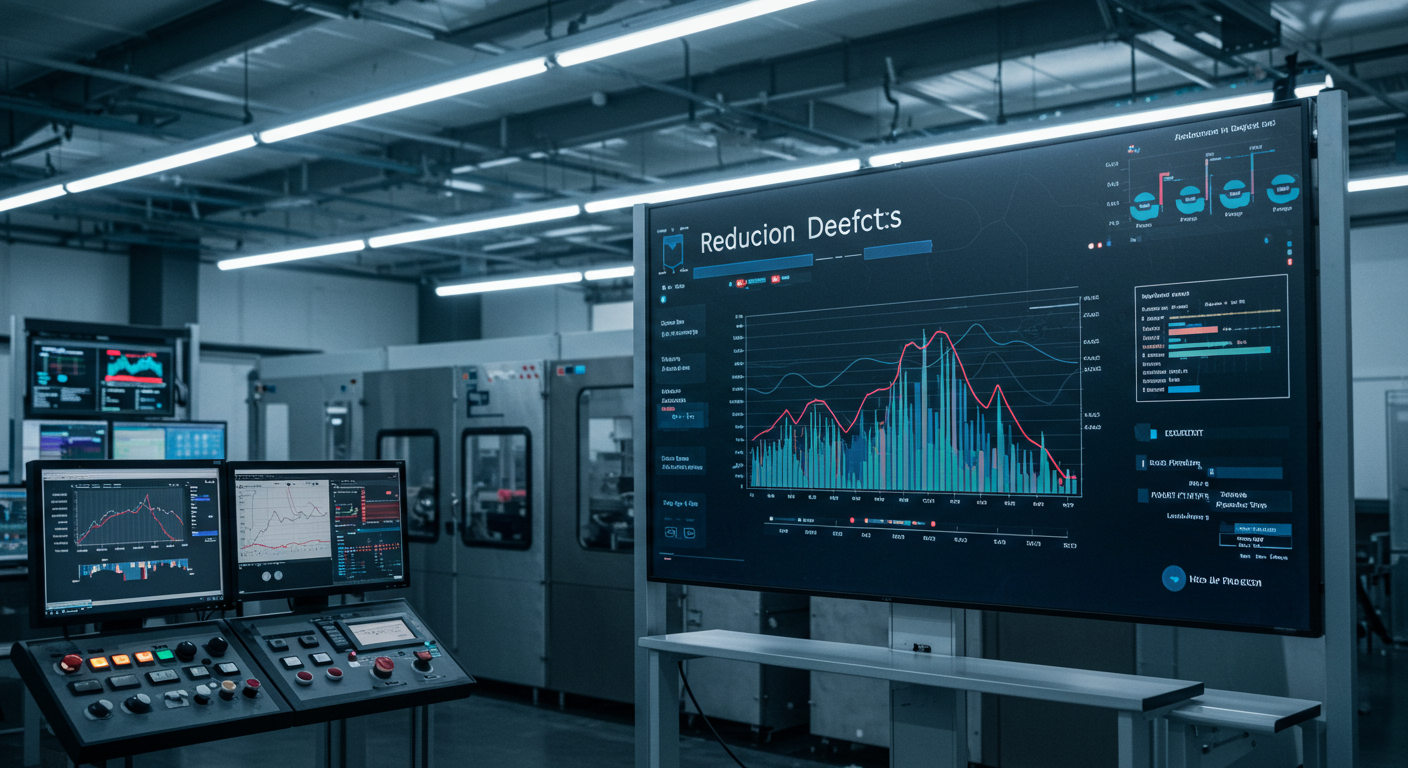
Defect inspection in the MES
2-3. Raising OEE and utilization
– Automated OEE (Overall Equipment Effectiveness) analysis through an MES improves equipment uptime, performance, and quality in an integrated way.
– One pharmaceutical company saw OEE rise 19% within 6 months,
– and Johnson Controls reports that its use of MES reduced equipment downtime and significantly improved OEE.
2-4. Shorter lead times and more efficient inventory management
– Across multiple industry cases, lead times fell by an average of 15–35%,
– and companies adopting comparable cloud-based systems reported reductions in excess inventory and waste.
2-5. ROI payback and cost savings
– In healthcare, pharmaceuticals, and similar fields, MES investments are assessed as recoverable within 1–2 years.
– In the Johnson Controls case, tangible cost savings came from reducing major defects and downtime.
3. 5 Things You Must Prepare Before Adoption
Merely ‘having adopted’ an MES guarantees nothing.
When companies see disappointing results, the cause is usually not the technology but insufficient preparation.
Here are the five essentials to consider for a successful MES rollout.
① Define goals and KPIs
Why are you adopting an MES?
The starting point is not “because we were told to build a smart factory” but concrete goals and measurable indicators (KPIs).
For example,
– Cut the defect rate by 30%
– Keep on-time delivery at 95% or higher
– Reach 85% or higher equipment utilization
Quantitative targets like these are essential.
📌 Example:
Food processor Company A adopted an MES with the goals of “real-time visibility into production processes” and “automatic CCP (Critical Control Point) monitoring,” dramatically improving its HACCP response speed.
② Map your processes and data flows
An MES is a system that runs on data.
So first examine what data your factory currently collects and records, and how.
If process sequences, operator roles, equipment interfaces, and quality inspection methods are not standardized, an MES can actually create confusion.
📌 Example:
When electronics component maker Company B documented its shop-floor work before adopting an MES, it found the same process was named differently by machine, and work instructions varied by team. Only after cleaning this up could the MES be applied.
③ Engage the floor and plan for resistance
The biggest obstacle to MES adoption is not technology but ‘human resistance.’
Operators especially may find a new system unfamiliar or feel they are being surveilled.
From the earliest stage, you need a strategy that reflects floor feedback and lowers the psychological barrier through demos, training, and incentives.
📌 Example:
Machining company Company C tested the MES UI/UX together with its operators, hiding unnecessary information and showing only what was actually needed — raising operator satisfaction and participation.
④ Review connected systems (ERP, SCADA, etc.)
An MES is not a standalone system.
It exchanges production plans with ERP, pulls equipment data from SCADA, and links with quality systems (QMS), warehouse systems (WMS), and more.
Without clearly defining in advance which systems will exchange which data and how, major confusion arises during implementation.
📌 Example:
Mid-sized electronics maker Company D had work order units in its legacy ERP that were too coarse and ambiguous, causing frequent errors when integrating with the MES. In the end, it had to redesign the ERP’s work order units before adopting the MES.
⑤ Build a phased adoption strategy
Attempting a company-wide rollout in one shot carries a high risk of failure.
The ideal path is to run a PoC (proof of concept) limited to a specific line, product family, or process, validate the impact, and then expand gradually.
📌 Example:
Medical device maker Company E applied its MES first not to its most complex line but to a line with many small-lot, high-mix orders. After confirming a 28% reduction in the order-to-delivery interval, it decided on company-wide expansion.
With this preparation, an MES becomes not a mere system rollout but a growth tool that strengthens the organization’s problem-solving and execution capabilities.
4. The Conditions for an MES Rollout That Does Not Fail
Among companies weighing MES adoption, you often hear things like this.
“We installed the system, but the floor has not changed.”
“They said it would all be automatic, but things got more complicated.”
This usually happens not because of the MES’s technical maturity but because the adoption approach was wrong.
Common traits of companies that fail
– They focus on ‘adopting’ and neglect ‘using’
– They lay the system on top without change management on the floor
– They design around features without considering workflows
– They amplify internal burden and resistance with an all-at-once rollout
This approach produces a system the floor ignores even though the technology arrived — an ‘invisible MES.’
3 strategies for successful MES adoption
① Approach it from a ‘floor-first’ improvement perspective, not a feature list
An MES is an IT system, but its essence is a change in how work is done.
Define the floor’s problems first, then use the MES as the means to solve them.
📌 Example:
Auto parts maker Company A started from the problem that “we are always late to see where production bottlenecks occur,” and designed its MES around real-time progress by process and equipment utilization visualization. Problem-solving, not technology, was the center.

Failing approach vs. successful approach
② ‘Phased expansion’ is more stable than a company-wide rollout
Attempts to cover every factory, process, and person at once mostly fail.
The wise path is to start small with a pilot, prove the impact internally, and then expand.
📌 Example:
Electronics assembler Company B piloted its MES in the SMT process and succeeded in automating defect history and rework management.
On that foundation, it is now expanding step by step into downstream processes, warehouse management, and delivery forecasting.
③ Build a three-way communication framework: floor–IT–management
An MES is not just an IT department project.
Floor practitioners, system administrators, and executives must participate together
– “what data to collect,”
– “what we want to improve,”
– “how we will measure results”
— and share these clearly.
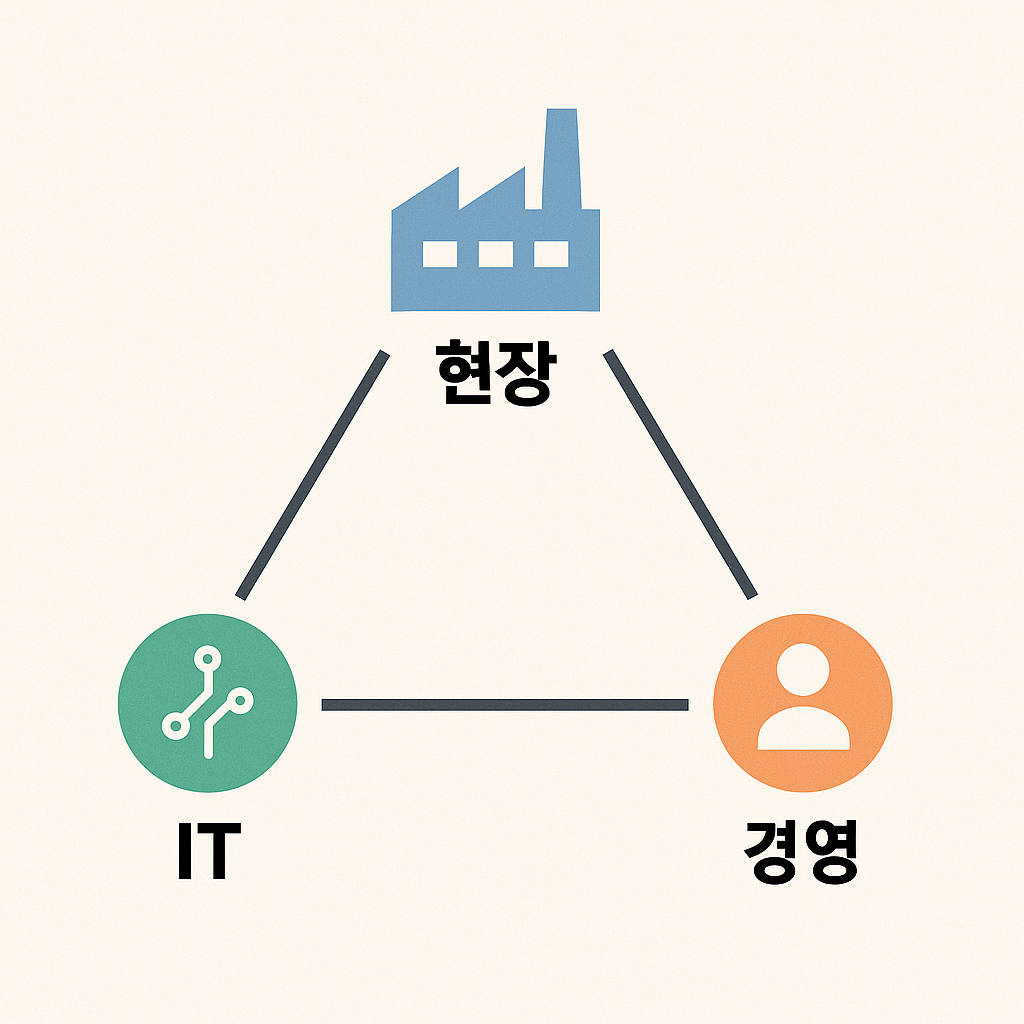
Building a three-way floor – IT – management communication framework
📌 Example:
Mid-sized food and beverage company Company C formed an MES task force in which representatives of each division met weekly with the vendor,
raising the quality of the rollout through a loop of requirements → feature planning → floor pilot → feedback.
A final word of advice
An MES is not shrink-wrapped software — it is a journey that shifts the organization’s entire way of operating onto a digital foundation.
Success depends on people more than technology, and on communication more than systems.
The moment your perspective shifts from ‘technology-driven’ to ‘floor-problem-solving’, the MES starts working as a system that produces results.
5. Closing Thoughts
An MES is not a mere system rollout. It is the starting point for strengthening shop-floor execution and turning manufacturing data into a strategic asset. With an MES, lead times shrink, quality stabilizes, and the floor becomes a place judged by “numbers” rather than “gut feel.”
But that impact is not realized by ‘technology’ alone.
– What problems is our factory experiencing?
– What data would make improvement possible?
– What will our people gain from the system?
When this advance thinking and preparation are in place, the MES delivers real results.
Regardless of company size, an MES is no longer a matter of choice. It is essential infrastructure for moving toward digitally driven manufacturing — the pivot that bridges the gap between ERP and equipment and enables real-time decision-making.
In the next post, we will look in detail at how the MES goes beyond work orders and performance management to realize ‘Connected Manufacturing’ in concert with IoT, cloud, and AI-based systems.