1. Why Is Choosing an MES So Hard?
Any manufacturer pursuing digital transformation has at some point wondered, “Should we adopt an MES?” But once you actually start the process, countless solutions pour in — features, prices, and deployment models vary wildly, and the choice itself is anything but easy. One MES highlights advanced quality analytics, another claims strength in IoT integration. Yet another touts tight ERP integration but turns out to be too complex for shop-floor workers or far too expensive. Companies often find it hard even to judge what they truly need.
Small and mid-sized manufacturers in particular rarely have dedicated IT staff or consulting advisors the way large enterprises do, so they frequently have to decide based on a vendor’s pitch or a demo alone. But risk hides here: many only realize after deployment that “it does not fit our processes,” “it is too hard to use on the floor,” or “the maintenance costs are too high.”
Moreover, an MES is not just a matter of picking a program. It is a system intertwined with equipment, workers, materials, process flows, ERP, quality standards, shipment records — production as a whole. A poorly chosen MES goes beyond inconvenience: it can trigger shop-floor resistance, data integrity problems, conflicts with ERP, and even process stoppages or production disruptions.
That is why choosing an MES requires more than asking “Does it have many features?” or “Is it cheap?” — it takes the judgment to pick the ‘right-fit solution’ for your real-world conditions: plant size, process complexity, and the need to connect with partners.
In this article, we put the question “Which MES is right for us?” at the center and walk through the essentials of MES selection — deployment types, selection criteria, the advantages of cloud MES, and a real 42Q case study.
2. Comparing MES Types: On-Premise vs. Cloud
One of the first decisions you face when choosing an MES is whether to go ‘On-Premise’ or ‘Cloud’. The two differ in far more than installation environment — they are core variables affecting adoption cost, maintenance approach, flexibility, and scalability across your entire operation.
What is an on-premise MES?
The server and MES system are installed and operated directly inside the factory.
Advantages
– Easy to custom-develop, so it can be optimized for complex processes
– Data stays entirely in-house, which helps with certain security requirements
– Deep integration possible with legacy systems such as ERP and SCADA
Disadvantages
– High upfront cost and long build time (several months to over a year)
– Requires staff for server and system maintenance
– Hard to scale or replicate when adding factories
– Limited connectivity with cloud-based platforms
What is a cloud MES?
The MES software is delivered as SaaS over the internet. A prime example is 42Q.
Advantages
– Fast deployment
– Runs on a subscription plan with no upfront investment
– Excellent scalability — connecting factories, integrating partners, and more
– Mobile and web access → flexible response on site
– Security, backups, and the like are managed by the cloud provider → lower maintenance burden
Disadvantages
– Internal security policies may restrict cloud use
– Constraints on in-house development or special customization
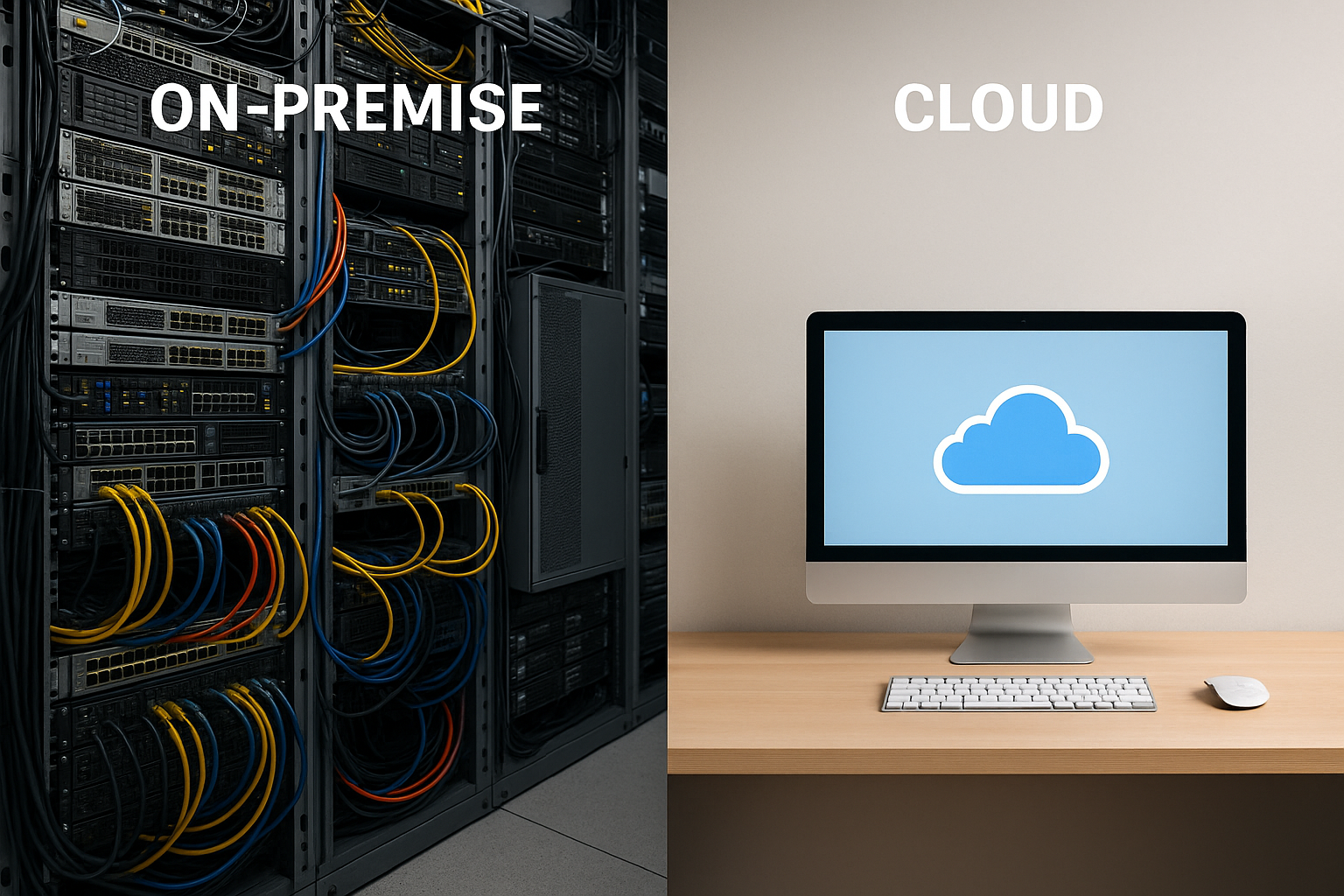
On-Premise vs. Cloud
Which approach suits which company?
|
Category |
On-Premise MES |
Cloud MES |
|
Company size |
Large enterprises with complex lines |
SMEs and mid-sized firms seeking rapid adoption |
|
Adoption goal |
Tailored, advanced customization |
Fast visibility, scalability first |
|
Budget structure |
Can afford a lump-sum upfront investment |
Low upfront burden, costs managed as opex |
|
Operating environment |
Closed network, in-house security first |
Multi-plant and partner connectivity matter |
|
Dedicated IT resources |
Has an infrastructure team |
Short on infrastructure staff |
In short, on-premise suits environments centered on deep customization and security, while cloud MES excels in speed, flexibility, and connectivity. For small and mid-sized manufacturers taking their first step toward digital transformation, a cloud MES can be “the realistic choice that works quickly and lets you expand connections gradually”.
3. Why 42Q: The MES Daliworks Chose
Hundreds of MES solutions exist, but Daliworks chose 42Q and signed an official distribution agreement in December 2024. 42Q offers cloud-based flexibility, proven global references, and an adoption structure optimized for small and mid-sized manufacturers.
42Q is a battle-tested MES developed and refined by Sanmina, a global leader in EMS (electronics manufacturing services), while operating some 80 factories worldwide. Proven for functionality and stability through years of use on real production floors, it is now used by global manufacturers across industries including medical devices, avionics, and industrial components.
Cloud-based, fast, and flexible to deploy
42Q runs as a SaaS (Software-as-a-Service) model rather than an installed system. It can be used immediately with nothing more than an internet connection — no separate servers or infrastructure — and scales flexibly when adding new factories or partners.
In fact, the first Korean reference customer, a robot manufacturer, deployed 42Q through Daliworks to a pilot line in just 6 weeks and has been seeing gains in production traceability and equipment quality from the very first month.
Securing data visibility
Many Korean manufacturers still rely on handwritten records, Excel management, and data siloed by machine. This makes it hard to grasp production performance at a glance and leaves them stuck in ‘reactive mode’, tracing causes only after problems occur.
To solve this, 42Q visualizes core production data — work orders, equipment status, quality inspections, traceability, and downtime — in real-time dashboards and reports. Everything is viewable directly in a web browser with no dedicated server, creating an environment where operators, managers, and headquarters decision-makers all see and act on the same data.
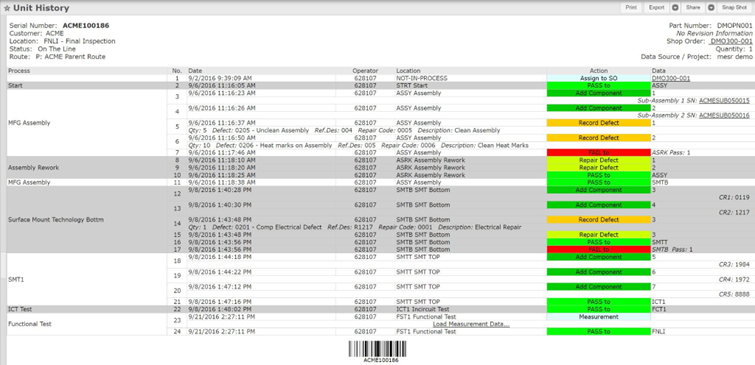
42Q’s production traceability features
Realizing Connected Manufacturing
42Q does not stop at managing a single factory — it is built to connect contract manufacturers, suppliers, and partners as well. This is the heart of Connected Manufacturing: a strategy that links the entire manufacturing ecosystem.
Suppliers delivering components, subcontractors handling assembly, and partners running test and shipment can all participate in a 42Q instance, making end-to-end traceability, quality issue detection, and shipment forecasting far more accurate. This connectivity goes beyond simple API integration — it leads to real-time information sharing at the MES level and a collaboration-based digital twin.
4. Selection Criteria: 6 Things You Must Weigh When Adopting an MES
As we saw above, Daliworks chose 42Q for a combination of reasons: cloud-based flexibility, rapid deployment, and supply chain connectivity.
But that choice was not made on product excellence alone. There is a ‘common set of selection criteria’ that applies to every company considering an MES.
Here are the 6 essential items to verify when choosing an MES.
42Q meets these criteria and offers a practical alternative, especially for small and mid-sized manufacturers.
① Scalability – “Can it reach beyond one factory and prepare you for future connections?”
An MES is not a single-factory system. You may later add plants or need to connect partners and overseas subsidiaries. What matters then is whether the architecture can expand easily without extra cost.
>> Because 42Q is SaaS-based, it scales to additional factories with no separate installation.
② Deployment speed – “How fast can you start and gain visibility?”
MES projects often take months to over a year. But without visibility gained quickly, decision-making inevitably slows down too.
>> 42Q delivers its core features as SaaS, enabling a pilot run within 4~6 weeks.
③ Maintenance and management – “Do we have the capacity to manage IT infrastructure?”
For SMEs, the shortage of IT staff is a real constraint. With a cloud-based MES, the provider handles server maintenance, security updates, and incident response in an integrated way.
>> 42Q performs system upgrades and security patches automatically.
④ Interoperability – “Does it connect easily with ERP, equipment, and IoT sensors?”
An MES does not exist in isolation. It must integrate naturally with ERP data consistency, equipment status collection, and sensor-based analytics.
>> 42Q provides REST APIs out of the box and has numerous integration references with SAP, Oracle, Thingplus, and more.
⑤ Usability – “Can shop-floor workers actually use it?”
A good MES is less about sophisticated technology and more about being usable by operators. Browser-based access, a touch-friendly UI, and simple workflows determine how well the system takes root after adoption.
>> 42Q’s intuitive UI/UX shortens training time and minimizes shop-floor resistance.
⑥ Operating model – “Does it fit our cost structure?”
Upfront lump-sum purchases are realistic only for large enterprises. For SMEs, a monthly subscription model improves budget flexibility and accessibility.
>> 42Q uses usage-based pricing that adjusts flexibly to plant size and feature scope.
Ultimately, choosing an MES is about picking ‘the right one’, not ‘the expensive one’. These 6 criteria can be the dividing line between MES success and failure.
5. A Real Case: A Robot Maker’s Digital Transformation, Achieved in One Month
In early 2025, leading robot manufacturer Company A decided to adopt an MES to take the visibility and control of its production lines to the next level. This decision was not simply about raising yield — it was a move to build a data-driven manufacturing ecosystem and lay the strategic foundation for evolving into an intelligent factory.
The challenge: inefficient manual processes and the limits of data management
Company A had relied on handwritten records and fragmented systems. Work history tracing was slow, data errors were frequent, and the weak link between work instructions and actual execution led to frequent process deviations. Ultimately, both production quality and decision-making speed were suffering.
The key to the solution was digitalization — above all, real-time traceability and a single source of truth.
The choice: the cloud-based MES ’42Q’
Among cloud-based MES options, Company A chose 42Q. Built on a stable AWS cloud environment, 42Q comes with real-time production data collection, storage, and visualization built in. Above all, every feature is available in a web environment with no dedicated servers or fixed infrastructure,
and the ability to deploy quickly without an IT infrastructure burden was the decisive factor.
Implementation: a strategic, shop-floor-first rollout
The company formed a dedicated project team and deployed 42Q in a way optimized for its actual production lines.
Real-time data collection (Production Workbench)
Operators entered inspection results and defect information in real time at each process step, and all of it was stored securely in the AWS environment, strengthening visibility across processes.
100% product traceability (Label Engine)
With barcode-scan-based history management in place, every assembly — from components to finished products — now carries its own unique history.
Integrated work instructions
Step-by-step manuals and instructions were integrated into the MES, letting operators view and follow documents directly in the system — sharply reducing process deviations.
Cloud infrastructure agility and security
Because 42Q runs on AWS, it can comfortably handle future multi-plant expansion and additional users.
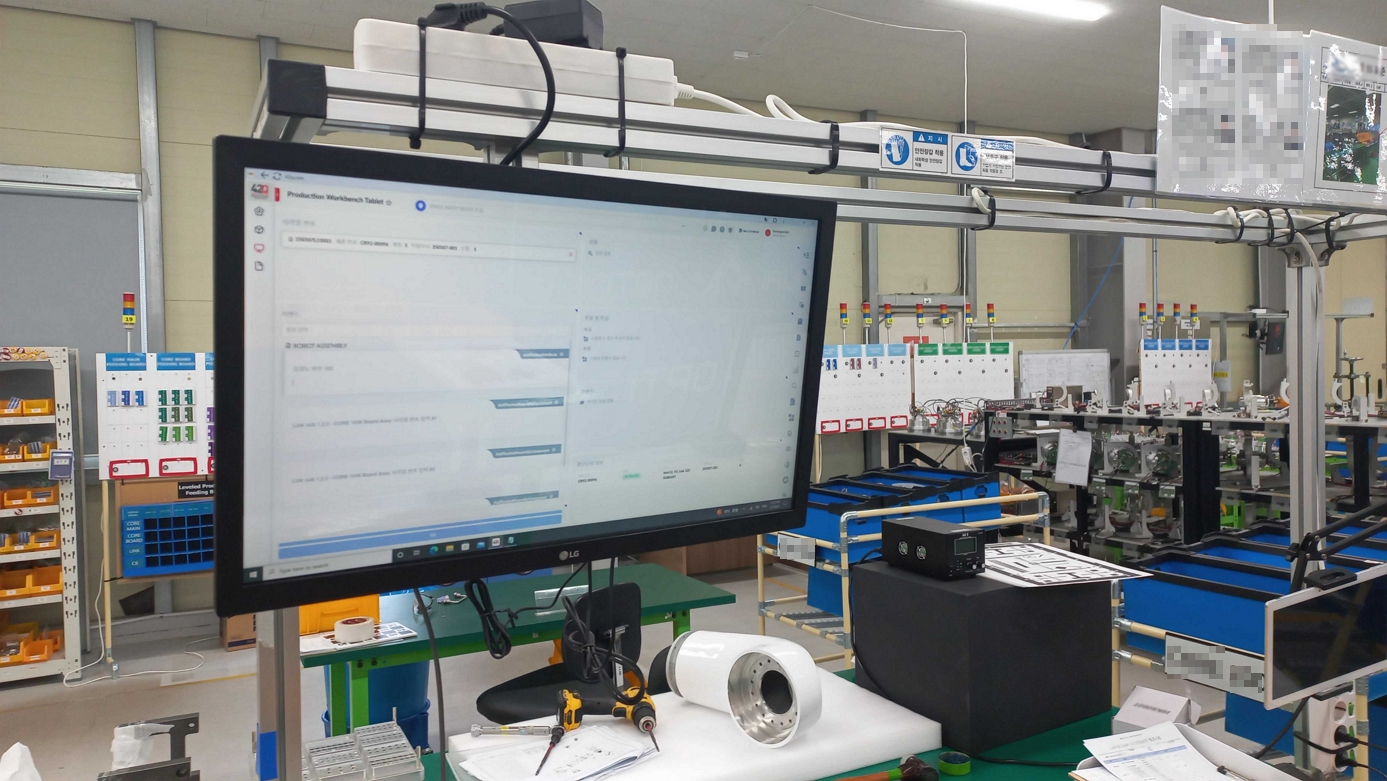
42Q deployed on the shop floor
The results: digital transformation realized in just 4 weeks
Company A completed the digitalization of its entire production line in just one month and produced clear results.
|
Result area |
Details |
|
Product traceability |
100% serial-number-based history tracking secured for every unit and component |
|
Data accuracy |
Error rates minimized and record accuracy improved by reducing manual work |
|
Quality responsiveness |
Real-time anomaly detection cut quality claim response time by 50% |
|
Report automation |
Automated key KPI reports shortened decision-making time |
|
Operational efficiency |
Intuitive dashboards made line operation management easier |
This was not just an MES rollout —
we created a turning point in digital transformation, preparing for the future of the robot manufacturing industry.
— Internal assessment from a company representative
As this shows, 42Q can be the most practical choice for companies weighing complex manufacturing processes, fast decision-making, and global expansion.
6. Execution Strategy and Checklist for MES Adoption
Adopting an MES is not simply installing software. It is a change management project that fundamentally reshapes how the organization operates, how data flows, and who is responsible for what. However good the solution, without proper preparation and an execution strategy it can degenerate into ‘a system with many features that nobody uses.’
Here are the execution strategy and checkpoints you must prepare to adopt an MES without failure.
The 5-Step Execution Strategy
|
Step |
Strategy |
Description |
|
Step 1 |
On-site diagnosis |
Diagnose manually managed areas, data flows by process, and bottlenecks in advance |
|
Step 2 |
Select priority processes |
Pilot first in the most problematic processes or those most urgently needing performance tracking |
|
Step 3 |
Run a PoC (pilot) |
Apply MES features to a small area to validate and gather feedback |
|
Step 4 |
Expand gradually |
Roll validated features out step by step to the full line or other plants |
|
Step 5 |
Train and internalize |
Embed the system and minimize shop-floor resistance through operator and manager training |
MES Adoption Checklist
If you are considering adoption, check these items one by one.
|
Check item |
Question |
|
Is the purpose clear? |
Beyond ‘we need an MES’ — have you articulated why you need it? |
|
Have you identified problem processes? |
Which processes are inefficient? Which are managed by hand? |
|
What is your IT infrastructure like? |
Is cloud-based adoption feasible? What are your IT staff’s capabilities? |
|
Do you understand the shop floor? |
Can you communicate with floor managers and operators? |
|
What about integration with ERP and other systems? |
Which systems need to be connected, and is API support available? |
|
Is the budget structure realistic? |
Which fits better — an upfront lump-sum purchase or a subscription? |
An MES is not a system — it is the work of creating a ‘shared language’ for your organization, processes, and data. It deserves an equally strategic approach.
In closing
In this post, we presented actionable criteria for MES selection, centered on the strengths and real-world application of an actual solution: 42Q.
With cloud-based flexibility, rapid deployment, an architecture that extends to partners, and visibility and traceability suited to the realities of Korean manufacturing, 42Q can be the fastest and most realistic MES option for small and mid-sized manufacturers.
Wondering about the next step?
-
Need an MES adoption consultation?
-
Want to assess why your factory needs an MES?
Daliworks goes beyond selling solutions — we are your execution partner for manufacturing digital transformation.
Contact us anytime.