The Internet of Things (IoT) has moved beyond simple sensor networks and is evolving into advanced systems capable of intelligent judgment, secure data processing, and real-time response. On top of AI, edge computing, and low-power sensors, technologies such as cloud computing, blockchain, and security are converging rapidly, reshaping the very paradigm of IoT.
In this post, we take an in-depth look at IoT technology trends as of 2025, focusing on the real technical currents and the forces behind them.
1. AI: Giving IoT Devices Intelligence
The Rise of AIoT
AIoT (Artificial Intelligence of Things) is the combination of artificial intelligence (AI) and the Internet of Things (IoT). It enables IoT devices to go beyond simple data collection to learn, judge, and make autonomous decisions on their own. This makes IoT systems far more efficient and intelligent to operate.
The Role of AI and Where It Applies
– Data analysis and prediction: AI algorithms analyze the vast data collected by IoT devices to identify patterns and predict the future. A smart home system, for example, can learn residents’ living patterns and optimize energy use.
– Autonomous decision-making: AI responds automatically to real-time conditions, keeping systems running without human intervention. In a smart factory, for example, when early signs of equipment trouble are detected, maintenance can be scheduled or the production line adjusted automatically.
– Personalized services: Voice recognition and natural language processing enable human-centered interfaces. This is what makes user-friendly interfaces such as smart speakers and virtual assistants possible.
Case in Point: Smart Healthcare
Sensors collect patients’ vital signs in real time, and AI analyzes them to catch warning signs early. This helps clinicians make faster decisions and gives patients personalized health management.
2. Edge Computing: Processing Data Right Where It Is Created
Why the Edge Matters
In a traditional IoT architecture, data is sent to a central cloud server for processing. But this approach suffers from latency, bandwidth limits, and security concerns. Edge computing processes data in real time close to the IoT device, minimizing latency and reducing network load. It is drawing attention as a core technology especially in manufacturing and transportation systems, where large volumes of data must be analyzed in real time.
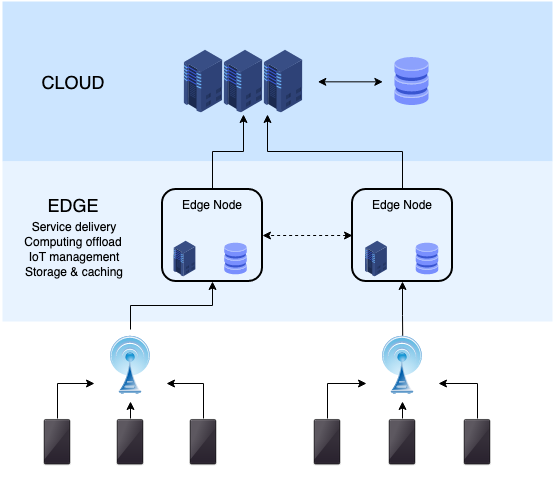
Edge computing
Edge computing
Roles and Applications
– Minimal latency: Cutting the round trip to the cloud enables responses within a few milliseconds.
– Data security: Sensitive information is processed on-site, reducing the risk of leaks.
– Network efficiency: Eliminating unnecessary data transfers cuts costs and communication load.
Case in Point: Smart Manufacturing
An autonomous vehicle must perceive its surroundings and make split-second decisions while driving. In the same way, AI-equipped edge devices analyze equipment data, detect warning signs, and feed the findings straight back into the process, raising productivity and preventing breakdowns.
3. Low-Power Sensors: The Foundation for a Battery-Free IoT Era
The Key to Sustainable IoT
Power supply has long been a major obstacle to the widespread adoption of IoT. Low-power design is essential, especially in places where battery replacement is difficult or in large-scale sensor networks. As a result, low-power communication technologies and energy-harvesting sensors are advancing rapidly.
Roles and Applications
– Low-power wireless communication: Technologies such as BLE, Zigbee, and LoRa reduce the power consumed by sensor-to-sensor communication.
– Energy harvesting: Sensors generate their own power from ambient energy such as sunlight, heat, and vibration, making battery-free sensors possible.
– Ultra-low-power MCU integration: Microcontrollers process and transmit data with minimal energy. The latest MCUs deliver high performance while minimizing power draw, improving the energy efficiency of IoT devices.
Case in Point: Smart Agriculture
Sensors measuring soil moisture, temperature, and CO₂ levels recharge themselves with solar power and transmit data over long distances via LoRa. Low-power sensors can run for long periods without maintenance, making precision agriculture a reality.
4. Cloud Computing: The Engine of Scalable IoT
The Synergy of Cloud and IoT
The cloud provides the infrastructure to centrally store, process, and analyze the massive data generated by IoT devices. This is what makes scalable, flexible, and cost-efficient IoT solutions possible.
Roles and Applications
– Data storage and management: Large-scale sensor data is stored and managed reliably.
– Analytics and insight: Cloud-based machine learning enables pattern analysis and prediction.
– Device management and updates: Firmware can be updated remotely OTA (Over-the-Air).
– Hybrid architectures: Linking edge and cloud achieves real-time response and integrated analytics at the same time.
Case in Point: Smart Buildings
Data from hundreds of sensors across a building is consolidated in the cloud to optimize energy use and respond immediately when anomalies occur.
5. Blockchain: The Core Technology of a Trust-Based IoT Ecosystem
Where IoT Meets Blockchain
Blockchain is a distributed ledger technology that guarantees trust without a central server, making it highly effective for securing the transparency and integrity of data in IoT environments.
Roles and Applications
– Tamper-proof data: Data recorded on a blockchain cannot be altered, securing the trustworthiness of the data IoT devices generate.
– Decentralized device authentication: Individual IoT devices can authenticate each other through digital IDs without a central server.
– Smart contracts: Contracts that execute automatically when conditions are met strengthen IoT-driven automation. For example, when a sensor detects a certain reading, a parts order can be placed automatically.
Case in Point: Smart Logistics and Energy
– Supply chain management: Every step from production to delivery is recorded on the blockchain, securing transparency and preventing counterfeiting.
– Smart cities: Data such as traffic signals and energy use is stored on the blockchain, raising the efficiency and transparency of city operations.
– Energy: Smart-contract-based P2P power systems can automatically trade solar power with neighbors.
6. IoT Security: The Shield of a Connected World
No Trust Without Security
Because IoT connects so many devices, it is highly vulnerable to hacking, data leaks, and DDoS attacks. Every device can become an entry point into the network, so a single vulnerability can affect the entire system. Security has therefore become an essential consideration from the very design stage of IoT.
Roles and Applications
– Zero-trust architecture: Security models that trust no device or user by default and verify continuously are being adopted.
– AI-based threat detection: Machine learning security solutions that detect and respond to anomalous behavior in real time are spreading.
– Security certification programs: Certification standards that consumers and businesses can trust, such as the U.S. Cyber Trust Mark, are being introduced.
Case in Point: Industrial IoT (IIoT)
Production equipment is fitted with security modules and AI-based threat detection, addressing physical safety and cyber threats at the same time.
7. The Synergy of Convergence: An Integrated Approach Opens the Future
Technologies Are Stronger When Connected
IoT is not a single technology but an ecosystem where AI + edge + sensors + cloud + security + blockchain combine. Only when they are integrated does a truly smart system emerge. In a hybrid IoT architecture that combines the strengths of cloud and edge computing, for example, first-pass analysis happens at the edge while long-term insight and management run in the cloud, striking a balance across speed, security, cost, and analytics.
Roles and How They Fit Together
– Sensors: The starting point of data collection. They detect a wide range of physical information and provide the system’s inputs.
– Edge computing: Real-time response and distributed processing. Latency-sensitive field data is processed on the spot to maximize responsiveness.
– AI: The brain for judgment and prediction. It performs predictive analytics, anomaly detection, and automated decision-making on the collected data.
– Cloud: Central integration and scalability. It governs the operation of the entire IoT system, from data storage and integrated analytics to OTA (Over-the-Air) updates.
– Blockchain: Guaranteed data integrity and transparency. It provides the foundation of trust: tamper prevention, device-to-device authentication, and transaction history management.
– Security: The shield of the connected ecosystem. Comprehensive protection is built in from design through transmission, storage, and computation.
Case in Point: Technology Convergence in the Smart City
The smart city is the definitive showcase of technology convergence.
– Traffic management: Road sensors → edge AI analysis → integrated cloud control → automatic traffic signal control
– Energy management: Smart meters → real-time usage analysis → AI prediction → automatic lighting and HVAC control
– Policing and safety: CCTV + AI analysis → abnormal situation detection → emergency alerts → security center response
– Data governance: All city infrastructure data stored on the blockchain for transparent administration and citizen trust
The ability to design systems that weave technologies together toward a single goal will be the most important digital transformation asset of the years ahead.
Closing Thoughts
IoT is no longer a simple connectivity technology. It is transforming into intelligent systems that judge at the edge, extract data from sensors, and learn and predict with AI.
Through the convergence of these core technologies, the IoT of the future will evolve into systems that are ever more real-time, autonomous, and energy efficient.
IoT is evolving beyond simple connectivity under the keywords of intelligence, autonomy, stronger security, and energy optimization. For companies and technology leaders, now is the time to make IoT a new source of competitiveness through an AI-centered convergence strategy.