Building a FEMS Predictive Model: A Step-by-Step Guide
As energy management in manufacturing grows more sophisticated, predictive models within FEMS (Factory Energy Management System) are drawing attention. By forecasting energy consumption patterns, manufacturers can cut costs, improve efficiency, and advance environmental sustainability. This article explains how to build a FEMS predictive model step by step, along with the key considerations for successful model design.
The FEMS Predictive Model Building Process
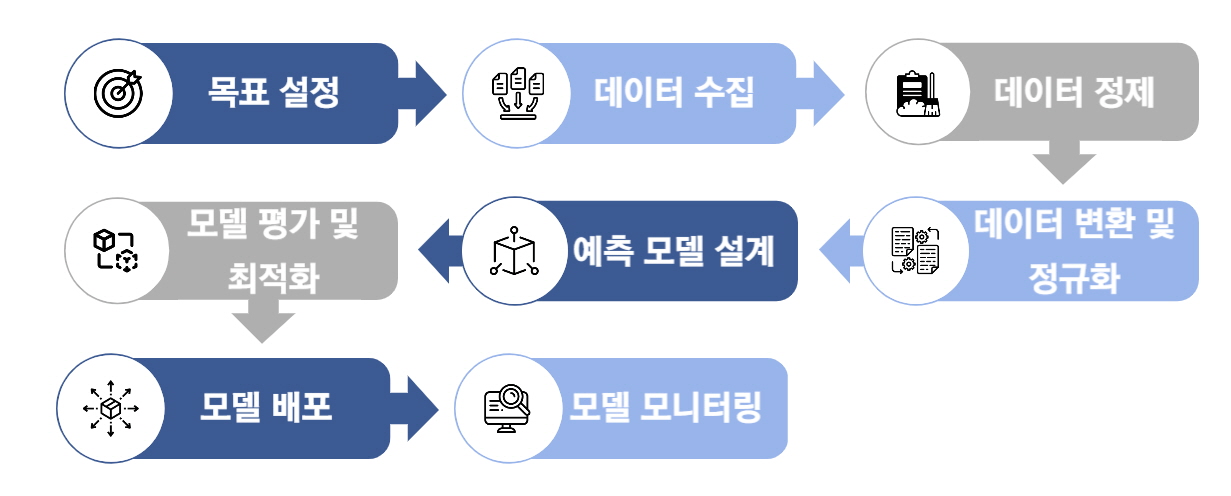
1. Preparing the Predictive Model
Before building the model, you need to clearly define your prediction goals and secure the necessary data.
① Goal setting: Establish clear objectives such as forecasting peak-time energy demand, distributing energy efficiently, or optimizing equipment operating patterns.
② Data collection: Gather data on energy consumption, environmental conditions (temperature, humidity, etc.), and equipment operating status.
2. Data Preprocessing
The collected data is refined through preprocessing into a form suitable for the model.
– Data cleansing: Handle missing data and outliers to secure highly reliable data.
– Data transformation and normalization: Align units and standardize timestamps for consistent analysis.
3. Predictive Model Design
FEMS predictive models are designed using a variety of machine learning and deep learning techniques, and algorithm selection is a critical design decision.
– Regression models: Techniques such as linear and polynomial regression can predict basic changes in energy demand.
– Time series models: Models such as ARIMA and LSTM account for temporal continuity to predict complex patterns.
– Ensemble models: To boost predictive performance, ensemble methods such as random forest and gradient boosting can be applied.
4. Model Evaluation and Optimization
Accurately evaluating and optimizing the model is essential to maximizing its predictive performance.
4-1. Evaluation Metrics
Model performance is reviewed using a range of evaluation metrics, with several used in combination depending on the situation.
– MAE (Mean Absolute Error): The average of absolute errors, used to evaluate the model’s overall prediction accuracy.
– RMSE (Root Mean Square Error): The square root of the mean of squared errors, more sensitive to large gaps between predicted and actual values.
– MAPE (Mean Absolute Percentage Error): Calculates prediction error as a percentage, measuring model performance in relative terms.
4-2. Hyperparameter Tuning
Setting optimal hyperparameters improves the model’s predictive performance.
– Grid Search: Explores every predefined combination of hyperparameters to find the optimum.
– Random Search: Samples hyperparameter combinations at random to find good values quickly.
– Bayesian Optimization: Optimizes while evaluating performance, enabling efficient tuning.
4-3. Model Ensembling
This approach combines multiple models to improve predictive performance. For example, ensembling a regression model with a time series model produces predictions that combine the strengths of both.
5. Model Deployment and Monitoring
5-1. Model Deployment
The finished model is deployed as an API or web service so it can deliver predictions in real time. Integrated into the FEMS, it enables real-time energy consumption forecasting and automated management.
5-2. Model Monitoring
A model in production can degrade over time, so its prediction accuracy must be checked through periodic monitoring. When performance degradation is detected, the model is retrained with the latest data.
Key Considerations When Building a FEMS Predictive Model
The following factors should be considered to build a successful model.

– Data quality: The accuracy and completeness of collected data directly affect model performance. Ensuring data reliability is critical.
– Model complexity: An overly complex model can overfit the training data, while an overly simple one can lose prediction accuracy. The right level of complexity must be maintained.
– Seasonality and periodicity: Energy consumption can vary with seasonal and cyclical factors, so the model design needs to reflect them.
– External factors: Incorporating external factors that can affect energy consumption (e.g., weather conditions, economic variables) can improve prediction accuracy.
– Interpretability: To understand the model’s output and make decisions based on it, interpretability must be considered. This is especially important for models used in business settings.
An Approach to Building a Successful FEMS Predictive Model
FEMS predictive models play an important role in maximizing energy efficiency in manufacturing while contributing to cost savings and environmental protection. By following the step-by-step approach described in this article, you can build a data-driven, optimized energy management system.
✅ Recommended Reading
FEMS Predictive Analytics Success Story: Achieving Efficiency Gains and Cost Savings