Digital transformation without guaranteed results is meaningless
This strategy series builds on ‘✅ Top 5 Smart Factory Trends for the Second Half of 2025.’
In this installment, we answer the question companies preparing for smart factory adoption ask most: “How much return will it actually generate?”
Smart Factory: How Much Do You Invest, and How Much Do You Get Back?
A smart factory requires not only equipment and systems but also data-driven operational capability, so a certain level of upfront investment is unavoidable.
So can it actually generate returns to match?
The answer is “yes — but you need to run the numbers first.”
The heart of a digital transformation (DX) investment is not the technology but the results (ROI).
Success requires calculating ROI before adoption and defining the smart factory scope and priorities that fit your plant.
ROI = (Annual Expected Benefit – Annual Maintenance Cost) ÷ Initial Investment
ROI is the metric that shows, in numbers, “how much benefit you gained relative to what you spent”.

✔️ Return on Investment sample formula
ROI = [(Annual Cost Savings + Productivity Gains + Defect Reduction Benefit) – Annual Maintenance Cost] ÷ Initial Investment
Benefit Analysis by Line Item

→ Total expected benefit: KRW 200 million / Initial investment: KRW 150 million → ROI = 33%
📌 The figures above are conservative averages based on smart factory performance reports from Korea’s Ministry of Trade, Industry and Energy and Ministry of SMEs and Startups, reports from global consulting firms (McKinsey, Deloitte), and real cases covered in the Korean press.
3 Key Factors That Determine ROI

① Selecting the Scope
– Start with the 1~2 processes with the biggest impact rather than rolling out across every process
– Examples: energy-intensive equipment, high-value equipment that needs anomaly detection
② Setting Measurable Goals
– Not vague “smartification” but targets like “raise utilization of equipment A by 10%”
– Only number-based goals make results measurable
③ Using Data-Driven Diagnostics
– Before adoption → through on-site diagnosis + a pilot test
– Verify actual savings potential and required capabilities first
How to Calculate Your Smart Factory ROI
Step 1: Itemize the Costs
– Equipment automation: IoT sensors, gateways, motor controllers, etc.
– Systems: cloud platform, dashboards, analytics algorithms
– Infrastructure: communications equipment, power meters, etc.
– Training and consulting: initial setup, administrator training, etc.
Step 2: Quantify the Expected Benefits
– Energy costs: How much can FEMS-driven peak management save?
– Labor costs: Can equipment automation reduce night-shift staffing?
– Quality gains: How much does shipment yield rise when defect rates fall?
– Process efficiency: How much downtime does automated monitoring eliminate?
Step 3: Build a Numbers-Based Comparison Table
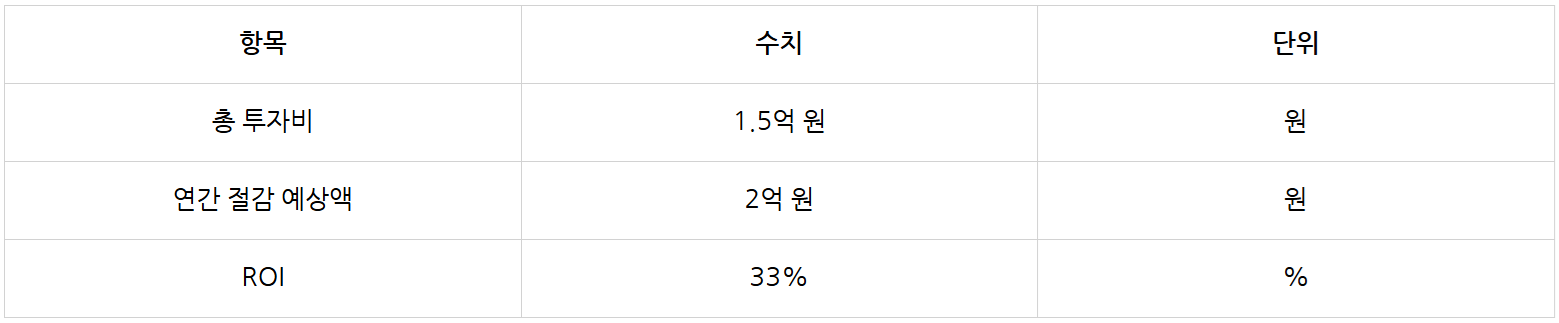
An ROI of 25~40% can be judged a “successful investment”
Pre-Adoption Checklist

✅ Do you know your current operating costs by equipment and process?
✅ Which line items generate the most cost?
✅ Is a pilot project with measurable ROI feasible?
✅ Can you distinguish short-term wins from long-term operating strategy?
Conclusion: What Matters More Than Technology Is a ‘Results-First’ Adoption Strategy
A smart factory is not about “adopting technology” — it is a strategic effort to design and deliver results.
ROI calculation is a powerful tool for proving the business case, earning trust on the shop floor, and driving executive decisions.
Before you adopt, calculate the return first.
✅ Recommended Reading