In the Netherlands, farms produce more food than the country has people; in Japan, unmanned robots harvest strawberries before dawn. And in Korea as well, a growing number of farms are using smartphones, sensors, and artificial intelligence to manage crop cultivation like a factory.
At the center of all this change is a single keyword.
That keyword is the Smart Farm.
Let’s take a look at where this new agricultural innovation, one that goes beyond traditional farming, begins.
1. What Is a Smart Farm?
A smart farm is an agricultural system that uses information and communication technology (ICT) to manage the growing environment of crops or livestock with precision and consistency.
Where conventional farming relied on a farmer’s experience and intuition, a smart farm draws on technologies such as sensors, IoT, big data, and artificial intelligence (AI) to collect and analyze data in real time and automatically adjust conditions to their optimum.
For example, environmental data such as soil moisture and temperature, CO2 concentration in the air, and light intensity is measured in real time, and that data is used to adjust irrigation volumes or decide when to apply fertilizer. The essence of the smart farm is keeping the environment best suited to crop growth, even without human intervention.
This approach goes beyond simply reducing labor, offering benefits such as:
– Increased production
– Uniform quality
– Resource savings
– Reduced environmental pollution
and a variety of other positive effects.
In short, the smart farm is an innovative attempt to bring digitally driven scientific management and automation to agriculture, raising productivity and sustainability at the same time.
2. Why Do We Need Smart Farms?
A Shrinking, Aging Farming Population
Korea and other major agricultural nations around the world face a serious problem: a declining farming population.
In Korea in particular, people aged 65 or older now account for more than half of all agricultural workers, rapidly weakening the productive base of rural communities. Younger generations are moving to the cities, and farming keeps getting older.
Against this backdrop, smart farm technology, which lets a small workforce manage large areas efficiently, is emerging as the key to keeping agriculture sustainable.
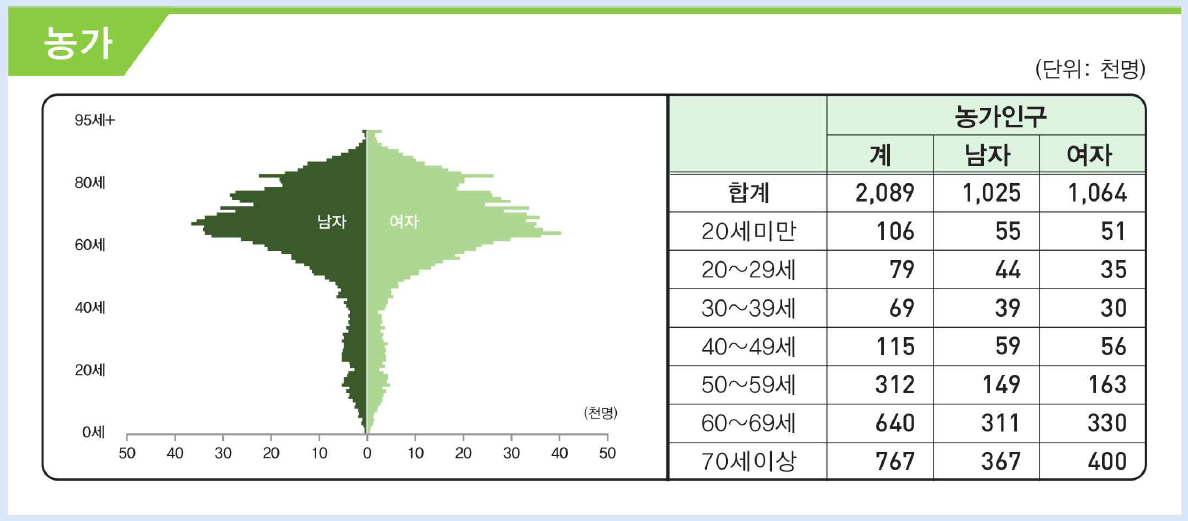
Farm household population structure (2023 Census of Agriculture, Forestry and Fisheries, Statistics Korea)
Climate Change and Falling Productivity
Climate change is another major threat to agriculture.
Droughts, torrential rain, and abnormal temperatures directly damage crop growth, and with conventional methods they are hard to predict or respond to.
Smart farms collect and analyze a wide range of environmental data in real time, playing a major role in building agricultural systems that can respond nimbly to a changing climate.
For example, if an unexpected temperature drop is detected, heating can be switched on immediately; if a moisture shortage is detected, irrigation runs automatically, minimizing damage to crops.
IoT technology is being used as an innovative solution across a wide range of industries. Let’s look at a few examples.
Growing Global Demand for Food
The world’s population keeps growing, and projections suggest that by 2050 we will need about 70% more food than we produce today.
Traditional labor-intensive farming cannot meet that level of demand.
Smart farms make more efficient use of limited land and resources, maximizing output per unit area.
In doing so, they can help solve the global food problem in a sustainable way.
3. How Smart Farms Will Change the Future of Agriculture
Higher Productivity and Better Quality
The biggest change smart farms bring is a dramatic leap in productivity.
In the past, yields swung widely with the weather and soil conditions. Smart farms control the environment precisely, securing consistent quality and yields all year round.
For example, by optimizing temperature, humidity, and sunlight, and by detecting and responding to pests and diseases in advance, growing conditions can be managed like an optimized factory. As a result, more crops can be produced more reliably on the same land.
For high-value crops in particular (such as hydroponic ginseng, herbs, and functional crops), quality uniformity can be a key factor in building brand value.
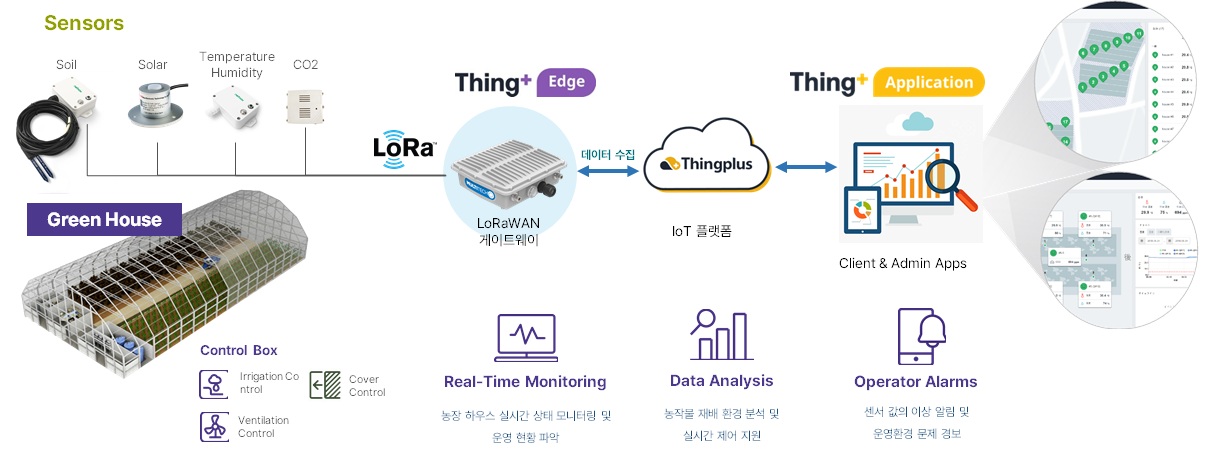
A smart farm built with Daliworks Thingplus
Labor Savings and Farm Automation
Smart farms accelerate the automation of agriculture.
Sensors collect the data, artificial intelligence analyzes it, and the system handles irrigation, ventilation, lighting adjustments, and more on its own.
Because this process takes only a minimal workforce, farmers no longer have to spend all day running around the fields.
In rural areas where aging is severe, labor savings are an essential requirement for keeping agriculture viable.
In addition, through automated systems farms can:
– Monitor the farm even at night
– Respond immediately to warning signs
– Improve quality of life through lighter workloads
These are welcome side benefits that come with automation.
A Shift Toward Eco-Friendly, Sustainable Agriculture
Smart farms go beyond simple productivity gains to make eco-friendly, sustainable agriculture possible.
They use only the precise amounts of water and fertilizer required, cutting resource waste,
and keep pest and disease control to the necessary minimum, reducing environmental pollution.
Combined with energy-efficient equipment designed to cut carbon emissions (such as solar panels and high-efficiency heating systems), agriculture too can put ESG management into practice.
Going forward, smart farms will play a vital role in addressing global issues such as climate change, food security, and environmental conservation.
4. What Is Accelerating Smart Farm Adoption
Stronger Government Smart Agriculture Policies
Governments around the world are actively promoting smart farms with the goals of securing food supplies, strengthening agricultural competitiveness, and revitalizing rural communities.
The Korean government in particular is growing a smart agriculture ecosystem through policies such as building Smart Farm Innovation Valleys, supporting young farmers who launch smart farm businesses, and establishing IoT-based agricultural data.
This government-led support reduces the burden of upfront investment and lays the groundwork for even small farms to adopt smart farm technology with ease.
Deregulation around smart farming, expanded R&D investment, and talent development programs are also expected to act as catalysts that make the smart farm market grow even faster.
Technology Innovation from Private Companies and Startups
Alongside large corporations, countless startups have entered the smart farm market with innovative technologies and services.
– IoT-based environmental monitoring systems
– AI crop growth prediction solutions
– Automated irrigation and fertigation systems
– Robotic harvesters
are already in commercial use, and companies like Daliworks offer next-generation smart farm solutions built around easy installation and intuitive management. 🙂
Private-sector innovation is playing an important role in making smart farms more accessible, lowering the cost of adopting the technology, and spreading tailored solutions that fit a wide variety of farm environments.
The Accelerating Digital Transformation Trend
Since the COVID-19 pandemic, digital transformation has accelerated across industries, and agriculture is no exception.
As contactless management, remote monitoring, and data-driven decision-making grow in importance, farmers too have begun to feel a pressing need for smarter agriculture.
Changes in the broader environment, including the rise of digitally savvy young farmers and the wider spread of smart devices, are also fueling smart farm adoption.
In the Next Post
We will take a closer look at the four core technologies that power smart farms. Join us as we explore the IoT, sensor network, big data, and AI technologies that make smart farming possible!