Motor Diagnostics Process and Adoption Guide: A Step-by-Step Walkthrough
Motors are among the key pieces of equipment that determine productivity and efficiency on industrial sites. With continuous use, however, they can suffer performance degradation, energy inefficiency, and breakdowns. Motor diagnostics is essential for preventing these issues and catching problems early. This guide walks you through the motor diagnostics process and how to adopt it successfully, step by step.
1. What Is Motor Diagnostics?
Motor diagnostics is a technology that assesses the condition of a motor and detects problems early to maintain or improve efficiency. It helps reduce energy losses, extend equipment life, and prevent unexpected production stoppages.
2. Why Motor Diagnostics Is Necessary

– Failure prevention: Motors emit specific signals before they fail. Diagnostics can detect these signals early.
– Cost savings: Proactive maintenance costs less than emergency repairs.
– Improved efficiency: Detecting abnormal operation early helps improve energy efficiency.
– Enhanced safety: A compromised motor can cause accidents, so periodic inspections are essential.
3. Motor Diagnostics Adoption Guide
To adopt a motor diagnostic system successfully, follow these steps.
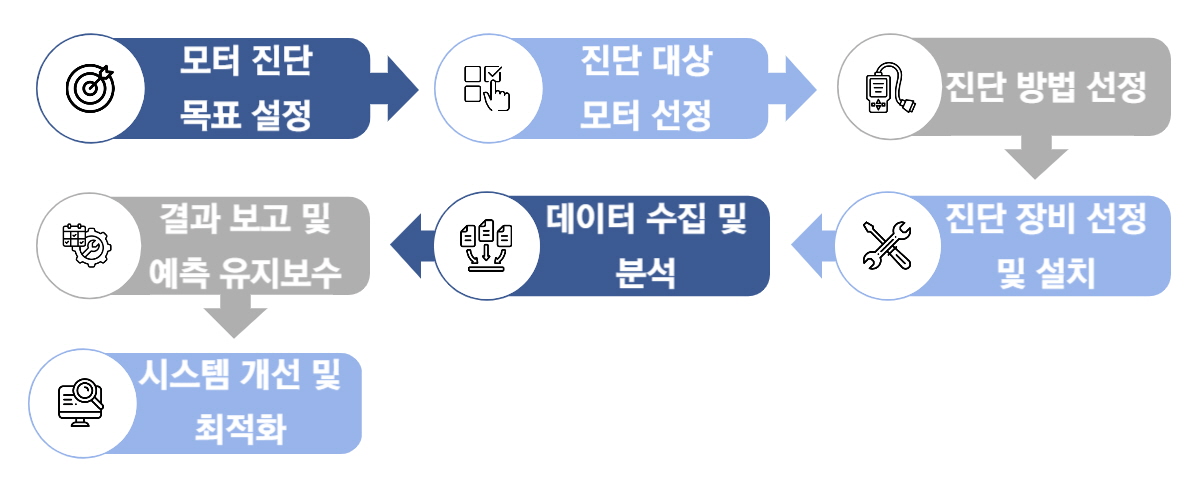
Step 1: Set Motor Diagnostics Goals
– Define objectives: Clearly define what you want to achieve through motor diagnostics. (e.g., stronger preventive maintenance, higher productivity, greater energy efficiency, longer equipment life)
– Set the scope: Clearly establish the types, scale, and operating environments of the motors to be diagnosed.
Step 2: Select the Motors to Diagnose
– Assess criticality: Prioritize based on each motor’s impact on the production line and the scale of losses in the event of failure.
– Assess risk: Adjust priorities by evaluating the safety impact of a potential failure.
Step 3: Choose Diagnostic Methods
– Vibration analysis: The most common method, used to evaluate the motor’s mechanical condition.
– Thermal imaging analysis: Identifies overheating areas of the motor to diagnose thermal issues.
– Insulation resistance measurement: Evaluates insulation condition to predict the risk of insulation breakdown.
– Current quality analysis: Evaluates the motor’s electrical condition to analyze load imbalance, harmonics, and more.
– Ultrasonic inspection: A non-destructive testing method for detecting internal defects early.
Step 4: Select and Install Diagnostic Equipment
– Equipment specifications: Select suitable equipment based on measurement range, accuracy, and analysis capabilities.
– Sensor installation: Install sensors on the motors and build a data collection system.
Step 5: Collect and Analyze Data
– Data collection: Collect a range of data — vibration, temperature, current, and more — at the configured intervals.
– Data analysis: Analyze the collected data to identify warning signs and predict failures.
Step 6: Report Results and Perform Predictive Maintenance
– Diagnostic reporting: Evaluate the motor’s condition based on the analysis results and prepare a report.
– Predictive maintenance: Carry out repairs ahead of the predicted failure point to prevent downtime.
Step 7: Improve and Optimize the System
– Refine the data analysis model: Improve model accuracy through continuous data analysis.
– Enhance system performance: Increase system efficiency and improve user convenience.
Key Considerations When Adopting a Motor Diagnostic System
① Budget: Establish a budget that accounts for initial investment and ongoing maintenance costs.
② Skilled personnel: You will need qualified staff for data analysis and system operation.
③ System integration: Consider interoperability and data integration with existing systems.
④ Security: Put measures in place for both data security and system security.
Closing Thoughts
Motor diagnostics goes beyond simple inspection — it is a key driver of efficiency and reliability in industrial facilities. Adopting it helps you prevent failures before they happen, reduce maintenance costs, and maximize productivity.
Adopt a professional motor diagnostic system today and take your industrial operations to the next level!
✅ Recommended Reading
Motor Diagnostics Success Story: Cutting Costs with Preventive Maintenance