This is Part 5 of our series, ‘Cooling Cost Reduction Strategies You Can Start Right Now.’
Part 1: 🌡️ The More You Run the AC, the Higher the Bill? How to Save with HVAC AI
Part 2: 💨 Smart Cooling for Franchise Stores: The Savings Potential of IR Control
Part 3: 🧍♂️ Factory Cooling That AI Switches On and Off by Itself: The Evolution of Occupancy Detection
Part 4: 🎛️ Remote or Wired? A Comparative Analysis of AC Control Methods
Do you find yourself sighing every time the summer electricity bill arrives?
In fact, when replacing cooling equipment or adopting a smart control system, taking advantage of government support programs can significantly lower the upfront cost burden and deliver a faster return on investment.
In this article, we look at the key government support programs related to smart cooling, along with the real-world savings achievable everywhere from small retail stores to manufacturing plants.
What Government Support Programs Are Available?
Every year, the central government and local municipalities run energy efficiency support programs to improve energy efficiency and cut greenhouse gas emissions. Representative examples include the following.
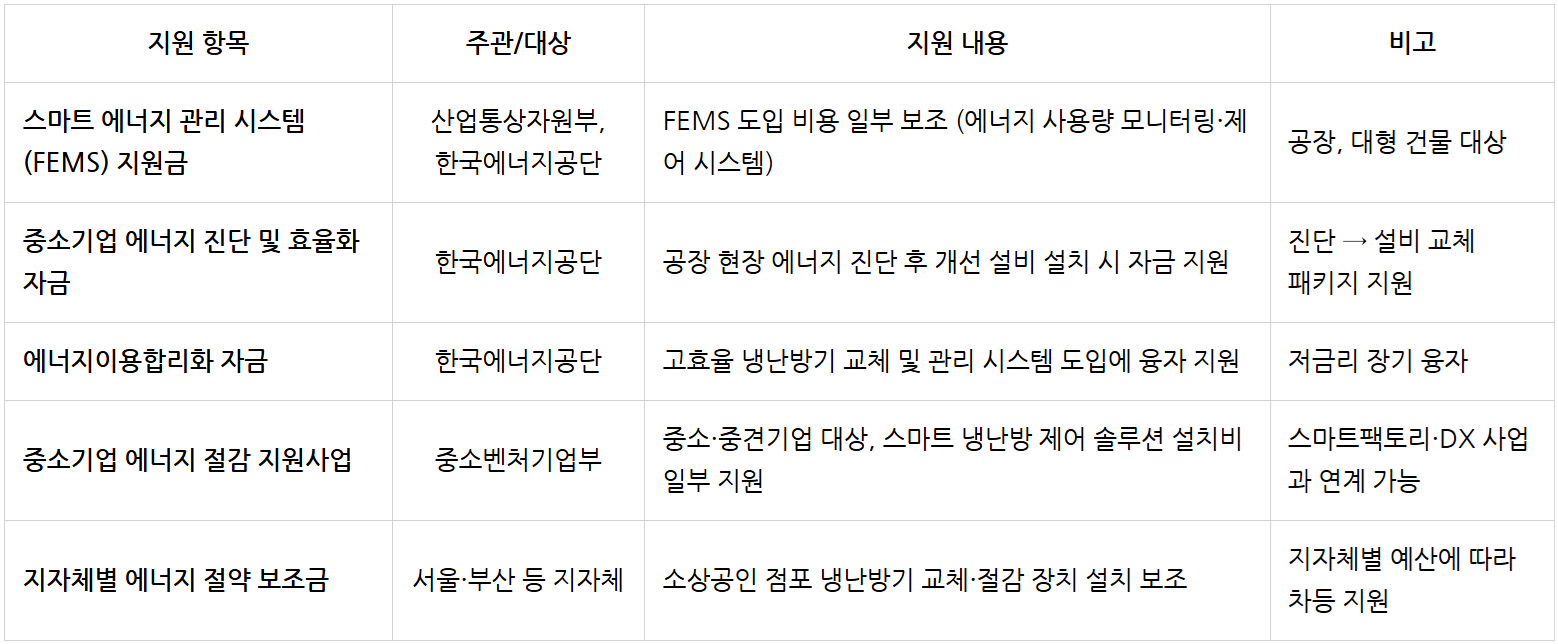
Subsidies typically cover 20~40% of the total installation cost, with rates varying by industry and business size.
👉 The key point is that not only simple equipment replacement but also AI-based cooling control solutions can be eligible for support.
How Much Can You Save with Support?

Government support delivers lower adoption costs + lower electricity bills — two benefits at once.
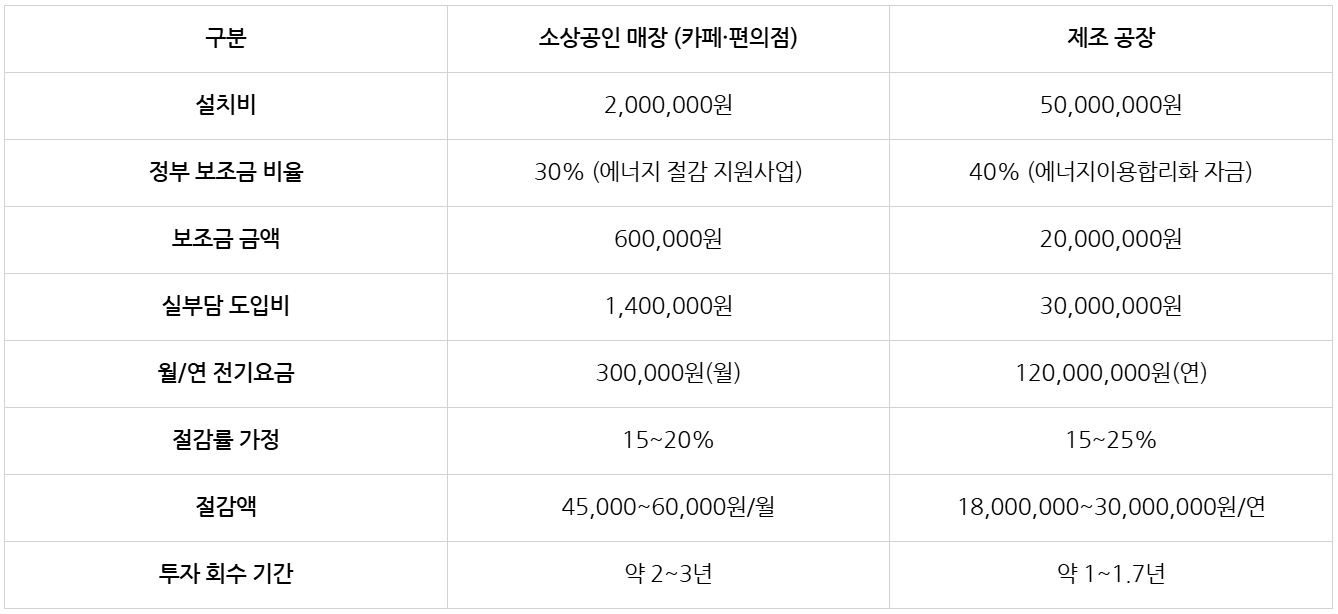
Example ① Small Business Storefront (Cafe or Convenience Store)
– Installation cost of KRW 2 million → KRW 600,000 subsidy → actual burden of KRW 1.4 million
– Monthly electricity bill of KRW 300,000, savings rate of 15~20% → monthly savings of KRW 45,000~60,000
– Investment recovered in about 2~3 years
Example ② Manufacturing Plant
– Installation cost of KRW 50 million → KRW 20 million subsidy → actual burden of KRW 30 million
– Annual electricity bill of KRW 120 million, savings rate of 15~25% → annual savings of KRW 18~30 million
– Investment recovered in about 1~1.7 years
The greatest strength of combining government support with AIoT cooling management is that it applies across the board — small storefronts (cafes and convenience stores), mid-to-large franchises, and large manufacturing plants alike.
📊 Comparison Chart: Small Business Storefront vs. Manufacturing Plant
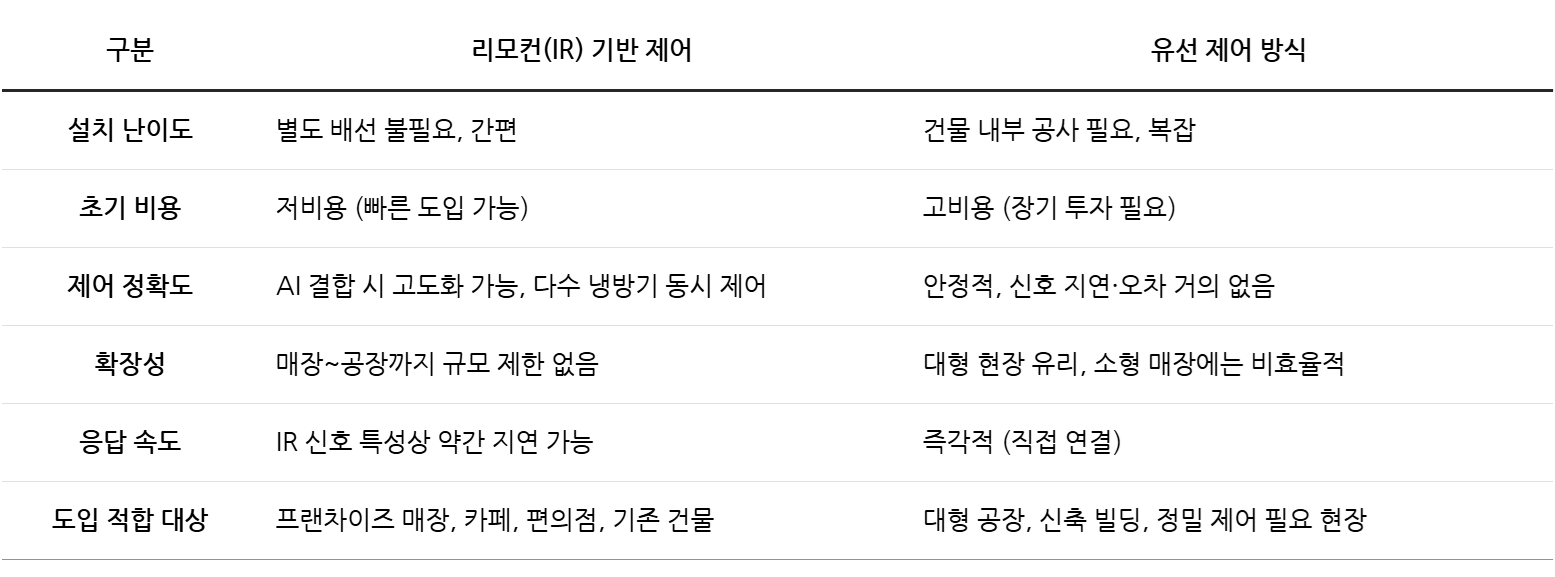
Remote (IR) + AI Control
– Quick to deploy at low cost
– Optimizes multiple AC units simultaneously across stores, offices, and factories of any size
– With signal reliability addressed, savings on par with wired control can be expected
Wired Control
– Highest technical reliability
– However, adoption barriers (construction and cost) limit its practical range of application
📊 Remote (IR) vs. Wired Control Comparison
👉 Insights
– Small businesses face a low upfront cost; the payback period is somewhat longer, but the monthly reduction in fixed costs is unmistakable.
– Manufacturing plants require a larger installation investment, but with savings measured in tens of millions of KRW, the payback comes much faster.
– Above all, government support sharply reduces the initial investment burden for both, lowering the barrier to entry.
How Should You Get Started?
1. Check What Support Your Business Can Receive
– Check announcements on the Korea Energy Agency and local government websites
2. Assess Your Eligibility
– Varies by building size, industry, and power consumption
3. Consult a Professional Solution Provider
– Simulate actual installation costs, savings rates, and payback periods
– Small stores: With fast deployment and low cost as priorities, remote (IR) + AI control is the best fit
– Large factories and new buildings: If long-term operational stability matters most, wired control is the sensible choice
Support + AIoT Adoption: Why Now Is the Opportunity

– Government support eases the initial burden
– AIoT control cuts long-term operating costs
– Flexibility to scale from stores to factories
By taking advantage of government support programs, small businesses can start with little burden, and manufacturing plants can recover their investment even faster on the path to smart cooling.
In particular, the Thingplus Energy Saving service covers everything from IR control to factory-scale wired control, so applying it together with subsidies delivers optimal ROI.
Conclusion
✅ With government support, the barrier to adoption drops while the AI-driven savings remain intact.
That makes “checking support policies and moving quickly on adoption before next summer arrives” the smartest choice.
✅ Recommended Reading
IR Remote or Wired? A Comparative Analysis of AC Control Methods