Meet Daliworks and Thing+, the Muscles and Sinews of the Smart Factory
In step with the global trend of the Fourth Industrial Revolution, and backed by expanded support from the government’s public-private smart factory promotion initiative, more small and mid-sized companies plan to adopt smart factories this year. Yet many companies are still hesitant because smart factories remain unfamiliar territory. To find out how manufacturers can experience a smart factory more easily while cutting costs, we visited Daliworks Co., Ltd. (hereafter Daliworks), a smart factory platform and software company, to hear how the technology works and what distinguishes its flagship services.
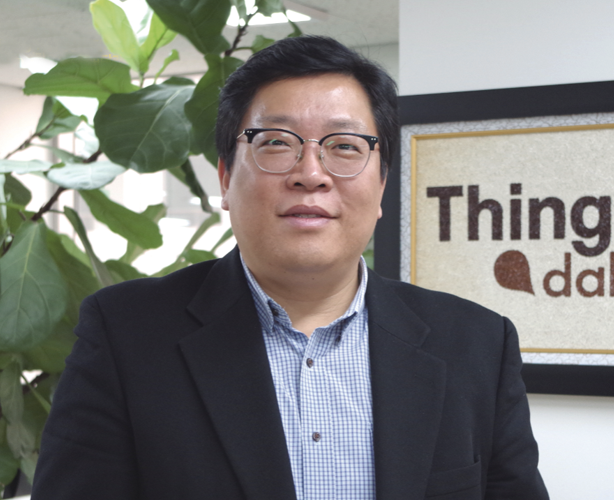
Founded in 2013 and active across a wide range of IoT businesses, Daliworks sums up its smart factory concept in a single phrase: a “data-driven digital factory.” CEO Soonho Lee explains, “Traditional factories often run on the know-how of the people who operate them. So when someone new arrives, the system changes or production consistency wavers. Our idea was to turn every machine and every environmental factor in the factory into data, and use that data to run operations more efficiently — that is what led us to expand into the smart factory space.” Starting from smart farms, Daliworks has extended its services to smart fish farms, smart logistics, smart buildings, smart hospitals, and smart factories — a sign of how diverse customer needs have become.
Smart Factory Services Delivered Through the ‘Thing+’ IoT Cloud Platform
What enables Daliworks to deliver smart factory and many other IoT services is Thing+, the proprietary IoT cloud platform the company develops and operates. By connecting to the platform, customers link the machines and environmental factors in their factories to sensors and can check the collected data in real time. Fundamentally, running a smart factory efficiently comes down to turning operations into data through sensors. Lee explained the principle behind the smart factory: “What people call the Fourth Industrial Revolution is built on CPS — the Cyber Physical System. A physical world such as a large factory is too big to experiment on directly, so you recreate the motors identically in a virtual space and operate them there. You map the physical world onto the cyber world, run it, bring the data back for big data analysis, and identify the most efficient approach. Then you map it back onto the physical world and use it to drive the actuators that control the actual factory.”
The Advantages of Running a Smart Factory
So what are the benefits of a smart factory? First, with a smart factory system in place, anyone — a floor operator or a manager — can check factory operations in real time, 24 hours a day, 365 days a year, from a smartphone, tablet, or PC. From anywhere in the world, they can instantly see which factory in which region has the highest production utilization, what the defect rate is, and even the temperature and humidity inside the plant — everything from quality control down to the smallest workplace conditions — and respond immediately when problems occur. “You can see on the dashboard how factory processes are progressing and how quality is improving,” Lee said. “From a manager’s perspective, you can monitor production output in real time, see how output tracks against daily, weekly, and monthly targets, and see at a glance how many defects occur based on sensor values. And when a part is finished, a camera inspects it and automatically classifies it as defective or normal, which makes quality control much easier.” He added, “From an equipment operator’s perspective, it is easy to see how much each machine is running and, when a machine stops, why it stopped — errors and problems in equipment status are easier to find, so responsiveness on the floor grows accordingly.” To catch additional errors that can develop in machines, Daliworks runs a factory for at least three months, learns its patterns through deep learning, and implements data algorithms that flag anomalies deviating from those patterns. Managing the factory environment also makes it possible to foresee factors that affect worker safety and production quality. “These days, customers often already know what they want and come to us with specific questions,” Lee said. “To carry out this work, Daliworks uses sensors specialized for each industry.” He also emphasized, “In the past, this meant building a costly system, but now you simply go to the web and log in to see the state of your factory operations immediately — so as a service it is also excellent in terms of cost savings.” In Korean industrial settings in particular, much of the production equipment was built and installed without network connectivity in mind. By attaching sensors and control modules to such legacy machines and connecting them to an IoT cloud platform over wired or wireless links, they can be transformed into an intelligent factory. With inexpensive sensors or control panels applied to machinery, even production systems worth hundreds of millions of won or HVAC (Heating, Ventilation, Air Conditioning) systems can be operated smartly.
Stability and Scalability: Essential Criteria for Any IoT Service
The platform serves as the tree trunk of smart factory operations, and the key question is how stable and scalable that platform is. This is where long experience and technical depth show. Most IoT service providers build solutions within the confines of orders from large corporations, so their offerings lack versatility — and software that performs reliably when tens of thousands of devices are connected is rare. The greatest strength of Thing+, the platform Daliworks provides, is that any device can be connected, and the service remains stable and affordable even with vast numbers of different devices attached. The embedded software supplied alongside it for stable device connection and implementation is another major advantage for scaling the service.
“Embedded software on each device gathers data through sensors, and the collected data can be displayed on dashboards you create,” Lee explained. “Then, through the rule engine, you can control systems, analyze data, and handle events — all of these functions can be checked on the server.” Customers thus receive data analysis and statistics in convenient graphical form. Daliworks also makes it easy to tailor settings to customer needs and offers a variety of widgets. And so that users can monitor easily on a PC, mobile phone, or tablet, the company built Thing+ Portal, a browser-based application open to users worldwide. “We have opened up every function of our platform through standard APIs, so anyone — a developer building an IoT system, or someone integrating with our system for additional IoT services — can connect to and use the Daliworks platform,” Lee said, adding, “Manufacturing customers who already use MES also integrate with us, pulling data from our side to control their systems.” Daliworks delivers these platform and software services in collaboration with its partner hardware equipment vendors and sensor manufacturers.
Daliworks: Even Better Known Abroad
Through active marketing, including trade show appearances, Daliworks has already earned recognition for its technology overseas, holding partnerships with leading global companies such as DELL, QUALCOMM, and ADVANTECH. Its list of IoT awards is impressive as well. It was the first company in Asia to win Best IoT Cloud Platform at the 2015/2016 Postscape IoT Awards, and it drew attention as a Silver Winner in the DELL IoT Contest. In 2017, it was also named one of the Most Promising Cloud Solutions Providers of the year by APAC CIO Outlook. Today, users of the Daliworks Thing+ platform span 25 countries, with more than 8,500 gateways, more than 235,000 sensors, and more than 5,300 developers passing through the platform every day.
Under the catchphrase “Connect, rule, and analyze your devices,” Daliworks continues its steady growth toward stable smart factory deployments in Korea and around the world. With the trifecta of IoT, cloud platform, and big data analytics — the core of today’s digital technology — the company believes the day is not far off when it stands shoulder to shoulder with the world’s best IoT platform companies.
“Our goal is to become Asia’s No. 1 and a world-class company in the IoT platform field by 2020,” Lee said. “To make 2018 a big leap for our smart factory business, we are discussing win-win business models with production consulting firms, related software service providers, and hardware manufacturers.” Smart factory — would you not like to start now with simple equipment and monitor your factory in real time? Essential for higher product quality, better productivity, and sound factory management, a smart factory can begin this lightly, without a heavy investment.
by Plastic Science Magazine, reporter Minjeong Lee