The IoT Technologies Building the Smart Campus
Universities are joining hands with telecom carriers and IT companies to build IoT-powered smart campuses. Applying global technology trends — the Internet of Things (IoT), artificial intelligence (AI), machine learning, and data — across every corner of campus, they are developing the services their communities need and changing the paradigm of campus space. In the ‘new normal’ era that follows the COVID-19 pandemic, universities too must step beyond old ways and fulfill their mission anew. Let’s look at how universities are preparing for the future at this turning point.
Smart Campus Cases Powered by IoT
Korea University – A Participatory Smart Campus
Korea University built a ‘participatory smart campus’ that folded in ideas from students and other members of the university community from the design stage. Its pioneering blockchain-based mobile student ID uses blockchain-based mobile decentralized identity (DID) technology to protect personal information while sharing only what is needed, serving many purposes from using campus infrastructure to verifying attendance.
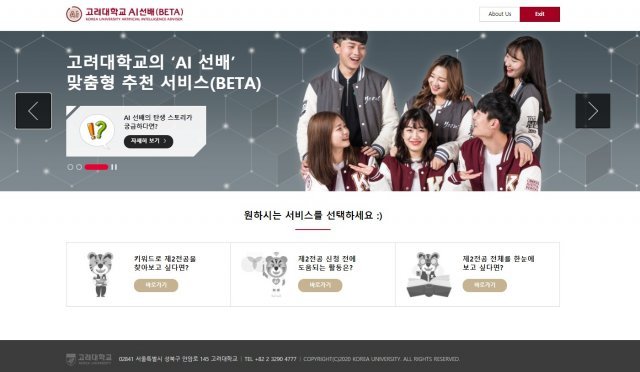
Beta version of Korea University’s AI Senior
It went further, creating participatory smart campus platforms such as ‘AI Senior,’ which draws on campus big data to help students register for courses. Based on 20 years of course-history data from seniors in the same department or similar courses, students receive elective recommendations as well as support related to their major through second-major guidance and recommended activities. Where students once leaned on nearby seniors and classmates for advice on courses and majors, they will now be supported by AI grounded in accumulated data.
Administration is no exception to the participatory smart campus project. Mobile access and office automation through robotic process automation (RPA) are making work more efficient. With the participatory smart campus, the physical space of campus is being transformed into part of a data-driven daily life.
Gwangju University – An EMS System
Gwangju University runs its smart campus on an IoT sensor-based energy management solution (EMS). With smart thermostats, sensors, and switches fitted to lighting and heating/cooling across campus buildings, the system watches empty lecture halls and labs and automatically cuts wasted power — delivering the double benefit of energy savings and fire prevention.
Once the smart energy management system and IoT sensors are installed, the lighting, heating and cooling, and outlets of unoccupied lecture halls and labs can be remotely monitored and shut off to improve power efficiency. The system runs without human intervention: results collected in real time are transmitted as data and analyzed to find improvements. The project targets energy savings of 20-30%, with a range of research under way to maximize the effect. Expecting a strong fire-prevention benefit as well, the university plans to expand the smart energy management system.
Dongguk University – A Smart Safety Care System
Dongguk University signed an industry-academia cooperation agreement with LG Uplus to build a smart safety care system. Smart safety care means using IoT sensors and devices to improve quality of life for vulnerable groups such as the elderly, and building and operating public-safety management systems for purposes like cultural heritage protection and tracking missing persons.
On the Dongguk campus, a danger-zone entry detection service helps prevent accidents such as falls from building rooftops. Without barring rooftop access, AI-based IoT sensors detect danger signals in advance and raise the alert. The plan goes further: linking radar sensors with CCTV to eliminate blind spots within facilities, and applying the system to finding missing persons such as seniors with dementia, preventing cultural heritage theft, and detecting danger at children’s facilities.
Pusan National University – A 5G Smart Campus
Pusan National University built ICT infrastructure — a next-generation wired and wireless network environment, an integrated information security solution, and an integrated control system — across its four campuses in Busan, Yangsan, Miryang, and Ami. With remote education now routine, this is the first step in gradually transforming the university into a 5G network-based smart campus.
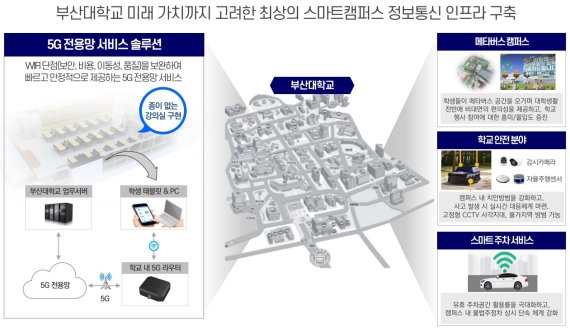
Bird’s-eye view of Pusan National University’s 5G smart campus
The 5G-cloud linked service supports a ‘cloud system’ that lets anyone access campus systems anytime, anywhere from a smartphone or laptop. It also enables high-definition streaming ‘remote classes’ and attention tracking through facial recognition. A metaverse-based campus environment is planned, offering contactless conveniences across university life from admission to graduation — orientation, entrance and graduation ceremonies, remote lectures, clubs, and festivals.
IoT sensors and devices also power a smart safety care system that guards against potential accidents on campus. The framework enables rapid response to incidents such as building fires, and the plan is to use the data to create an environment where accidents can be prevented before they happen.
California State University – A Smart Campus
California State University’s Fullerton campus built a smart campus focused on safety and connectivity. It modernized the campus with services such as smart parking, electric vehicle charging, and WiFi, aiming to make everyday campus life comfortable for students.
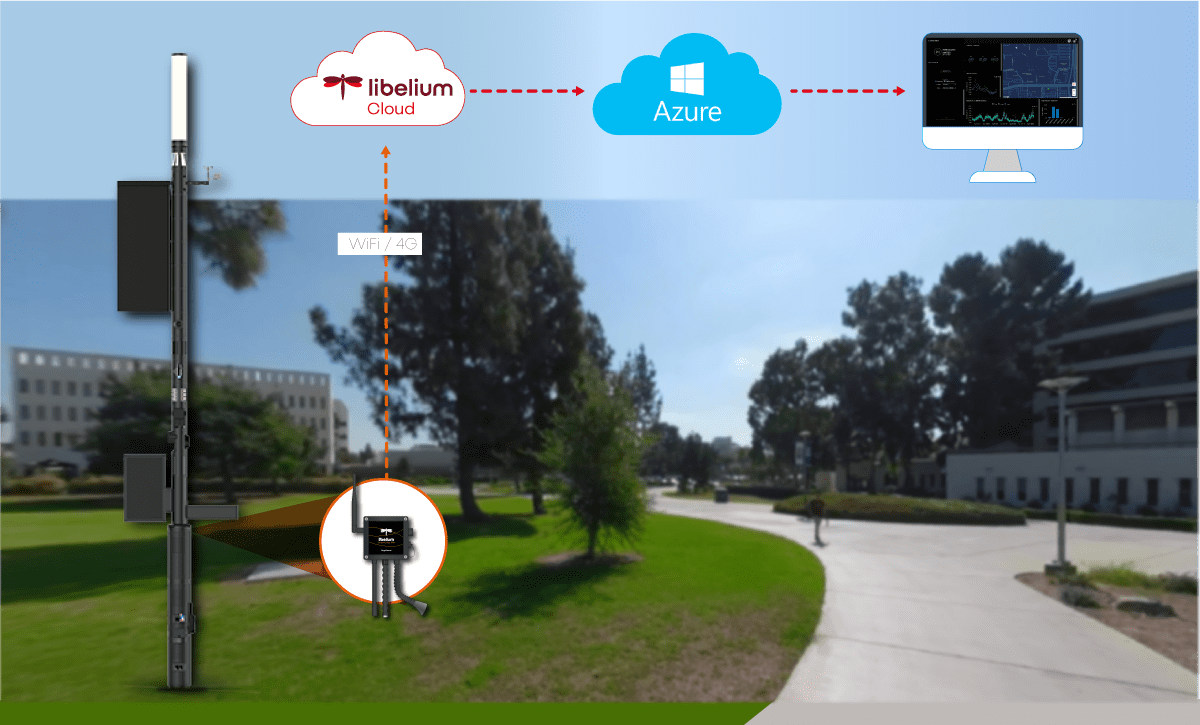
California State University’s smart campus with intelligent streetlights
The intelligent streetlights switch on and off automatically with natural light levels and adjust their brightness on their own. Built-in ultrasonic sensors detect approaching objects, while ambient control probes measure air quality and inform the campus community of environmental conditions. There is even a weather station providing local climate information.
Arizona State University – A Smart Campus
Arizona State University is a front-runner in campus IoT: sensors connected over Wi-Fi and cellular networks measure temperature and humidity, manage leaky faucets, and even manage noise levels.
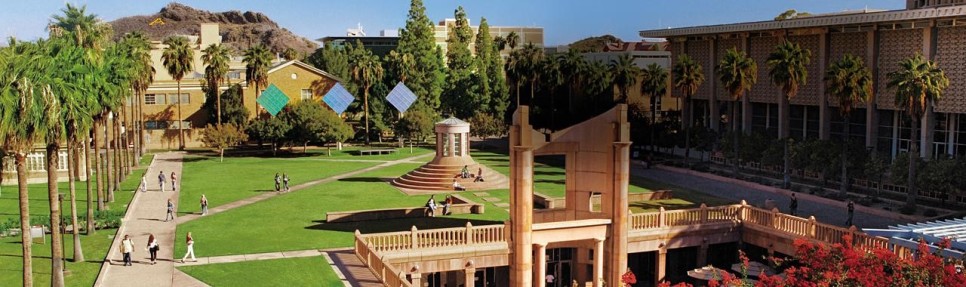
A view of Arizona State University
Campus washing machines text students when laundry is done, student movement patterns are collected to plan campus repair work, and sports instructors automatically receive information on athletes’ weight and body fat — just a few of the many IoT technologies in use.
What Will the IoT-Transformed Smart Campus Look Like?
Through IoT, the university campus becomes a small smart city. IoT sensors connect the buildings, and wireless network technology manages these spaces.
Smart Gardens · Orchards
Install IoT sensors in campus gardens or create organic gardens that monitor weather and crop growing conditions, watering only when needed.
Smart Gardens · OrchardsAir Quality and Noise Monitoring
Air and noise pollution affect people’s health. An air pollution control network across multiple points on campus checks pollution levels and restricts road traffic when they reach saturation. Monitoring noise levels across different spaces identifies peak saturation points that could harm educational activity and coexistence on campus.
Parking Occupancy Control
Parking availability is an important service point for the campus community. Radar devices that detect open spaces (both indoor and outdoor) put parking capacity to full use. This can even generate extra revenue from spaces that would otherwise sit unoccupied but could turn over faster.
EV Charging Station Optimization
Electric vehicle users keep growing in number, and charging stations are being installed on campus. To use them more efficiently, devices can be installed to monitor parking space occupancy.
Vehicle and Pedestrian Traffic Measurement
Identification technology for smartphone Bluetooth devices and hands-free car devices can detect vehicle and pedestrian traffic. Understanding occupancy of specific indoor and outdoor spaces and adjusting campus services to the community’s consumption patterns and habits is enormously useful.
Campus Space Management
Smartphones handle space reservations, access control, occupancy management, sensor monitoring, and more. Book a study room right from your phone and simply tap the access device to rent it on the spot.
Smart Building Applications
Lecture halls equipped with temperature, humidity, and scream-detection sensors can guarantee comfort and safety. Controlling heaters and lights in empty rooms lowers energy consumption and reduces fire risk.
Big Data Platforms
An open-source data hub site ready for AI presents all kinds of analysis, from course registration analytics to the state of convergence majors. Students can draw on it to shape a more rewarding university life.
Build Your Smart Campus with IoT
For students, the campus is a living space. Shaping it around students’ daily rhythms while minimizing the digital divide among community members is widely seen as the right direction. As participants’ data accumulates and the benefits flow back to the community, we hope this feedback loop establishes the campus as a cradle for nurturing future talent.
IoT technology can build your smart campus. To learn about the solutions and the specifics of getting started, contact Thingplus!
References
Gwangju University’s IoT-based smart campus draws attention
Making campuses safer with IoT… LG Uplus builds smart safety care system with Dongguk University
LG Uplus to build a 5G smart campus at Pusan National University