2025 Smart Factory Support Programs & Vouchers: Seize the Digital Innovation Opportunity
In an era when digital transformation determines manufacturing competitiveness, the smart factory has moved beyond technology trend to become a necessity. The government is pursuing a range of policies and support programs to accelerate digital innovation in manufacturing and help small and mid-sized companies adopt smart factories. Among them, the 2025 smart factory support programs and voucher schemes stand out as key measures that reduce the heavy upfront cost burden and help companies put the best solutions to work.
In this post, we review the key details of the 2025 smart factory support programs and voucher schemes, the benefits they offer, and how to apply. Here is everything you need to know about the stepping stone to your company’s future growth!
AI Voucher Program
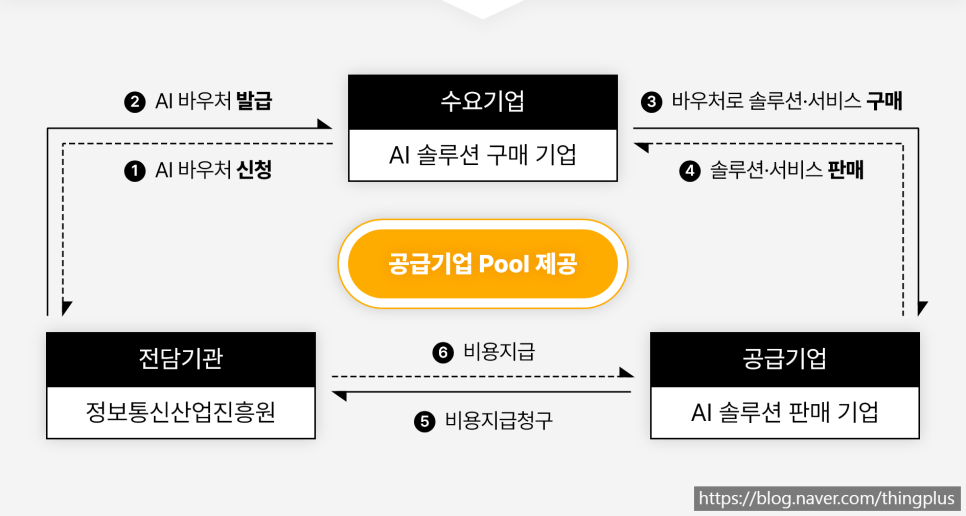
To put AI technology developed by Korean AI solution companies to effective use, the Ministry of Science and ICT and the National IT Industry Promotion Agency operate a program that provides vouchers to SMEs, venture firms, mid-market companies, and medical institutions looking to adopt AI. This eases the upfront investment burden and lets demand-side companies adopt the AI solutions they need quickly and efficiently to realize digital transformation.
The program works by selecting a suitable supplier from the government-provided AI solution supplier pool (to be published after final confirmation in 2025), forming a consortium, and applying to the AI voucher program.
Eligibility and Terms
– Eligibility: Korean SMEs, venture firms, mid-market companies, and medical institutions under the Medical Service Act that plan to purchase AI solutions and apply them to their own products or services
– Funding: KRW 200 million in government funds per project, plus KRW 6.7 million self-funded in cash (as of 2024)
* The final funding amount varies with the budget review, and costs beyond the government grant must be covered by private matching (cash or in-kind).
Adoption Process
1. Select a partner from the supplier pool: find a suitable AI solution supplier and form a consortium
2. Prepare and submit the project plan: submit the business plan in February
3. Evaluation and selection: final selection announced after review, including a presentation evaluation, followed by agreement signing
4. Solution adoption: build the smart factory in partnership with the selected supplier
5. Reporting and evaluation: report results after project completion and undergo final evaluation
Data Voucher Program
For companies aiming to innovate their business and develop new services and products with data and AI, the government runs a program supporting data purchase and processing services — the Data Voucher Program. Under this scheme, funding is provided in voucher form so that demand-side companies can more easily use the data products and processing services offered by Korean data companies.
Companies wishing to participate should visit the Data Voucher Portal to review the available data products and processing services, then submit an application through the Data Voucher management system per the announcement guidelines. Note that applications are limited to data products and services designated and registered on the portal, so the right match with a supplier offering the data you need is critical.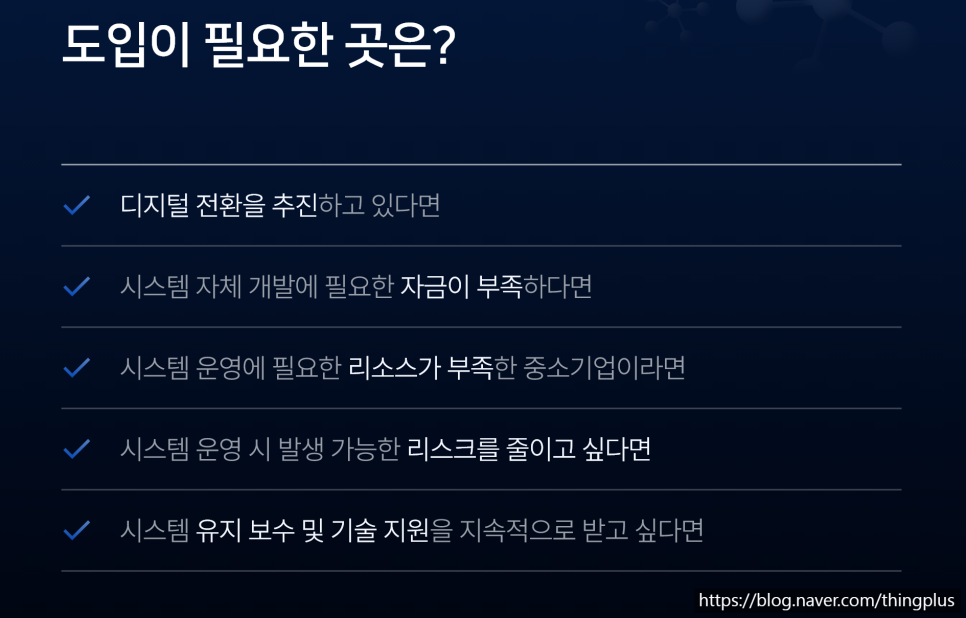
Eligibility and Terms
– Eligibility: Korean small businesses, early-stage mid-market companies, micro-enterprises, and aspiring founders looking to use data and AI
– Funding: up to KRW 54 million per project, plus KRW 1.8 million self-funded in cash (as of 2024)
* A portion of costs beyond the government grant must be self-funded.
Adoption Process
1. Check the Data Voucher Portal: browse data products and processing services
2. Submit the business plan: file the required documents and execution plan through the Data Voucher management system in March
3. Evaluation and selection: final selection announced after review, followed by agreement signing
4. Data adoption: apply data-driven technology to the smart factory in partnership with the supplier
5. Reporting and evaluation: report results after project completion and undergo final evaluation
Cloud Service Deployment and Expansion Program
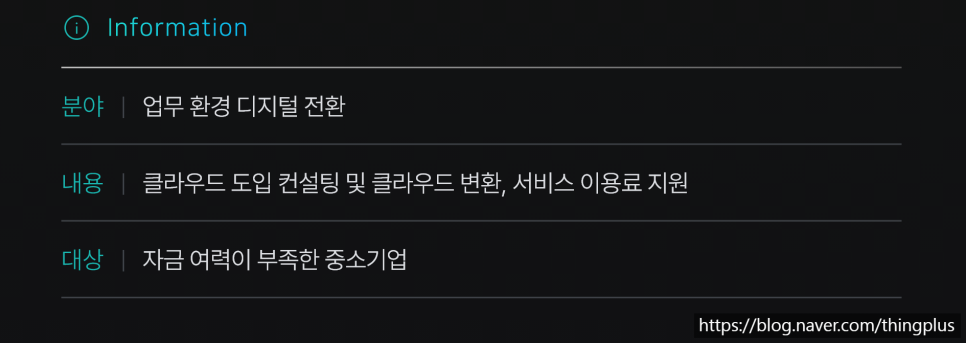
To support the digital transformation of Korean SMEs, the government runs the cloud support program, which promotes cloud service adoption. The program provides everything from cloud adoption consulting to subscription fee support, helping SMEs transition smoothly to a digital environment while aiming to energize the domestic cloud market and strengthen corporate competitiveness.
Companies receive support for data migration, user training, and more through cloud services and adoption consulting matched to their work environment. With subscription fee support, they can also choose and use a suitable service within the government-provided cloud service pool (to be published after confirmation in 2025).
Eligibility and Terms
– Eligibility: Korean SMEs seeking digital transformation
– Funding: up to KRW 12 million per project, plus KRW 3.2 million self-funded in cash (as of 2024)
* Participation entails a cash self-funding share of about 20%.
Adoption Process
1. Explore the cloud service pool: review and select a suitable cloud service
2. Submit the application: file application materials and the business plan between March and May
3. Evaluation and selection: final selection announced after review
4. Service adoption and use: migrate to the cloud and build the smart factory in partnership with the selected supplier
5. Performance review: after completion, an evaluation confirms the program’s impact
Smart Workshop Technology Program for Micro-Manufacturers
The smart workshop technology program is a support program for digitalizing manual, handwork-centered manufacturing processes to raise productivity and efficiency. It aims to accelerate smart adoption among micro-manufacturers and strengthen manufacturing competitiveness through automation equipment, data collection and integration, and shared solutions. Support covers automation linkage by production process and the adoption of H/W and S/W for automation from production through distribution.
By supporting the digital transformation of micro-manufacturers, this program is a key measure for streamlining production processes and strengthening competitiveness, and it will play a major role in the sustainable growth of small businesses.
Eligibility and Terms
– Eligibility: micro-manufacturers with fewer than 10 full-time employees whose main business is manufacturing under the Korean Standard Industrial Classification mid-level categories (industry codes C10~C34)
– Funding: up to KRW 42 million per project, plus KRW 9 million self-funded in cash (as of 2024)
Adoption Process
1. Announcement: program announced through the Small Enterprise and Market Service (in January)
2. Application: applicants submit to the Small Enterprise and Market Service (in February)
3. Document review: the evaluation committee screens documents (in March)
4. On-site evaluation: site inspection and assessment by the committee (in April)
5. Agreement: signed among the Small Enterprise and Market Service, the micro-manufacturer, and the supplier
6. Execution: adopt and apply smart workshop technology
7. Reporting and settlement: report results and settle project costs after completion
Carbon-Neutral Smart Factory Program
The carbon-neutral smart factory program helps small and mid-sized manufacturers raise energy efficiency and transition to low-carbon management. It aims to deliver productivity gains and carbon reduction at the same time by building smart factories on high-efficiency equipment and specialized solutions.
The program’s central purpose is to help manufacturers boost productivity and build smart factories that are effective at cutting carbon. Through it, companies improve energy efficiency and receive support in moving to a low-carbon management system.
Eligibility and Terms
– Eligibility: Korean small and mid-sized manufacturers that need to build a carbon-neutral smart factory
– Funding: up to KRW 50 million per project for same-level advancement, plus KRW 50 million self-funded in cash (as of 2025)
– Scope of Support
① Implementation consulting: full-cycle support including end-to-end coordination, change management, and performance measurement
② Building a carbon-reducing smart factory
FEMS solution: a specialized solution for efficiently managing the energy consumption of processes and equipment
Control and measurement devices: support for control and instrumentation devices linked to energy-intensive processes and equipment
High-efficiency equipment replacement: support for replacing aging equipment and adopting high-efficiency substation systems, smart distribution panels, and more
Adoption Process
1. Form a consortium and submit the business plan: the adopting company and supplier form a consortium and submit by January 2025
2. Document evaluation: roughly 1.5 times the target number of projects shortlisted based on business plans
3. Technical evaluation: in-person presentations assess technical feasibility and program fit
4. Site verification and costing: on-site checks and review of budget appropriateness
5. Final selection: evaluation results are consolidated to confirm the funded projects
6. Agreement and kickoff: the managing agency and consortium sign, and the project begins
SME Smart Service Support Program
The SME smart service support program backs the digitalization of small service companies through solutions built on advanced information and communication technologies (ICT) such as big data and artificial intelligence (AI), promoting competitiveness and innovation across the service industry.
It aims to raise the productivity of small service companies, move them up the value chain, and create new business models through advanced ICT such as big data and AI. In doing so, it accelerates the digital transformation and competitiveness of Korea’s service industry and actively supports the construction of core ICT-based smart service solutions.
Eligibility and Terms
– Eligibility: SMEs under Article 2 of the Framework Act on Small and Medium Enterprises (non-manufacturing service sectors)
– Funding: up to KRW 60 million per project for building new core ICT-based smart service solutions, plus KRW 60 million self-funded in cash (as of 2024)
Adoption Process
1. Announcement and application: with pre-assessment and consulting (in April)
2. Requirements review and on-site evaluation: experts assess business need, commitment and capability, and the fitness of the execution framework (in May)
3. Selection evaluation: a committee of industry, academic, and research experts reviews plan adequacy and commercialization capability through written and in-person evaluations (in June)
4. Agreement and execution: starting in July, with an interim check in September and a final check in December
5. Completion and follow-up: the following January
In Closing
In this post we looked at how to achieve digital innovation using the various 2025 support programs. Government programs like these offer an important opportunity to lay the groundwork for digital transformation. But successful execution comes down to choosing the solution that truly fits your company — and a supplier with the expertise to deliver it.
In our next post, we will introduce Daliworks’ flagship solutions — PRIME (manufacturing equipment management), EnergyQ (FEMS), and SignalVax (AI motor diagnostics) — explain how each connects with the support programs, and make the case for choosing Daliworks as your supplier. We will also detail which demand-side companies fit each program best, so be sure to check it out.
Curious how to adopt these solutions through smart factory support programs? Contact Daliworks today!
Contact :02-2274-3254 / E-mail : contact@daliworks.net
✅ Recommended reading